
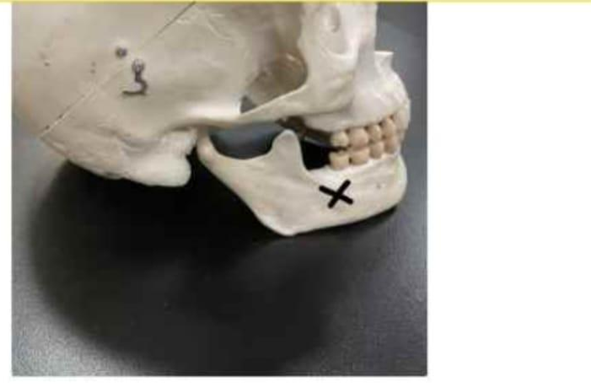
Identify the bone marked X in the image below.
Maxilla
Zygomatic bone
Mandible
Temporal bone
The Correct Answer is C
The marked structure is the mandible, which is the largest and strongest facial bone forming the lower jaw. It is the only movable bone of the skull, articulating with the temporal bone at the temporomandibular joint (TMJ). The mandible supports the lower teeth and plays a critical role in mastication, speech, and facial structure. It is shaped like a horseshoe and consists of the body and two rami.
A. Maxilla: The maxilla forms the upper jaw and is a fixed bone of the facial skeleton. It contributes to the hard palate, the floor of the orbit, and the upper dental arch. Unlike the mandible, it is immovable and does not form a joint for chewing motion.
B. Zygomatic bone: The zygomatic bone forms the prominence of the cheek and part of the lateral wall of the orbit. It contributes to facial contour and protection of the eye. Compared to the mandible, it is a non-movable facial bone and does not participate in jaw movement or mastication.
C. Mandible: The mandible is the lower jawbone and the only movable bone of the skull. It articulates with the temporal bone at the TMJ, allowing chewing, speaking, and mouth opening. It supports the lower teeth and provides attachment for muscles of mastication such as the masseter and temporalis. Since the marked structure is the movable lower jaw, it corresponds to the mandible.
D. Temporal bone: The temporal bone forms part of the lateral skull and houses structures of the ear. It contributes to the cranial base and forms the socket for the mandibular articulation (TMJ). However, it is not the jawbone itself but rather the bone that articulates with the mandible.
Nursing Test Bank
Naxlex Comprehensive Predictor Exams
Related Questions
Correct Answer is A
Explanation
Neural communication in the nervous system involves complex synaptic arrangements that allow integration and processing of information. One important organizational pattern is convergence, which enables multiple incoming signals to influence a single postsynaptic neuron. This arrangement is essential for integrating sensory input, coordinating motor responses, and refining neural processing. It allows the central nervous system to combine information from different sources into a unified output.
A. Axons from neurons in different parts of the nervous system contact the same neuron: convergence refers to multiple presynaptic neurons sending signals via their axons to a single postsynaptic neuron. This allows integration of information from various sources before a response is generated. It is a key mechanism in sensory processing, such as when multiple sensory inputs influence a single motor response. Convergence enhances the nervous system’s ability to interpret complex stimuli.
B. Dendrites from neurons in different parts of the nervous system contact the same neuron: dendrites are receptive structures on the postsynaptic neuron, not structures that originate from different neurons to form connections. While dendrites receive incoming signals, convergence specifically refers to multiple axons synapsing onto one neuron. This misidentifies the anatomical structures involved in synaptic integration.
C. One neuron sends impulses to multiple target neurons: This option describes divergence, not convergence. Divergence occurs when a single presynaptic neuron branches and transmits signals to multiple postsynaptic neurons, allowing one signal to influence multiple pathways. This mechanism amplifies and distributes information rather than integrating it.
D. Sensory impulses are amplified in a single synapse: convergence is not defined by amplification of signals at a single synapse. Synaptic strength may vary, but convergence specifically refers to multiple presynaptic inputs onto one postsynaptic neuron. Amplification can occur in neural pathways, but it is not the defining feature of convergence.
Correct Answer is D
Explanation
Skeletal muscle contraction occurs through the sliding filament mechanism, where actin (thin filaments) and myosin (thick filaments) interact to generate force. This process is regulated by calcium ions and involves cyclic interactions between contractile proteins within the sarcomere. Cross-bridges are fundamental structures formed during contraction when myosin heads attach to binding sites on actin filaments. This interaction enables filament sliding and shortening of the muscle fiber, producing contraction.
A. Troponin binding to tropomyosin: troponin and tropomyosin are regulatory proteins, not the structures that form cross-bridges. Tropomyosin normally blocks myosin-binding sites on actin, and troponin shifts tropomyosin when calcium binds. While this regulatory system controls contraction, it does not physically generate force or form cross-bridges. This interaction facilitates contraction but is not the cross-bridge itself.
B. Calcium binding to troponin: calcium binding to troponin is an initiating regulatory step, not a structural cross-bridge. When calcium binds to troponin C, it causes a conformational change that moves tropomyosin away from actin’s binding sites. This allows myosin heads to attach to actin. However, calcium does not form the mechanical link responsible for force generation, so it is not a cross-bridge.
C. ATP binding to myosin heads: ATP binding to myosin heads is involved in detachment and energy cycling, not cross-bridge formation. ATP binding causes myosin to release from actin, and ATP hydrolysis re-energizes the myosin head for the next contraction cycle. While essential for contraction, ATP itself does not create the physical connection between filaments.
D. Myosin heads binding to actin: cross-bridges are formed when energized myosin heads attach directly to binding sites on actin filaments. This interaction is the fundamental force-generating step in muscle contraction. Once attached, the myosin heads pivot (power stroke), pulling actin filaments toward the center of the sarcomere. This repeated attachment and detachment cycle produces muscle shortening and force generation.
Whether you are a student looking to ace your exams or a practicing nurse seeking to enhance your expertise , our nursing education contents will empower you with the confidence and competence to make a difference in the lives of patients and become a respected leader in the healthcare field.
Visit Naxlex, invest in your future and unlock endless possibilities with our unparalleled nursing education contents today