
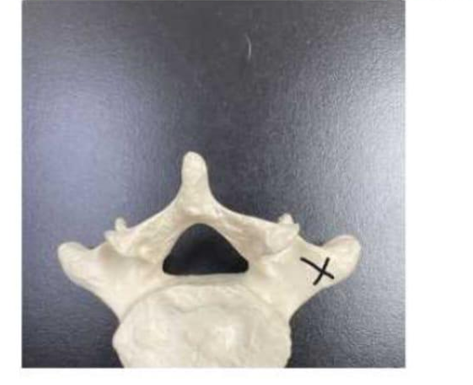
Which structure is indicated by the X in the image below?
Transverse process
Spinous process
Superior articular facet
Vertebral foramen
The Correct Answer is A
The vertebra is a complex irregular bone designed to provide structural support, flexibility, and protection for the spinal cord. It consists of a central body, a vertebral arch, and several specialized bony projections that serve as attachment points for muscles and ligaments. In the image, the structure marked with an "X" is one of the lateral projections extending from the vertebral arch, which is essential for stabilizing the vertebral column and facilitating movement through muscular pull.
A. The transverse process is the lateral bony projection that extends from the junction of the pedicle and lamina on each side of the vertebra. These processes serve as critical attachment sites for deep back muscles and, in the thoracic region, articulate with the ribs. The structure marked with an "X" is clearly identified as this lateral projection.
B. The spinous process is the singular, posterior-facing projection located at the midline of the vertebral arch. It is easily palpable through the skin along the back and serves as an anchor for various ligaments and muscles that support the spine. It is distinct from the lateral structure marked in the image, which originates from the side of the arch.
C. The superior articular facet is a smooth surface on the superior aspect of the vertebral arch that articulates with the inferior articular facet of the vertebra above it. These facets are crucial for limiting movement and maintaining the alignment of the vertebral column. They are located near the pedicle-lamina junction but are not the lateral extension identified by the "X" in the image.
D. The vertebral foramen is the large, central opening created by the vertebral arch and the posterior surface of the vertebral body. It houses the spinal cord, its associated protective meninges, and the surrounding blood vessels. The mark "X" is placed on the external lateral surface of the bone, not within this central canal.
Nursing Test Bank
Naxlex Comprehensive Predictor Exams
Related Questions
Correct Answer is C
Explanation
The marked structure is the olecranon process of the ulna, which is the large, proximal bony prominence of the ulna forming the tip of the elbow. It projects posteriorly and fits into the olecranon fossa of the humerus during elbow extension, stabilizing the elbow joint. The ulna is the medial forearm bone and plays a key role in forming a stable hinge joint at the elbow with the humerus, allowing flexion and extension movements.
A. Radial head: The radial head is the proximal, disc-shaped end of the radius located laterally in the forearm. It articulates with the capitulum of the humerus and the radial notch of the ulna, allowing pronation and supination of the forearm. Unlike the olecranon, it is smooth and rounded rather than a large posterior projection of the elbow.
B. Coronoid process of ulna: The coronoid process is a triangular anterior projection of the proximal ulna. It fits into the coronoid fossa of the humerus during elbow flexion, preventing anterior dislocation. Compared to the olecranon, it is anterior and inferior rather than the prominent posterior elbow tip.
C. Olecranon process of ulna: The olecranon process is the large, posterior bony prominence of the proximal ulna that forms the tip of the elbow. It inserts into the olecranon fossa of the humerus during extension, acting as a lever for triceps brachii muscle attachment. It is easily palpable at the back of the elbow and is the main structure responsible for elbow extension mechanics.
D. Trochlea of humerus: The trochlea is a spool-shaped articular surface located on the distal humerus medially. It articulates with the ulna (specifically the trochlear notch) to form the hinge of the elbow joint. Unlike the olecranon process, it is part of the humerus rather than the ulna and is not a projecting bony landmark at the elbow tip.
Correct Answer is A
Explanation
Skeletal muscle contraction is based on the sliding filament theory, where thin (actin) and thick (myosin) filaments interact to produce force and movement. These interactions occur in a highly organized structural unit within myofibrils. The arrangement of sarcomeres in series allows coordinated shortening of muscle fibers. Understanding the functional unit of contraction is essential for explaining how muscles generate tension at the microscopic level.
A. Sarcomere: The sarcomere is the correct answer because it is the smallest functional (contractile) unit of skeletal muscle. It is defined as the segment between two Z-discs and contains organized actin and myosin filaments. During contraction, myosin heads bind to actin and pull the thin filaments inward, shortening the sarcomere. This coordinated shortening of many sarcomeres produces overall muscle contraction.
B. Myosin cross-bridge: a cross-bridge is a molecular interaction, not a complete functional unit. It refers specifically to the temporary attachment between a myosin head and an actin binding site. While cross-bridge cycling generates force, it occurs within the sarcomere and depends on its structural organization. It is a mechanism within the functional unit rather than the unit itself.
C. Muscle fiber: a muscle fiber is a single multinucleated muscle cell containing many myofibrils. Although it is the cellular level at which contraction occurs, it is not the smallest functional unit. Each muscle fiber contains thousands of sarcomeres arranged in series and parallel. Contraction occurs within the fiber, but the sarcomere is the true functional unit.
D. Myofibril: a myofibril is a long cylindrical structure within a muscle fiber composed of repeating sarcomeres. It serves as the structural framework for contraction but is not itself the basic contractile unit. Myofibrils transmit force generated by sarcomeres along the length of the muscle cell. It is an organizational structure rather than the functional unit of contraction.
Whether you are a student looking to ace your exams or a practicing nurse seeking to enhance your expertise , our nursing education contents will empower you with the confidence and competence to make a difference in the lives of patients and become a respected leader in the healthcare field.
Visit Naxlex, invest in your future and unlock endless possibilities with our unparalleled nursing education contents today