
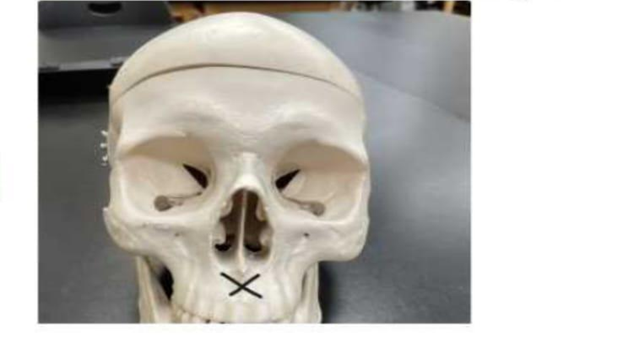
Which structure is indicated by the X in the image below
Nasal bone
Vomer
Maxilla
Mandible
The Correct Answer is C
The facial skeleton is composed of several paired and unpaired bones that form the architecture of the orbits, nasal cavity, and oral cavity. The bone marked with an "X" in represents a central structural element of the midface, serving as the foundation for the upper teeth and contributing to the floor of the nasal cavity. Understanding the complex articulations of these facial bones is critical for clinicians evaluating facial structure, dental alignment, and potential fractures of the midface region.
A. The nasal bones are a pair of small, rectangular bones that form the bridge of the nose. They are located superior to the area marked with an "X" . While they are part of the nasal region, the marked area is situated lower, on the alveolar process of the upper jaw, which is distinct from the nasal bridge.
B. The vomer is an unpaired, thin, plow-shaped bone that forms the posterior and inferior part of the nasal septum. It is situated deep within the nasal cavity and is not visible from this external anterior view of the skull. The mark "X" is placed on the external surface of the facial skeleton, not deep within the midline nasal structure.
C. The maxilla is the correct identification for the structure marked with an "X". This bone forms the entire upper jaw, the majority of the hard palate, and the lower margins of the nasal aperture. The area indicated is the alveolar process of the maxilla, which contains the sockets (alveoli) for the upper teeth, confirming its role as the primary bone of the midface.
D. The mandible is the lower jaw bone and is the only mobile bone of the skull. It is located inferior to the maxilla and is separated from it by the oral cavity. Because the area marked with the "X" is firmly attached to the midface region above the upper teeth, it is anatomically separate from the mandible.
Nursing Test Bank
Naxlex Comprehensive Predictor Exams
Related Questions
Correct Answer is D
Explanation
The marked structure is the parietal lobe, a major division of the cerebral cortex located superiorly in the brain between the frontal and occipital lobes. It lies posterior to the central sulcus and anterior to the occipital lobe, forming a significant portion of the superior and lateral aspects of each cerebral hemisphere. The parietal lobe is primarily responsible for processing somatosensory information such as touch, pressure, temperature, and pain. It also integrates sensory input to support spatial awareness, body orientation, and proprioception.
A. Frontal lobe: The frontal lobe is located anteriorly in the cerebrum, in front of the central sulcus. It is responsible for executive functions such as decision-making, judgment, personality, voluntary motor control, and speech production via Broca’s area. Compared to the parietal lobe, it is more anterior and not primarily involved in somatosensory integration or spatial processing.
B. Temporal lobe: The temporal lobe is located on the lateral aspect of the brain beneath the lateral sulcus. It is primarily involved in auditory processing, language comprehension (Wernicke’s area), and memory formation. Unlike the parietal lobe, it does not process primary somatosensory input or spatial body awareness.
C. Occipital lobe: The occipital lobe is located at the posterior pole of the brain and is the primary center for visual processing. It receives and interprets visual stimuli from the retina via the optic pathways. Compared to the parietal lobe, it is more posterior and specialized for vision rather than somatic sensation or spatial integration.
D. Parietal lobe: The parietal lobe is positioned superiorly and centrally on the cerebral hemispheres, posterior to the frontal lobe and anterior to the occipital lobe. It contains the primary somatosensory cortex located in the postcentral gyrus, which processes tactile and proprioceptive input from the body. It integrates sensory information to support spatial awareness, body positioning, and coordination of movement. Its location and function correspond to the marked region.
Correct Answer is A
Explanation
The marked structure is the humerus, which is the long bone of the upper arm extending from the shoulder to the elbow joint. It articulates proximally with the scapula at the glenohumeral joint and distally with the radius and ulna at the elbow. The humerus plays a key role in upper limb movement, serving as an attachment site for multiple muscles involved in flexion, extension, rotation, and lifting. It is essential for both gross motor function and fine upper extremity coordination.
A. Humerus: The humerus is the long bone of the upper arm located between the shoulder and elbow joints. It articulates proximally with the scapula and distally with both the radius and ulna. It serves as the primary lever for upper limb movement and muscle attachment for the biceps, triceps, and deltoid.
B. Radius; The radius is one of the two forearm bones, located on the lateral (thumb) side of the forearm. It primarily articulates with the humerus at the elbow and with the carpal bones at the wrist, enabling pronation and supination. Unlike the humerus, it does not form the upper arm structure but instead functions in forearm rotation. This makes it anatomically distal to the marked upper arm bone.
C. Ulna: The ulna is the medial forearm bone, positioned on the side of the little finger. It forms the primary hinge joint with the humerus at the elbow, providing stability during flexion and extension. However, it does not extend into the upper arm region and is not involved in shoulder articulation. Compared to the humerus, it is a forearm stabilizing bone rather than the main upper limb shaft.
D. Femur: The femur is the long bone of the thigh and the strongest bone in the body, extending from the hip joint to the knee joint. It supports weight-bearing and locomotion in the lower extremity. Although it is also a long bone like the humerus, it is located in the lower limb and has no anatomical relationship to the upper arm region.
Whether you are a student looking to ace your exams or a practicing nurse seeking to enhance your expertise , our nursing education contents will empower you with the confidence and competence to make a difference in the lives of patients and become a respected leader in the healthcare field.
Visit Naxlex, invest in your future and unlock endless possibilities with our unparalleled nursing education contents today