
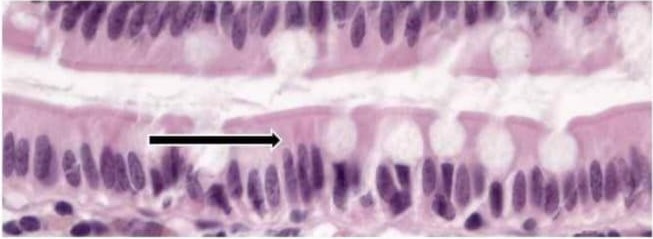
Identify the shape of the cell indicated by the arrow.
Squamous
Cuboidal
Columnar
Transitional
The Correct Answer is C
Epithelial tissues are categorized based on the shape of the surface cells and the number of layers present. Columnar epithelium is characterized by cells that are significantly taller than they are wide, often appearing rectangular or pillar-like in histological cross-sections. This morphology is frequently associated with tissues involved in secretion or absorption, as seen in the intestinal lining depicted in the image, where these tall cells are interspersed with mucus-secreting goblet cells.
A. Squamous cells are defined by their flattened, scale-like morphology, where the width of the cell is significantly greater than its height. They are typically found in areas where rapid diffusion is required, such as the alveoli of the lungs or the lining of blood vessels. The cells indicated by the arrow are clearly elongated vertically, making "squamous" an incorrect description.
B. Cuboidal cells are approximately equal in height and width, appearing roughly square in cross-section with centrally located, spherical nuclei. They are common in glandular ducts and the kidney tubules. The cells shown in the image are much taller than they are wide, which distinguishes them from the cube-shaped morphology of cuboidal epithelium.
C. Columnar cells are the correct identification for the indicated cells. They are tall, narrow cells with elongated, oval-shaped nuclei typically positioned near the base of the cell. This tall, pillar-like shape is clearly visible in the highlighted region, where the cells stand side-by-side to form a protective and functional barrier.
D. Transitional epithelium is a specialized type of stratified tissue found primarily in the urinary system, such as the bladder, where cells change shape (from cuboidal to flattened) as the organ distends. The single layer of tall, uniform cells shown here does not exhibit the variable, layered architecture characteristic of transitional tissue.
Nursing Test Bank
Naxlex Comprehensive Predictor Exams
Related Questions
Correct Answer is D
Explanation
Taste (gustation) is a special sensory modality mediated by taste buds located primarily on the tongue, soft palate, and oropharynx. These receptors detect dissolved chemical substances and transmit signals via cranial nerves VII, IX, and X to the gustatory cortex. The primary taste sensations are classically defined as sweet, salty, sour, bitter, and umami. These basic tastes represent fundamental chemical qualities required for nutrient detection and toxin avoidance. Other sensations like pungency are not true tastes but are instead mediated through different sensory pathways.
A. Sour: Sour taste is a primary gustatory sensation mediated by hydrogen ion concentration in acidic substances. These ions stimulate ion channels in taste receptor cells, particularly on the sides of the tongue. The signal is transmitted via cranial nerves IX and VII to the brainstem and gustatory cortex. Sour taste plays a protective role by helping detect potentially spoiled or unripe foods.
B. Sweet: Sweet taste is a primary taste modality triggered by sugars and certain amino acids. It is detected by G-protein-coupled receptors (T1R family) located in taste buds. These receptors initiate intracellular signaling cascades that send impulses through cranial nerves VII and IX. Sweet taste is important for identifying energy-rich nutrients such as carbohydrates.
C. Salty: Salty taste is detected primarily through sodium ion channels in taste receptor cells. When sodium ions enter these channels, they depolarize the cell membrane and generate a neural signal. This information is transmitted via cranial nerves VII and IX to the brain for interpretation. Salty taste helps regulate electrolyte balance and hydration status.
D. Pungent: Pungent sensation is not a true taste but a chemesthetic response mediated by the trigeminal nerve (cranial nerve V). It is triggered by irritants such as capsaicin in chili peppers, which activate pain and temperature receptors rather than taste buds. This produces sensations of burning or heat rather than a chemical taste quality. Since it does not arise from gustatory receptors or taste buds, pungent is not classified as a primary taste sensation.
Correct Answer is C
Explanation
Oxygen debt (also called excess post-exercise oxygen consumption, EPOC) refers to the increased oxygen requirement after strenuous exercise. During intense physical activity, skeletal muscles may require more oxygen than the cardiovascular and respiratory systems can supply. When this occurs, cells temporarily rely on anaerobic metabolism to produce ATP. This leads to the accumulation of lactic acid and depletion of energy reserves, which must be corrected after exercise ends.
A. Because the heart stops delivering blood during exercise: the heart does not stop during exercise; in fact, cardiac output increases significantly to meet the heightened metabolic demands of skeletal muscles. Heart rate and stroke volume both rise to enhance oxygen delivery. Oxygen debt is not caused by cessation of blood flow but by insufficient oxygen delivery relative to demand.
B. Because muscles produce excess ATP that cannot be stored: ATP is not produced in excess during strenuous exercise; rather, ATP demand exceeds supply. Additionally, ATP is not stored in large quantities in cells and must be continuously regenerated. The issue in oxygen debt is not excess ATP production but inadequate oxygen availability for aerobic ATP synthesis.
C. Because oxygen supply cannot meet the high demand during strenuous activity, leading to anaerobic metabolism and lactic acid buildup: during intense exercise, oxygen delivery to muscles becomes insufficient for aerobic respiration. As a result, muscles shift to anaerobic glycolysis, producing ATP less efficiently and generating lactic acid as a byproduct. This lactic acid accumulation and depletion of oxygen stores (myoglobin and blood oxygen) create an oxygen deficit. After exercise, extra oxygen is required to metabolize lactic acid and restore physiological balance, which defines oxygen debt.
D. Because carbon dioxide completely replaces oxygen in muscle cells: carbon dioxide does not replace oxygen in muscle cells. Instead, carbon dioxide is a metabolic waste product of cellular respiration and is transported away via the bloodstream to the lungs for exhalation. Oxygen remains essential for aerobic ATP production whenever available. This statement is physiologically inaccurate and does not explain oxygen debt.
Whether you are a student looking to ace your exams or a practicing nurse seeking to enhance your expertise , our nursing education contents will empower you with the confidence and competence to make a difference in the lives of patients and become a respected leader in the healthcare field.
Visit Naxlex, invest in your future and unlock endless possibilities with our unparalleled nursing education contents today