
Patient data
For each medication, chose the most likely option for drug classification and treatment goal.
|
Medication |
Drug Classification |
Treatment Goals |
|
Furosemide |
_______________
|
_______________
|
|
Digoxin |
_______________
|
_______________
|
|
Captopril |
_______________
|
_______________
|
The Correct Answer is {"dropdown-group-1":"A","dropdown-group-2":"B","dropdown-group-3":"C","dropdown-group-4":"A","dropdown-group-5":"B","dropdown-group-6":"C"}
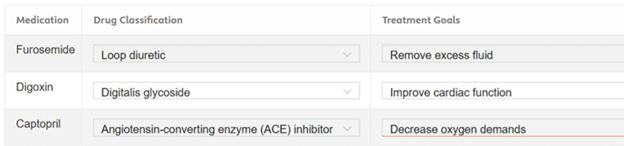
Furosemide → Loop diuretic → Remove excess fluid
Digoxin → Digitalis glycoside → Improve cardiac function
Captopril → Angiotensin-converting enzyme (ACE) inhibitor → Decrease oxygen demands
Rationale:
Furosemide is a loop diuretic that works by promoting excretion of sodium and water through the kidneys. In heart failure, fluid accumulates due to poor cardiac pumping ability, leading to pulmonary congestion and edema. By removing excess fluid, furosemide reduces preload, improves lung function, and decreases symptoms such as tachypnea and crackles. In this infant, who presents with coarse breath sounds, tachypnea, and decreased urine output, fluid overload is a major concern, making this medication essential for fluid management.
Digoxin is a digitalis glycoside that increases the force of cardiac contraction (positive inotropic effect) and slows the heart rate. In infants with heart failure from conditions like ventricular septal defect, the heart works harder but less efficiently. Digoxin improves cardiac output, allowing better perfusion to tissues and organs. This helps reduce fatigue, improves feeding tolerance, and supports growth in infants experiencing failure to thrive.
Captopril is an ACE inhibitor that works by blocking the conversion of angiotensin I to angiotensin II, leading to vasodilation. This reduces afterload (the resistance the heart must pump against), making it easier for the heart to eject blood. By decreasing cardiac workload, captopril reduces oxygen demand and improves overall cardiac efficiency. In this infant with tachycardia, hypoxia, and signs of increased work of breathing, lowering cardiac workload is critical.
Nursing Test Bank
Naxlex Comprehensive Predictor Exams
Related Questions
Correct Answer is C
Explanation
A. Applying a fitted respirator mask, such as an N95, is not required for routine care of clients with influenza. Influenza is transmitted via droplets, not airborne particles, so standard droplet precautions, including a surgical or procedure mask, are sufficient. Recommending a respirator mask is unnecessary and could create confusion or unnecessary expense.
B. Instructing the UAP to notify the nurse of changes in respiratory status is important for ongoing monitoring, but it does not address the immediate infection control concern observed. While important, it is a secondary action rather than the priority in this scenario.
C. Reviewing the need for the UAP to wear a face mask while in close contact with the client is correct. Droplet precautions are indicated for influenza, and wearing a surgical mask is necessary to prevent transmission to healthcare workers. The nurse should ensure the UAP understands and consistently implements this precaution along with gloves and gown to maintain infection control standards.
D. Assigning the UAP to another client and assuming full care is unnecessary if the UAP can safely provide care using appropriate personal protective equipment (PPE). This action would disrupt workflow without addressing the knowledge gap regarding proper infection control practices.
Correct Answer is ["B","C","E","F"]
Explanation
Rationale for correct answers:
- Client states, "It's been hard to catch my breath.": This subjective report of dyspnea (shortness of breath) is a significant indicator of respiratory distress or cardiovascular compromise, especially given her oxygen saturation was only 83% on room air.
- Crackles are heard in the bases of bilateral lungs: Crackles (rales) typically indicate fluid in the alveolar spaces. In a patient with a history of MI and hypertension, this is a classic sign of pulmonary edema related to left-sided heart failure.
- Heart rate is 118 beats/minute with a regular rhythm: This is tachycardia (a heart rate over 100 bpm). The heart is likely overcompensating for low oxygen levels or decreased cardiac output.
- Bilateral peripheral pitting edema of 2+ is present in both legs: Pitting edema indicates systemic fluid volume overload, commonly associated with right-sided heart failure or the heart's inability to pump effectively.
Rationale for incorrect choices:
- Client is alert and oriented to person, place, time, and situation: This is a normal neurological finding (A&O x4), indicating that brain perfusion is currently adequate.
- S1 and S2 heart sounds noted: These are the "lub-dub" sounds of normal heart valve closure. Their presence is a baseline normal finding.
- Client denies pain: At 0125, the absence of pain is a stable finding (though follow-up became necessary at 0135 when she began reporting "heavy" chest pain).
- Reports voiding prior to coming to hospital: This indicates recent renal perfusion and bladder function, which is a normal historical detail.
Whether you are a student looking to ace your exams or a practicing nurse seeking to enhance your expertise , our nursing education contents will empower you with the confidence and competence to make a difference in the lives of patients and become a respected leader in the healthcare field.
Visit Naxlex, invest in your future and unlock endless possibilities with our unparalleled nursing education contents today