
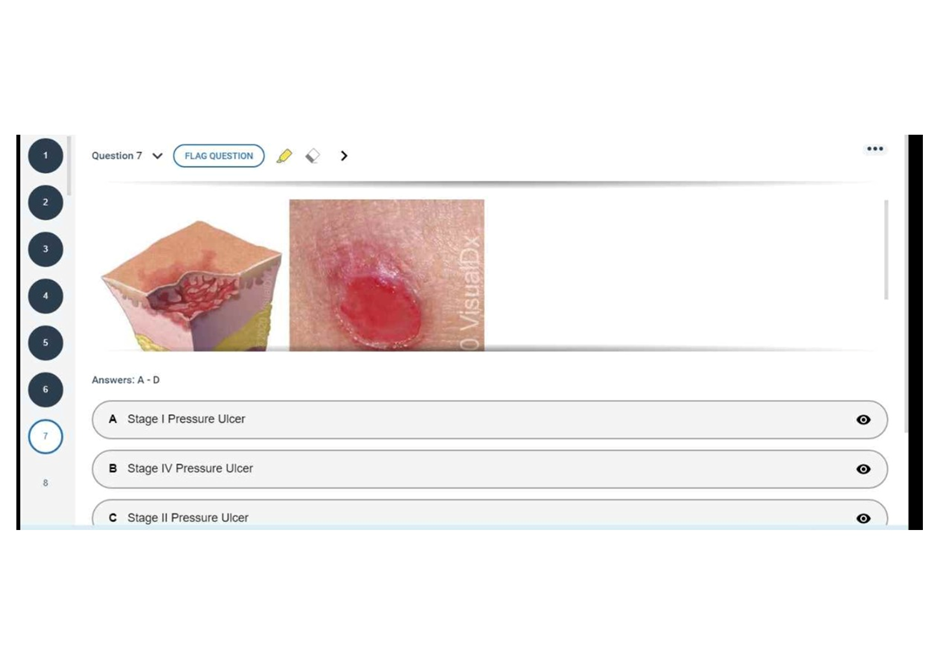
Stage the following:
Stage I Pressure Ulcer
Stage IV Pressure Ulcer
Stage II Pressure Ulcer
Unstageable
The Correct Answer is C
A. Stage I Pressure Ulcer: Characterized by intact skin with nonblanchable erythema (redness) only; there is no open wound or partial-thickness skin loss.
B. Stage IV Pressure Ulcer: Involves full-thickness tissue loss with exposed bone, tendon, or muscle and often deep tunneling -the pictured lesion does not show exposed deeper structures.
C. Stage II Pressure Ulcer: Presents as partial-thickness skin loss involving the epidermis and possibly superficial dermis, appearing as a shallow open ulcer with a red/pink wound bed without slough -this description matches the pictured shallow, red wound.
D. Unstageable: Occurs when full-thickness skin and tissue loss is present but the base is obscured by slough or eschar, making depth indeterminate; the wound bed in the photo is visible and not covered by slough.
Nursing Test Bank
Naxlex Comprehensive Predictor Exams
Related Questions
Correct Answer is ["B","D","E"]
Explanation
A. Recap the needle after giving an injection: Avoid recapping needles because it increases the risk of accidental needlestick injuries; safe practice is to dispose of the needle/syringe immediately without recapping.
B. Use needleless devices whenever possible: Utilizing needleless systems and safety-engineered devices reduces the number of opportunities for percutaneous injury and is a recommended prevention strategy.
C. Remove needle and dispose in sharps box: After completing the procedure, the entire needle/syringe assembly should be placed directly into a puncture-resistant, clearly marked sharps container without recapping or removing the needle from the syringe.
D. Never force needles into the sharps disposal: Do not force items into the sharps container -forcing can lead to accidental puncture or spills; use an appropriate-sized container that is accessible and not overfilled.
E. Use clearly marked sharps disposal containers: Clearly labeled, puncture-resistant sharps containers placed at point of use are essential for safe, timely disposal and to minimize handling.
Correct Answer is D
Explanation
A. The client adjusts the cane to keep the arm at 90 degrees: A 90° elbow angle is too flexed for proper cane height; the handle should allow about 20–30° of elbow flexion (wrist crease level) for good posture and leverage.
B. The client adjusts the cane 3 inches below the axilla: Positioning the cane relative to the axilla is not correct-cane height should be set to the wrist crease with the client standing; a placement 3 inches below the axilla suggests incorrect measurement and may cause poor gait mechanics.
C. The client steps forward with their left leg with the cane on the left side of their body: When the cane is held on the same side as the affected (weaker) leg, it provides less effective support; the cane is most beneficial when placed on the side opposite the affected leg.
D. The client steps forward with their left leg while using the cane on the right side of the body: Holding the cane on the stronger (right) side and advancing the cane together with the weaker (left) leg increases stability and offloads the affected limb, which reflects appropriate cane technique.
Whether you are a student looking to ace your exams or a practicing nurse seeking to enhance your expertise , our nursing education contents will empower you with the confidence and competence to make a difference in the lives of patients and become a respected leader in the healthcare field.
Visit Naxlex, invest in your future and unlock endless possibilities with our unparalleled nursing education contents today