
The nurse is caring for a child in respiratory distress who is experiencing substernal retractions. Select the red area where SUBSTERNAL retractions occur.
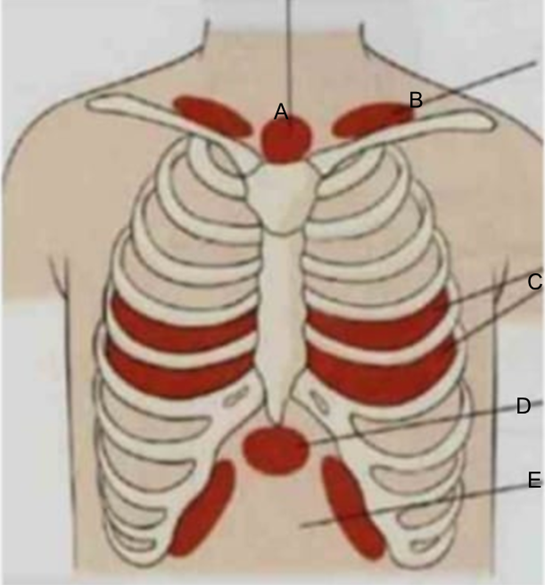
A
B
C
D
E
The Correct Answer is D
Rationale:
A. Suprasternal retractions occurs at the notch above the sternum, not below it.
B. Supraclavicular retractions are seen above the clavicles, often with severe distress.
C. Intercostal retractions appear between the ribs, not beneath the sternum.
D. Substernal retractions occur just below the sternum when the child is working hard to breathe.
E. Subcostal retractions are located beneath the rib cage, closer to the abdomen, not at the sternum.
Nursing Test Bank
Naxlex Comprehensive Predictor Exams
Related Questions
Correct Answer is {"dropdown-group-1":"B","dropdown-group-2":"A"}
Explanation
Rationale for Correct Choices:
• Cracked lips and strawberry tongue are hallmark mucocutaneous changes in Kawasaki disease, reflecting widespread inflammation of mucous membranes in the acute phase. These are often accompanied by conjunctival injection and rash.
• Aspirin and IV gamma globulin are the mainstay treatments for Kawasaki disease, reducing inflammation and significantly lowering the risk of coronary artery aneurysms when given early in the illness.
Rationale for Incorrect Choices:
• Petechiae and purpura rash are more commonly seen in platelet or clotting disorders such as idiopathic thrombocytopenic purpura or meningococcemia. Kawasaki disease typically presents with diffuse erythematous rash, not pinpoint hemorrhages.
• Polyarthritis may occur in the later stages of Kawasaki disease, but chorea is a neurological manifestation linked to rheumatic fever. This combination does not fit the acute presentation of Kawasaki disease.
• Corticosteroids and antibiotics are not first-line treatments for Kawasaki disease. Antibiotics are ineffective as the cause is not bacterial, and corticosteroids are generally reserved for IVIG-resistant cases.
• ACE inhibitors and NSAIDs are not standard therapy for Kawasaki disease. ACE inhibitors are used in hypertension or heart failure, and NSAIDs are not as effective as high-dose aspirin in reducing the acute inflammatory response in this condition.
Correct Answer is C
Explanation
Rationale:
A. Demonstrates cog-wheeling in arm movements and in walking and shows a characteristic shuffling gait when walking: Cog-wheeling and shuffling gait are more characteristic of Parkinson’s disease and are not associated with Duchenne muscular dystrophy or Gower’s sign.
B. Walks flat footed with a duck-like walk, although the child will not walk unless someone insists and makes the child walk: A waddling gait can occur in Duchenne muscular dystrophy, but reluctance to walk unless prompted is not a defining feature of Gower’s sign.
C. Uses a series of maneuvers and walks the hands up the legs in order to rise from a sitting to a standing position: This is the hallmark of Gower’s sign. It occurs due to proximal muscle weakness, especially in the hips and thighs, forcing the child to push on their own legs to stand.
D. Grabs onto furniture or people in order to get from any position to a standing position: While this suggests difficulty rising, reliance on external support does not describe Gower’s sign, which specifically involves using one’s own body for leverage.
Whether you are a student looking to ace your exams or a practicing nurse seeking to enhance your expertise , our nursing education contents will empower you with the confidence and competence to make a difference in the lives of patients and become a respected leader in the healthcare field.
Visit Naxlex, invest in your future and unlock endless possibilities with our unparalleled nursing education contents today