
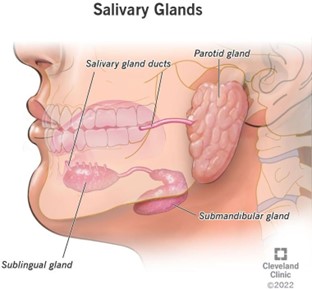
What are the three types of salivary glands and where are they located in the mouth?
Parotid, sublingual, and submandibular glands located in the cheeks, tongue, and roof of the mouth, respectively.
Sublingual, submandibular, and buccal glands located in the tongue, cheeks, and lips, respectively.
Parotid, sublingual, and submandibular glands located in the roof of the mouth, cheeks, and under the jawbone, respectively.
Sublingual, parotid, and buccal glands located in the tongue, cheeks, and lips, respectively.
The Correct Answer is C
The three major pairs of salivary glands are the parotid glands, sublingual glands, and submandibular glands. The parotid glands are located just in front of your ears. The sublingual glands are below either side of your tongue, under the floor of your mouth. The submandibular glands are located below your jaw
Nursing Test Bank
Naxlex Comprehensive Predictor Exams
Related Questions
Correct Answer is A
Explanation
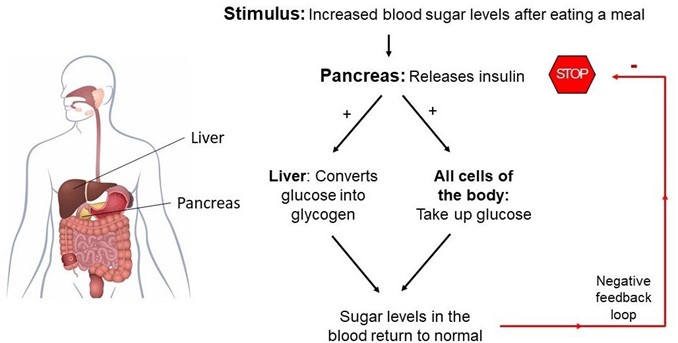
Insulin is a hormone produced by the pancreas that plays a crucial role in regulating the levels of glucose (sugar) in the blood. After a person eats a meal, the levels of glucose in the blood rise, which stimulates the pancreas to release insulin into the bloodstream. Insulin acts on various cells in the body, particularly those in the liver, muscles, and adipose tissue, to promote the uptake, use, and storage of glucose.
Insulin helps to lower the levels of glucose in the blood by increasing the uptake of glucose by cells, stimulating the liver and muscle cells to store glucose in the form of glycogen, and inhibiting the production and release of glucose by the liver. This process is known as glucose homeostasis, and it helps to keep the levels of glucose in the blood within a normal range.
Deficiencies or abnormalities in insulin production or function can lead to a range of metabolic disorders, including type 1 and type 2 diabetes. In type 1 diabetes, the body does not produce enough insulin, while in type 2 diabetes, the body becomes resistant to the effects of insulin, leading to elevated levels of glucose in the blood.
Correct Answer is C
Explanation
The molecular geometry of a molecule of Sulphur dioxide (SO2) is bent or V-shaped. This is because of the presence of two lone pairs on the sulfur atom, which cause repulsion and distort the bond angles in the molecule.
SO2 has a central sulfur atom bonded to two oxygen atoms by double bonds. The two double bonds and the two lone pairs of electrons on the sulfur result in a trigonal planar arrangement of electron pairs around the sulfur atom. However, the repulsion between the lone pairs causes the two oxygen atoms to be pulled closer together, resulting in a bent or V-shaped molecular geometry.
The bent molecular geometry of SO2 affects its properties, such as its polarity and reactivity. SO2 is a polar molecule due to the asymmetric distribution of electrons, which results in a partial positive charge on the sulfur atom and partial negative charges on the oxygen atoms. This polarity makes SO2 a good solvent and reactant in chemical reactions, as well as a contributor to air pollution and acid rain.

Whether you are a student looking to ace your exams or a practicing nurse seeking to enhance your expertise , our nursing education contents will empower you with the confidence and competence to make a difference in the lives of patients and become a respected leader in the healthcare field.
Visit Naxlex, invest in your future and unlock endless possibilities with our unparalleled nursing education contents today