
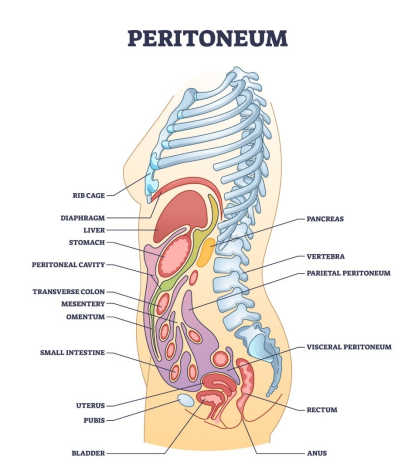
What is the function of the peritoneum in the abdominal cavity?
Providing support and reducing friction
Producing digestive enzymes
Storing bile
Filtering waste products
The Correct Answer is A
A. Providing support and reducing friction: The peritoneum is a continuous serous membrane that lines the abdominal cavity and covers the abdominal organs. It secretes a lubricating serous fluid that allows organs to glide against each other without friction during digestion and movement. It also helps suspend organs in place via folds (mesenteries).
B. Producing digestive enzymes: Digestive enzymes are primarily produced by the glandular organs such as the pancreas, salivary glands, stomach lining, and the small intestine, not the peritoneal membrane.
C. Storing bile: Bile is produced by the liver and stored/concentrated in the gallbladder.
D. Filtering waste products: The filtration of waste products from the blood is the primary function of the kidneys (and to a metabolic extent, the liver), not the peritoneum.
Nursing Test Bank
Naxlex Comprehensive Predictor Exams
Related Questions
Correct Answer is ["E","F"]
Explanation
A. Epinephrine: Epinephrine is produced by the adrenal medulla, not the cortex.
B. Testosterone: Partially correct physiologically, because the adrenal cortex secretes androgens, but testosterone is mainly produced by the testes. It is not a major adrenal cortex hormone involved in stress response.
C. Thyroxine: Thyroxine is produced by the thyroid gland, not the adrenal cortex.
D. Norepinephrine: Produced by the adrenal medulla, not the cortex.
E. Aldosterone: A mineralocorticoid from the adrenal cortex. Aldosterone helps maintain blood pressure and volume during stress by increasing sodium and water retention.
F. Cortisol: A glucocorticoid from the adrenal cortex. Cortisol is the primary stress hormone-it regulates metabolism, suppresses inflammation, and helps the body adapt to stress.
G. Adrenocorticotropic hormone (ACTH): ACTH is released by the anterior pituitary, not the adrenal cortex. It stimulates the cortex but is not a hormone released from it.
Correct Answer is A
Explanation
A. Enteric nervous system:The Enteric nervous system is a mesh-like system of neurons that governs the function of the gastrointestinal tract (the "brain of the gut"). It manages digestion, not the systemic stress response.
B. Central nervous system:While the brain (specifically the hypothalamus and amygdala) perceives the threat, the execution of the physiological "fight or flight" changes (racing heart, dilated pupils) is carried out by the autonomic nerves.
C. Peripheral nervous system:Similar to Question 45, this is a broad anatomical term. While the stress response nerves are located in the periphery, the specific functional system is the Autonomic Nervous System.
D. Autonomic nervous system:The Autonomic Nervous System has two main branches: the Sympatheticand the Parasympathetic. The Sympathetic division is directly responsible for the "fight or flight" response, mobilizing the body's energy during stress.
Question: 47 of 48
A middle-aged woman has been diagnosed with a vitamin D deficiency. How does this deficiency affect her musculoskeletal system?
- Reduced calcium absorption leading to weak bones
- Increased muscle mass
- Enhanced collagen production
- Hypercalcemia due to excess calcium
Correct answer: A
A. Reduced calcium absorption leading to weak bones:The primary physiological role of Vitamin D is to facilitate the absorption of calciumin the intestines. Without sufficient Vitamin D, the body cannot absorb enough calcium from the diet. To maintain blood calcium levels, the body will then leech calcium from the bones, leading to lower bone density (osteopenia/osteoporosis) and increased fracture risk.
B. Increased muscle mass:Vitamin D deficiency is actually associated with muscle weakness and pain (proximal myopathy), not an increase in muscle mass.
C. Enhanced collagen production:Vitamin D is not a primary driver of collagen synthesis; Vitamin C is the key nutrient for collagen production.
D. Hypercalcemia due to excess calcium:A deficiency in Vitamin D leads to hypocalcemia(low calcium levels) because the gut cannot absorb it efficiently. Hypercalcemia would be a sign of Vitamin D toxicity (overdose) or hyperparathyroidism.
Whether you are a student looking to ace your exams or a practicing nurse seeking to enhance your expertise , our nursing education contents will empower you with the confidence and competence to make a difference in the lives of patients and become a respected leader in the healthcare field.
Visit Naxlex, invest in your future and unlock endless possibilities with our unparalleled nursing education contents today