
A patient with osteoporosis is concerned about bone strength. What type of bone cell is primarily responsible for bone resorption, and what role does it play in bone health?
Osteocyte; maintaining bone tissue
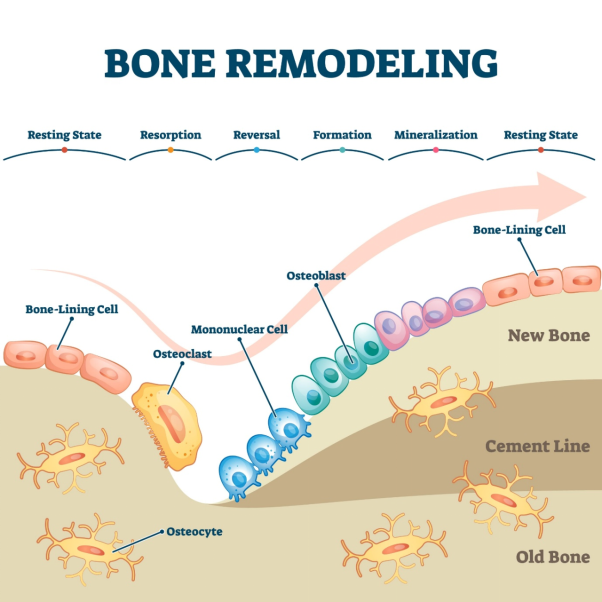
Osteoclast; breaking down bone tissue
Chondrocyte; forming cartilage
Osteoblast; forming new bone tissue
The Correct Answer is B
A. Osteocyte; maintaining bone tissue: Osteocytes are mature bone cells embedded within the bone matrix. Their primary role is to maintain the mineral concentration of the matrix and communicate mechanical stress to other cells, but they do not primarily break down or build bone mass.
B. Osteoclast; breaking down bone tissue: Osteoclasts are large, multinucleated cells responsible for resorption-the process of breaking down bone tissue to release minerals (like calcium) into the blood. In osteoporosis, osteoclast activity often outpaces osteoblast activity, leading to net bone loss.
C. Chondrocyte; forming cartilage: Chondrocytes are the cells found in cartilage, not bone. They are responsible for producing the cartilaginous matrix (collagen and proteoglycans).
D. Osteoblast; forming new bone tissue: Osteoblasts are the "builders." They synthesize the bone matrix (collagen) and coordinate the mineralization process. While essential for health, the question specifically asked for the cell responsible for resorption.
Nursing Test Bank
Naxlex Comprehensive Predictor Exams
Related Questions
Correct Answer is B
Explanation
A. Kyphosis; excessive outward curvature:Kyphosis describes an excessive outward curvature (increased thoracic convexity, producing a “hunchback” appearance). This is a curvature abnormality, but it refers specifically to exaggerated thoracic outward curvature. (True statement, but the option names a specific type - see B for lateral curvature.)
B. Scoliosis; lateral curvature:Scoliosis is an abnormal lateral (side-to-side) curvature of the spine and is the correct classification when a practitioner notes a lateral curvature.
C. Lordosis; inward curvature:Lordosis is an excessive inward curvature of the lumbar spine (swayback). It is a curvature abnormality but indicates inward (anterior) curve, not lateral.
D. Osteopenia; reduced bone mass:Osteopenia describes reduced bone mineral density (less severe than osteoporosis) and affects bone strength, not the curvature shape of the spine.
Correct Answer is B
Explanation
A. Epithelial tissue:Epithelial tissue covers body surfaces and lines cavities. It is specialized for protection, secretion, and absorption, not electrical transmission.
B. Nervous tissue:Nervous tissue consists of neurons, which are highly specialized cells capable of generating and conducting electrical signals (action potentials) to communicate information throughout the body.
C. Muscle tissue:While muscle tissue is "excitable" and can conduct an electrical signal along its membrane to trigger contraction, its primary physiological specialization is contraction/movement, not the transmission of information.
D. Connective tissue:Connective tissue provides structural support, transport (blood), and energy storage (fat). It does not conduct electrical impulses.
Whether you are a student looking to ace your exams or a practicing nurse seeking to enhance your expertise , our nursing education contents will empower you with the confidence and competence to make a difference in the lives of patients and become a respected leader in the healthcare field.
Visit Naxlex, invest in your future and unlock endless possibilities with our unparalleled nursing education contents today