
What is the primary advantage of wound healing by primary intention compared to secondary intention?
Faster healing with minimal scar formation.
Higher risk of infection.
Increased granulation tissue formation.
Enhanced epidermal migration.
The Correct Answer is A
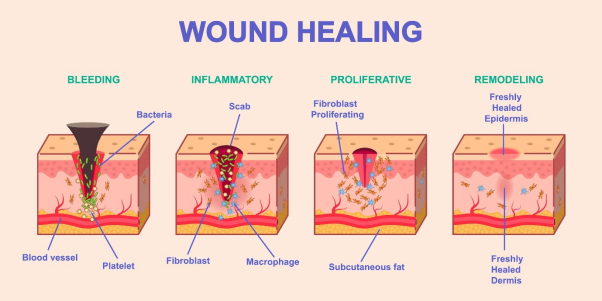
A. Faster healing with minimal scar formation. Primary intention occurs in clean, surgically incised wounds with minimal tissue loss, where the edges are closely approximated (e.g., with sutures). This method allows for rapid epithelialization and healing with a minimal formation of granulation tissue and resulting in a fine, linear scar.
B. Higher risk of infection. Wounds healing by primary intention generally have a lower risk of infection because the edges are closed, preventing microbial entry and reducing the exposed surface area compared to open wounds.
C. Increased granulation tissue formation. Secondary intention healing, which occurs in open, contaminated, or tissue-loss wounds (like large pressure injuries or burns), requires the formation of a large amount of granulation tissue to fill the wound bed before epithelialization can occur. Primary intention healing requires very little granulation tissue.
D. Enhanced epidermal migration. While epidermal migration (epithelialization) occurs in both, the overall process is much faster in primary intention because the epithelial cells only need to migrate across a very narrow gap. In secondary intention, the epithelium must migrate across a large surface area once the granulation tissue has filled the defect.
Nursing Test Bank
Naxlex Comprehensive Predictor Exams
Related Questions
Correct Answer is C
Explanation
A. The patient has a high-protein diet: A high-protein diet promotes healing, which would decrease the risk of wound separation.
B. Patient is ambulating frequently post-surgery: Frequent, gentle ambulation improves circulation and general strength, which helps recovery and reduces complications like infection and DVT.
C. The patient has a history of chronic coughing and sneezing: This is the most strongly contributing factor. Any activity that suddenly and dramatically increases intra-abdominal pressure (like severe coughing, vomiting, straining, or sneezing) can place extreme tension on a healing surgical incision, leading to separation (dehiscence) and potentially organ protrusion (evisceration).
D. Patient is on immunosuppressant therapy: This is a factor that impairs healing and increases infection risk, but it does not directly cause the mechanical failure of the incision, which is the immediate cause of evisceration.
Correct Answer is A
Explanation
A. To prevent shearing of the patient's skin: When a patient is pulled or dragged across a sheet, the deeper tissues (bone and muscle) are stationary while the skin moves, leading to shear injury—one of the primary mechanisms for Deep Tissue Pressure Injuries (DTPIs). Using a lift device raises the patient completely, eliminating this destructive shearing and friction force.
B. To make the repositioning process faster:While a lift device may be efficient, patient safety and skin protection are the clinical priorities, not speed.
C. To prevent the nurse from straining their back: This is an extremely important benefit for nurse safety and injury prevention, but the primary reason the intervention is implemented in the patient's plan of care is for the direct therapeutic benefit of protecting the patient's skin integrity.
D. To ensure the patient is positioned comfortably: This is a secondary benefit. While comfort is considered, the lift device's essential function is mechanical protection of the skin and underlying tissues.
Whether you are a student looking to ace your exams or a practicing nurse seeking to enhance your expertise , our nursing education contents will empower you with the confidence and competence to make a difference in the lives of patients and become a respected leader in the healthcare field.
Visit Naxlex, invest in your future and unlock endless possibilities with our unparalleled nursing education contents today