
What muscle is pictured below?
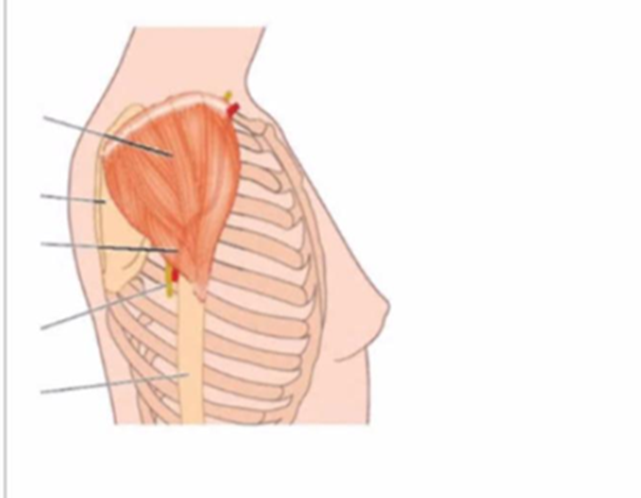
rectus femoris
deltoid
diaphragm
Dorsogluteal
The Correct Answer is B
Rationale:
A. Rectus femoris is one of the quadriceps muscles located in the anterior thigh, important for knee extension and hip flexion.
B. Deltoid is the large, triangular-shaped muscle covering the shoulder joint, responsible for abduction, flexion, extension, and rotation of the arm. This matches the pictured muscle.
C. Diaphragm is the dome-shaped muscle that separates the thoracic and abdominal cavities, playing a primary role in respiration.
D. Dorsogluteal refers to a site in the gluteal region (buttocks) commonly used for intramuscular injections, not a specific muscle.
Nursing Test Bank
Naxlex Comprehensive Predictor Exams
Related Questions
Correct Answer is A
Explanation
Rationale:
A. Flexion is a movement that decreases the angle between two bones at a joint. It often involves bending a limb, such as bending the elbow or knee, or moving the chin toward the chest at the neck. Flexion brings body parts closer together and is a fundamental movement in many joints.
B. The opposite of flexion, extension increases the angle between two bones, straightening a joint. For example, straightening the elbow after it has been bent is extension.
C. This is the movement of a body part toward the midline of the body, such as bringing the arm down to the side from a raised position. It does not specifically decrease the angle at a joint.
D. This is the movement of a body part away from the midline, such as lifting the arm or leg out to the side. Like adduction, it is not about decreasing the angle at a joint.
Correct Answer is B
Explanation
Rationale:
A. Apocrine glands are located mainly in the axillae, groin, and around the nipples. They become active during puberty and secrete a thicker sweat that is more related to emotional stress, not temperature regulation.
B. Eccrine glands are the primary sweat glands responsible for thermoregulation. They are distributed widely across the body and secrete watery sweat, which cools the body through evaporation, making them the most important for maintaining core temperature.
C. Sebaceous glands secrete sebum (oil) that lubricates skin and hair but have no role in temperature control.
D. Endocrine glands secrete hormones into the bloodstream and regulate many processes (such as metabolism and growth), but they are not directly responsible for cooling the body through heat dissipation.
Whether you are a student looking to ace your exams or a practicing nurse seeking to enhance your expertise , our nursing education contents will empower you with the confidence and competence to make a difference in the lives of patients and become a respected leader in the healthcare field.
Visit Naxlex, invest in your future and unlock endless possibilities with our unparalleled nursing education contents today