
Which finding would most likely prompt a nurse to use a Doppler instrument during the palpation of the dorsalis pedis pulse?
Bounding pulse graded 4+ using fingertips.
Normal 2+ pulse found on one foot only.
A pulse that is thready and difficult to palpate.
Differences in capillary refill time between extremities.
The Correct Answer is C
Choice A reason: A bounding, 4+ pulse is a high-amplitude, forceful pulse often associated with hyperdynamic states, fluid overload, or aortic insufficiency. This finding is easily palpable, so there is absolutely no clinical indication to use a Doppler, as the pulse is clearly present and clinically significant at a high magnitude.
Choice B reason: A normal 2+ pulse is the expected clinical finding. If a pulse is palpable at a 2+ grade, it indicates adequate distal perfusion to that extremity. A Doppler instrument is not indicated for a standard, healthy pulse, as it is designed to detect pulses that are not detectable by manual palpation alone.
Choice C reason: A thready or weak pulse suggests poor cardiac output or peripheral arterial disease. When a peripheral pulse is so weak that it cannot be accurately felt or graded by palpation, the nurse must use a handheld Doppler device to verify the presence, character, and location of blood flow.
Choice D reason: While capillary refill time is an important indicator of tissue perfusion, a delay in this time indicates microvascular circulation issues, not necessarily the status of the major peripheral arteries. Comparing refill times is a standard assessment that does not inherently dictate the use of a Doppler.
Nursing Test Bank
Naxlex Comprehensive Predictor Exams
Related Questions
Correct Answer is A
Explanation
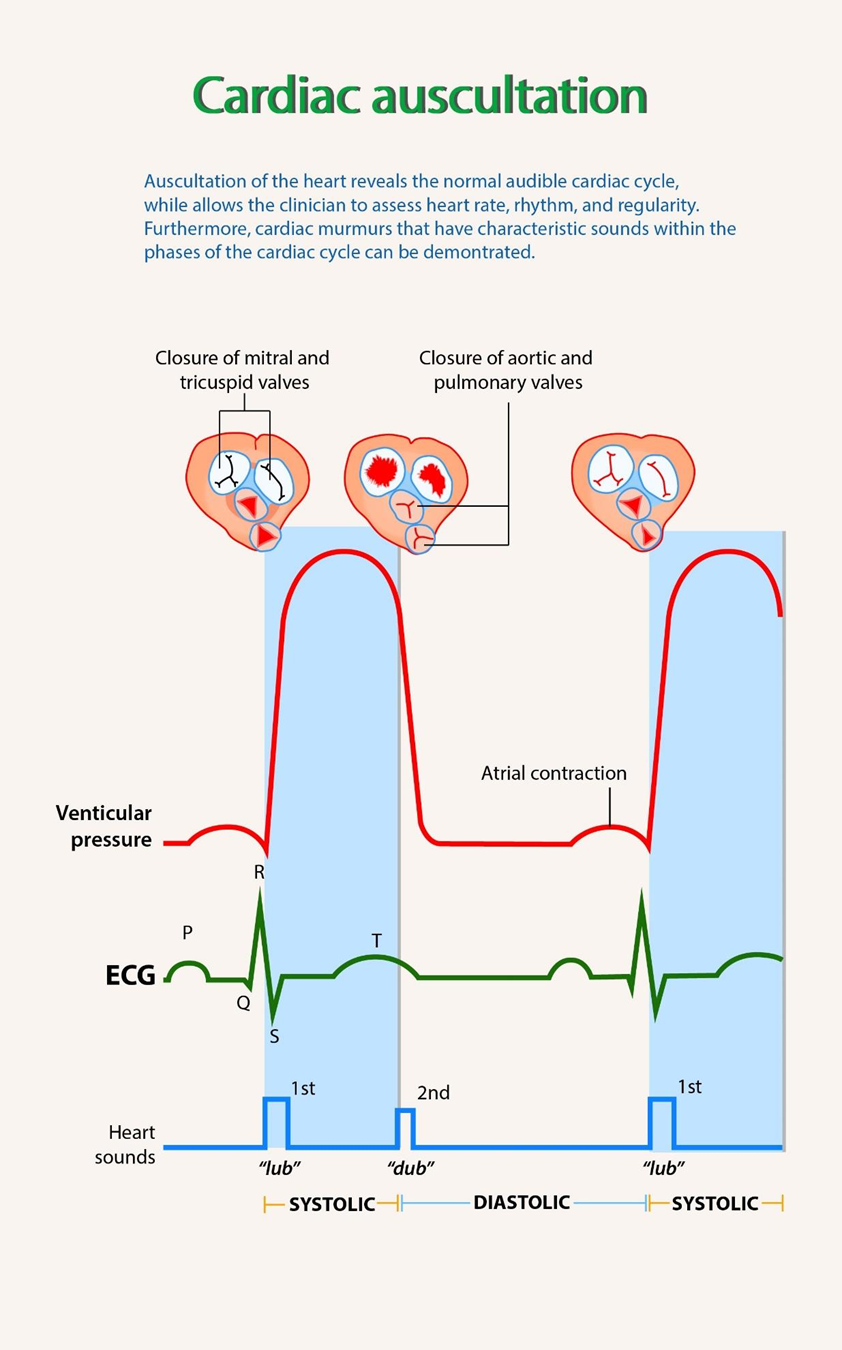
Choice A reason: The S1 heart sound represents the closure of the atrioventricular valves, and S2 represents the closure of the semilunar valves. The interval between S1 and S2 corresponds to ventricular systole. Any audible turbulence or vibration detected during this specific cardiac phase is classified as a systolic murmur, often resulting from increased blood flow or valvular pathology.
Choice B reason: While S1 and S2 are considered expected heart sounds, turbulence audible during the systolic phase is considered an adventitious sound. An expected or normal heart examination typically involves clear, crisp valvular closures without audible swishing or blowing sounds, which indicate abnormal blood flow patterns.
Choice C reason: The third heart sound is a low-frequency sound occurring during the rapid filling phase of early diastole, immediately following S2. It is produced by the vibration of the ventricular walls as blood rushes into the ventricles. It is not associated with the systolic interval between S1 and S2.
Choice D reason: The fourth heart sound is a low-pitched sound heard in late diastole, just before S1. It is generated by the atrial contraction forcing blood into a stiff, non-compliant ventricle. Like the S3, this sound occurs during diastole and is not related to the turbulence occurring during the systolic interval.
Correct Answer is D
Explanation
Choice A reason: While a foreign body can cause airway obstruction and localized wheezing, it is not the physiological explanation for the diffuse airway changes seen in pneumonia. Pneumonia involves generalized inflammation, whereas foreign body obstruction is typically sudden and localized to a specific bronchial branch.
Choice B reason: While fluid in the alveoli is a hallmark of pneumonia and leads to impaired gas exchange, this physiological process is more directly related to the finding of crackles (rales) due to the air moving through fluid-filled spaces rather than the wheezing associated with bronchial narrowing.
Choice C reason: Increased surface tension in alveoli is characteristic of respiratory distress syndrome (RDS) due to a surfactant deficiency. While it prevents full expansion and causes respiratory distress, it does not typically manifest as wheezing, which is a sound produced by the high-velocity movement of air through constricted airways.
Choice D reason: In pediatric pneumonia, the inflammatory response often leads to significant mucosal edema, cellular infiltration, and the production of viscous secretions within the bronchioles. This narrowing of the airway lumen increases resistance to airflow, causing the turbulence heard as wheezing, and forces the use of accessory muscles, resulting in retractions.
Whether you are a student looking to ace your exams or a practicing nurse seeking to enhance your expertise , our nursing education contents will empower you with the confidence and competence to make a difference in the lives of patients and become a respected leader in the healthcare field.
Visit Naxlex, invest in your future and unlock endless possibilities with our unparalleled nursing education contents today