
Which of the following would be falsification of health records? Select all that apply.
Documenting an assessment that was not performed
The nurse documents that the family has asked to speak to the doctor
The nurse fails to document the doctor's verbal order for a new medication
The nurse left their badge at home and cannot sign into the EHR
The nurse documents blood labs were sent before the blood draw was performed
Correct Answer : A,E
Correct answers are:
A. Documenting an assessment that was not performed
E. The nurse documents blood labs were sent before the blood draw was performed
Falsification of health records refers to deliberately misrepresenting, fabricating, or altering documentation, which could lead to severe consequences for patients and healthcare providers. In option A, documenting an assessment that was not performed is falsification of health records because it misrepresents the care provided to the patient. Similarly, in option E, documenting that blood labs were sent before the blood draw was performed is a falsification of health records because it is not an accurate representation of the actual order of events.
Options B, C, and D do not involve falsification of health records, but they may be considered documentation errors or violations of organizational policies.
Nursing Test Bank
Naxlex Comprehensive Predictor Exams
Related Questions
Correct Answer is D
Explanation
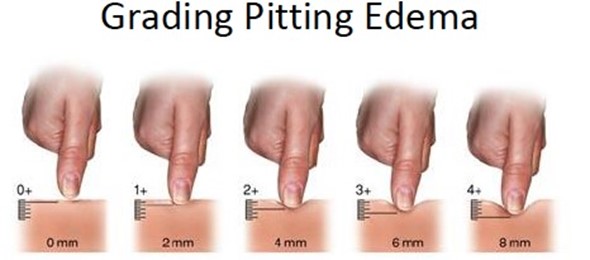
A. 2+ Pitting Edema:This refers to moderate pitting edema where the indentation is approximately 4 mm and disappears within 10-15 seconds.
B. 3+ Pitting Edema:This refers to moderately severe pitting edema where the indentation is approximately 6 mm and may last longer than 1 minute but does not remain for as long as 4 minutes.
C. 1+ Non-Pitting Edema:This grade refers to mild pitting edema with a 2 mm indentation that quickly disappears within a few seconds.
D. 4+ Pitting Edema:4+ pitting edema is characterized by a very deep pit (approximately 8 mm) that may last 2-5 minutes or more. This matches the scenario where the pit is 8 mm deep and remains for 4 minutes.
Correct Answer is ["725"]
Explanation
Intake = IV fluid + antibiotic
From 0700-0900 (2 hours), the patient received 100 mL/hr of IV fluid: 100 mL/hr x 2 hours = 200 mL
From 1000-1030 (0.5 hours), the patient received Kefzol 1 g in 25 mL of D5W over 30 minutes:
25 mL
From 1030-1530 (5 hours), the patient received 100 mL/hr of IV fluid: 100 mL/hr x 5 hours = 500 mL
Total intake from 0700-1530 = 200 mL + 25 mL + 500 mL = 725 mL. Therefore, the patient's intake from 0700 to 1530 was 725 mL.
Whether you are a student looking to ace your exams or a practicing nurse seeking to enhance your expertise , our nursing education contents will empower you with the confidence and competence to make a difference in the lives of patients and become a respected leader in the healthcare field.
Visit Naxlex, invest in your future and unlock endless possibilities with our unparalleled nursing education contents today