
Which structure is indicated by the X in the image below?
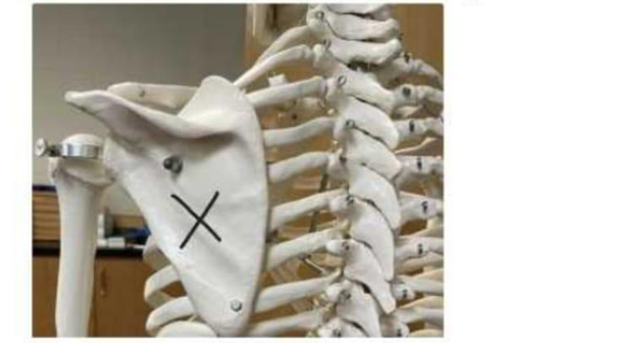
Scapula
Clavicle
Humerus
Ribs
The Correct Answer is A
The marked structure is the scapula, a flat, triangular bone located on the posterior aspect of the thoracic cage, commonly referred to as the shoulder blade. It lies over ribs 2–7 and forms the posterior component of the shoulder girdle. The scapula plays a central role in upper limb mobility by serving as an attachment site for multiple muscles that control shoulder movement and stabilization. It articulates with the clavicle at the acromioclavicular joint and with the humerus at the glenohumeral (shoulder) joint.
A. Scapula: The scapula is a flat, triangular bone positioned on the posterior thoracic wall. It contains important anatomical landmarks such as the spine, acromion, coracoid process, and glenoid cavity, which participate in shoulder articulation and muscle attachment. It allows a wide range of shoulder movements including elevation, rotation, and abduction through coordinated muscular action. Since the marked structure lies on the posterior upper back forming the shoulder blade, it corresponds to the scapula.
B. Clavicle: The clavicle is a long, S-shaped bone located anteriorly at the base of the neck. It connects the sternum to the scapula, acting as a strut that stabilizes the shoulder girdle. Its main function is to maintain shoulder position and allow upper limb mobility away from the trunk. Unlike the scapula, it is a horizontal anterior bone rather than a flat posterior structure.
C. Humerus: The humerus is the long bone of the upper arm extending from the shoulder to the elbow joint. It serves as the main structural bone for arm movement and muscle attachment. It articulates with the scapula at the glenoid cavity to form the shoulder joint. However, it is located in the arm rather than forming the posterior shoulder blade itself.
D. Ribs: The ribs are curved, flat bones forming the thoracic cage that protects the heart and lungs. They articulate posteriorly with the thoracic vertebrae and anteriorly with the sternum (via costal cartilage). Their primary function is protection and respiratory movement. Unlike the scapula, they are part of the thoracic cage rather than the shoulder girdle.
Nursing Test Bank
Naxlex Comprehensive Predictor Exams
Related Questions
Correct Answer is B
Explanation
Homeostasis is a fundamental physiological principle that describes how the human body maintains a relatively stable internal environment despite continuous changes in the external environment. This stability is essential for normal cellular function and survival, as enzymes, metabolic processes, and cellular activities operate within narrow optimal ranges. The body achieves homeostasis through coordinated feedback mechanisms involving the nervous and endocrine systems. These regulatory systems continuously monitor and adjust variables such as temperature, blood glucose, pH, and fluid balance.
A. The changing external conditions of the environment: This option describes environmental variability rather than internal regulation. Homeostasis is not about external changes themselves but about the body’s response to those changes. External conditions such as temperature, humidity, or atmospheric pressure may fluctuate, but homeostasis refers specifically to how the internal environment remains stable despite these fluctuations.
B. The maintenance of stable internal conditions: homeostasis refers to the body’s ability to maintain a constant internal environment within narrow physiological limits. This includes regulation of core temperature, blood glucose levels, blood pressure, and electrolyte balance. These processes are controlled through negative feedback mechanisms involving the nervous and endocrine systems. Stability of the internal environment is essential for proper cellular and organ function.
C. The breakdown of nutrients for energy production: This option describes metabolism, specifically catabolism, which involves the chemical breakdown of nutrients to release energy in the form of ATP. While metabolism is essential for life and is regulated in part by homeostatic mechanisms, it is not the definition of homeostasis itself. Therefore, this statement refers to a specific physiological process rather than the overall regulatory balance of the internal environment.
D. The transmission of electrical signals in neurons: This describes neural conduction, which is the process by which neurons transmit electrical impulses through action potentials. It is a key function of the nervous system involved in communication and coordination. However, it does not define the regulation of internal physiological stability.
Correct Answer is B
Explanation
The auditory ossicles are three small bones located in the middle ear within the tympanic cavity. They form a mechanical chain that transmits and amplifies sound vibrations from the tympanic membrane to the inner ear. This system is essential for efficient sound conduction from air (outer ear) to fluid-filled cochlear structures (inner ear). The ossicles work in a precise anatomical sequence to ensure proper impedance matching and effective hearing.
A. Stapes → malleus → incus: This sequence reverses the normal direction of sound transmission through the middle ear. The stapes is the most medial ossicle and connects to the oval window of the inner ear, making it the final structure in the chain. The malleus is attached to the tympanic membrane and should be the first ossicle to receive vibrations.
B. Malleus → incus → stapes: This is the correct sequence of auditory ossicle function. Sound waves first vibrate the tympanic membrane, which is attached to the malleus. The malleus transmits these vibrations to the incus, which then passes them to the stapes. The stapes ultimately transfers the mechanical energy to the oval window of the cochlea, converting air vibrations into fluid waves for auditory processing.
C. Incus → malleus → stapes: This order disrupts the anatomical continuity of the ossicular chain. The incus is the intermediate bone and cannot be the initial receiver of tympanic membrane vibrations. It must receive input from the malleus before passing it to the stapes.
D. Malleus → stapes → incus: This sequence bypasses the incus, which is the essential linking structure between the malleus and stapes. Anatomically, vibrations must pass through the incus to maintain proper mechanical transmission. Skipping this bone disrupts the amplification and coordination of sound conduction, making this option physiologically inaccurate.
Whether you are a student looking to ace your exams or a practicing nurse seeking to enhance your expertise , our nursing education contents will empower you with the confidence and competence to make a difference in the lives of patients and become a respected leader in the healthcare field.
Visit Naxlex, invest in your future and unlock endless possibilities with our unparalleled nursing education contents today