
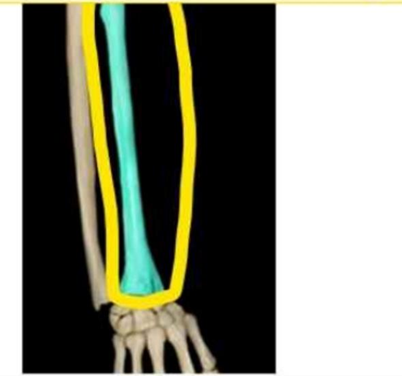
Identify the structure circled in the image below.
Humerus
Carpals
Radius
Ulna
The Correct Answer is C
The marked structure is the radius, one of the two long bones of the forearm located on the lateral side (thumb side). It articulates with the humerus at the elbow and with the carpal bones at the wrist, enabling forearm rotation movements such as pronation and supination. The radius works alongside the ulna to provide stability and mobility of the forearm and hand.
A. Humerus: The humerus is the long bone of the upper arm extending from the shoulder to the elbow joint. It serves as the primary structural bone of the upper limb and articulates with both the radius and ulna at the elbow. Compared to the radius, it is more proximal and located in the arm rather than the forearm.
B. Carpals: The carpals are a group of eight small bones forming the wrist joint between the forearm and the hand. They allow flexibility and fine movements of the wrist but do not extend along the forearm shaft. Unlike the radius, they are distal structures located at the wrist rather than a long forearm bone.
C. Radius: The radius is a long bone located on the lateral side of the forearm (thumb side). Proximally, it articulates with the capitulum of the humerus at the elbow, and distally it connects with the carpal bones at the wrist. It rotates around the ulna during pronation and supination, enabling rotational hand movements. This makes it essential for functional tasks such as turning a doorknob, writing, and lifting objects.
D. Ulna: The ulna is the medial forearm bone located on the little finger side. It forms the main hinge joint with the humerus at the elbow, providing stability during flexion and extension. Compared to the radius, it is more medial and less involved in wrist articulation and rotational movement.
Nursing Test Bank
Naxlex Comprehensive Predictor Exams
Related Questions
Correct Answer is A
Explanation
Skeletal muscle movements are produced through coordinated interactions between different muscle groups. These muscles work in pairs or groups to create smooth, controlled motion at joints. Each muscle in a functional group has a specific role depending on whether it produces, assists, or opposes a movement. Understanding these roles is essential for interpreting biomechanics and musculoskeletal physiology.
A. Antagonist: The antagonist is the muscle that opposes or reverses the action of the agonist during movement. When one muscle contracts to produce movement, the antagonist typically relaxes to allow smooth motion, and may contract to control or decelerate the movement. For example, during elbow flexion, the triceps brachii acts as the antagonist to the biceps brachii. This opposing function helps maintain joint stability and coordinated movement.
B. Agonist: The agonist is the muscle primarily responsible for generating a specific movement. It is the main active muscle during a particular action, such as the biceps brachii during elbow flexion. The agonist contracts to produce the desired motion at a joint. Since it produces rather than opposes movement, it is not the correct answer.
C. Prime mover: The prime mover is another term for the agonist muscle, referring to the main muscle responsible for a specific movement. It generates the majority of the force required for the action. For example, the quadriceps act as the prime mover during knee extension. Because it is synonymous with agonist and not an opposing muscle, it is incorrect.
D. Synergist: A synergist is a muscle that assists the agonist in producing a movement by adding extra force or stabilizing joints. It may also prevent unwanted movements that could interfere with the primary action. For example, forearm muscles may act as synergists during hand movements. Synergists assist rather than oppose movement.
Correct Answer is C
Explanation
Cardiac muscle tissue is a specialized involuntary muscle found only in the heart. It is responsible for generating rhythmic contractions that pump blood throughout the body. Unlike skeletal muscle, cardiac muscle cells must contract in a highly coordinated and synchronized manner to maintain effective cardiac output. This coordination is made possible by specialized cellular junctions that mechanically and electrically link adjacent cardiac muscle cells.
A. Motor end plates: Motor end plates are specialized regions of the sarcolemma found in skeletal muscle fibers. They are part of the neuromuscular junction where motor neurons release acetylcholine to stimulate skeletal muscle contraction. Cardiac muscle does not rely on motor end plates because it is not directly controlled by somatic motor neurons. Instead, it is regulated by intrinsic pacemaker activity and autonomic input.
B. Neuromuscular junctions: Neuromuscular junctions are synapses between motor neurons and skeletal muscle fibers that transmit signals using neurotransmitters such as acetylcholine. These junctions initiate voluntary skeletal muscle contraction. Cardiac muscle, however, does not depend on direct motor neuron stimulation for each contraction, as it has its own intrinsic conduction system. Neuromuscular junctions are not responsible for connecting cardiac muscle cells.
C. Intercalated discs: intercalated discs are specialized structures that connect adjacent cardiac muscle cells. They contain desmosomes for strong mechanical attachment and gap junctions for electrical coupling. This allows rapid spread of action potentials so that cardiac muscle contracts as a synchronized unit. These structures are essential for maintaining coordinated and efficient heart contractions.
D. T-tubules: T-tubules (transverse tubules) are invaginations of the sarcolemma that help transmit action potentials deep into muscle fibers. They are present in both skeletal and cardiac muscle cells and facilitate calcium release from the sarcoplasmic reticulum. However, they do not physically connect adjacent cardiac cells. Their role is intracellular signal transmission, not intercellular attachment.
Whether you are a student looking to ace your exams or a practicing nurse seeking to enhance your expertise , our nursing education contents will empower you with the confidence and competence to make a difference in the lives of patients and become a respected leader in the healthcare field.
Visit Naxlex, invest in your future and unlock endless possibilities with our unparalleled nursing education contents today