
Developmental Assessment
Infancy (0-12 months)
Physical Development
- Birth weight doubles by 5-6 months, and triples by one year.
- Rapid growth in length, with an average of about 1 inch per month.
- Head circumference increases by about 1/2 inch per month.
Motor Development
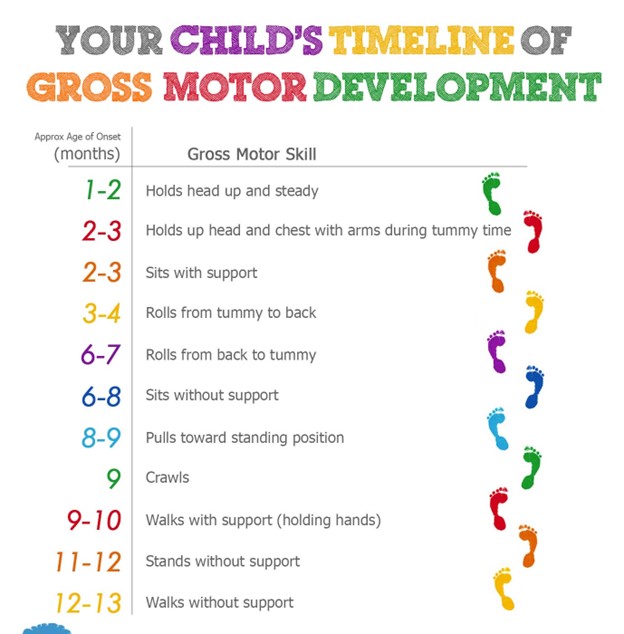
- Lifts head and chest when lying on stomach (around 2-4 months).
- Rolls over from front to back and back to front (around 4-6 months).
- Sits without support (around 6-8 months).
- Crawls or starts to crawl (around 7-10 months).
- Pulls up to stand and may take a few steps (around 9-12 months).
Sensory and Cognitive Development
- Begins to focus on objects and faces, and tracks moving objects.
- Begins to explore objects by mouthing and touching.
- Responds to own name and familiar voices.
- Begins to imitate gestures and sounds.
- Develops separation anxiety around 6-8 months.
Social and Emotional Development
- Forms strong attachments to caregivers.
- Smiles and shows enjoyment during interactions.
- May display stranger anxiety.
- Begins to show signs of basic emotions like joy, anger, and distress.
Early Childhood (1-5 years)
Physical Development
- Slower but steady growth in height and weight.
- Fine motor skills develop, allowing for activities like drawing, building with blocks, and self-feeding.
Motor Development
- Walks, runs, climbs, and balances.
- Throws and catches a ball, kicks with some accuracy.
- Hops and skips.
- Starts to dress and undress with minimal assistance.
Cognitive Development
- Learns basic shapes, colors, and numbers.
- Begins to understand cause-and-effect relationships.
- Engages in imaginative play and storytelling.
- Expands vocabulary and starts forming sentences.
Social and Emotional Development
- Forms friendships and begins to understand sharing and cooperation.
- Develop a sense of self and personal preferences.
- Shows empathy and concern for others.
- Exhibits independence and may test limits.
Middle Childhood (6-12 years)
Physical Development
- Steady growth continues, with a more gradual pace than earlier years.
- Muscle strength and coordination improve, leading to better athletic abilities.
Cognitive Development
- Expands knowledge base, with improved reading, writing, and math skills.
- Begins to think logically and solve problems.
- Shows an interest in more complex concepts and subjects.
Social and Emotional Development
- Forms deeper friendships with peers and may have "best friends."
- Develops a sense of belonging within social groups or teams.
- Begins to understand and follow rules and expectations.
- Shows increasing independence and responsibility.
Adolescence (13-18 years)
Physical Development
- Undergoes rapid growth spurts, particularly during early adolescence.
- Experiences puberty, including physical changes related to sexual development.
Cognitive Development
- Gains more abstract thinking abilities, including critical thinking and long-term planning.
- Develops a more sophisticated understanding of complex concepts.
Social and Emotional Development
- Forms romantic relationships and explores personal identity.
- Seeks greater independence from parents and begins to make more independent decisions.
- Develop a sense of self-esteem and identity.
- Grapples with social pressures, peer influence, and self-image.
Erikson's Stages of Psychosocial Development
Erik Erikson was a renowned psychologist who proposed a theory of psychosocial development, outlining eight stages that individuals go through across their lifespan.
Each stage is characterized by a specific psychosocial conflict or challenges that a person must navigate in order to develop a healthy sense of self.
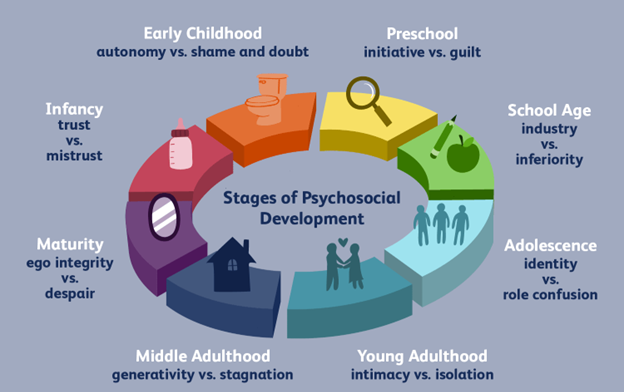
1. Trust vs. Mistrust (Infancy, 0-1 year)
- Conflict: The primary task is to develop a sense of trust in the world and in caregivers.
- Key Factors: Responsive and consistent caregiving helps the infant form a secure attachment, leading to a sense of trust. Inconsistent or neglectful care can lead to mistrust and insecurity.
2. Autonomy vs. Shame and Doubt (Early Childhood, 1-3 years)
- Conflict: The child begins to assert independence and autonomy. The challenge is to balance this newfound independence with boundaries set by caregivers.
- Key Factors: Encouragement of self-expression, exploration, and decision-making fosters a sense of autonomy. Overly controlling or harsh criticism can lead to feelings of shame and doubt.
3. Initiative vs. Guilt (Preschool, 3-6 years)
- Conflict: The child starts to take initiative in play and social interactions. They need to learn to balance their desires with consideration for others.
- Key Factors: Encouraging a child's curiosity, allowing them to explore, and providing opportunities for decision-making helps them develop a sense of purpose and initiative. Over-criticism or excessive control can lead to feelings of guilt and self-doubt.
4. Industry vs. Inferiority (School Age, 6-12 years)
- Conflict: Children begin to develop a sense of competence and mastery over skills and tasks. They need to feel valued and capable of achieving goals.
- Key Factors: Providing opportunities for success, recognizing achievements, and offering positive reinforcement helps build a sense of industry. Excessive criticism or unrealistic expectations can lead to feelings of inadequacy and inferiority.
5. Identity vs. Role Confusion (Adolescence, 12-18 years)
- Conflict: Adolescents are focused on forming a clear sense of self, including their values, beliefs, and aspirations. They navigate questions of identity and purpose.
- Key Factors: Encouraging exploration of personal values, interests, and roles, while providing support and guidance, helps foster a strong sense of identity. Lack of support or pressure to conform can lead to confusion and identity crisis.
6. Intimacy vs. Isolation (Young Adulthood, 18-40 years)
- Conflict: Young adults seek to establish meaningful, close relationships with others. This involves forming deep connections and the ability to commit to others.
- Key Factors: Developing trust and vulnerability in relationships, as well as maintaining a sense of individuality within partnerships, helps establish intimacy. Fear of rejection or excessive self-isolation can lead to feelings of loneliness and isolation.
7. Generativity vs. Stagnation (Middle Adulthood, 40-65 years)
- Conflict: Adults in this stage focus on contributing to society and future generations. They seek to leave a positive impact on the world and nurture the next generation.
- Key Factors: Finding meaningful ways to give back, mentor, and contribute to the community fosters a sense of generativity. A lack of purpose or involvement can lead to feelings of stagnation.
8. Ego Integrity vs. Despair (Late Adulthood, 65+ years)
- Conflict: Older adults reflect on their life and accomplishments. They seek to find a sense of fulfillment and acceptance of their life's journey.
- Key Factors: Coming to terms with life events, finding satisfaction in achievements, and accepting the inevitability of mortality leads to a sense of integrity. Regret and a lack of acceptance can lead to feelings of despair.
Piaget's Stages of Cognitive Development
Jean Piaget was a Swiss psychologist who made significant contributions to our understanding of how children develop cognitively. He proposed a theory of cognitive development that consists of four main stages, each characterized by distinct cognitive abilities and ways of thinking. Here are Piaget's stages of cognitive development:
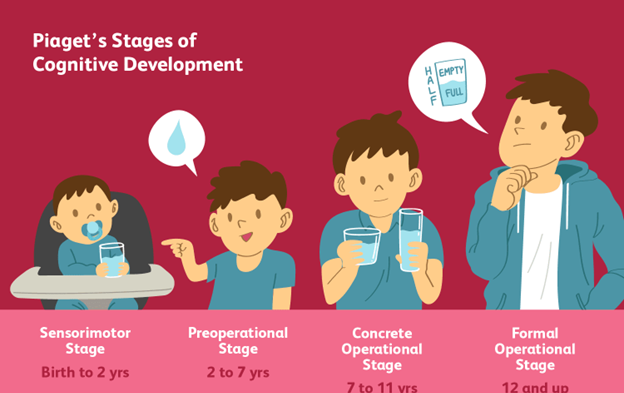
1. Sensorimotor Stage (Birth to 2 years)
Key Characteristics
- Object Permanence: Understanding that objects continue to exist even when they are not directly perceived.
- Stranger Anxiety: Developing a sense of familiarity with primary caregivers and becoming cautious or anxious around strangers.
- Motor Skills Development: Progressing from reflexive, instinctual movements to purposeful, goal-directed actions.
Activities and Milestones
- Engaging in sensory exploration through touching, mouthing, and grasping objects.
- Developing basic problem-solving skills, such as using trial and error to achieve goals.
- Beginning to imitate simple actions and gestures.
2. Preoperational Stage (2 to 7 years)
Key Characteristics
- Egocentrism: Difficulty understanding and considering other people's perspectives.
- Centration: Focusing on one aspect of a situation and ignoring other relevant aspects.
- Symbolic Representation: Ability to mentally represent objects and events through symbols, such as language and imagination.
Activities and Milestones
- Engaging in imaginative play and make-believe.
- Developing language skills and the ability to ask questions.
- Demonstrating an increasing understanding of symbols and concepts.
3. Concrete Operational Stage (7 to 11 years)
Key Characteristics
- Conservation: Understanding that quantity remains the same even when the shape or arrangement changes.
- Reversibility: Grasping that actions can be undone or reversed.
- Logical Thinking: Gaining the ability to think logically about concrete objects and events.
Activities and Milestones
- Demonstrating an understanding of basic arithmetic operations (addition, subtraction, multiplication, division).
- Solving practical problems involving real-world objects and situations.
- Developing a grasp of cause-and-effect relationships.
4. Formal Operational Stage (11 years and beyond)
Key Characteristics
- Abstract Thinking: Ability to think abstractly and reason about hypothetical situations.
- Hypothetical-Deductive Reasoning: Ability to form hypotheses and systematically test them.
- Metacognition: Awareness and understanding of one's own thought processes.
Activities and Milestones
- Engaging in complex problem-solving and critical thinking.
- Developing the ability to think about and plan for the future.
- Demonstrating an increased capacity for understanding and engaging with complex concepts in various academic disciplines.
Nursing Test Bank
Naxlex Comprehensive Predictor Exams
Questions on Developmental Assessment