
naxlex image logo
naxlex image logo
  • Home
  • Nursing School Content
  • TEAS Content
  • How It Works
  • TEAS
  • HESI prep
  • NCLEX
  • Nursing School Exams
  • Naxex Login
  • Get Started
  • Get Started
Discover valuable nursing resources and insights for your success—join our nursing community and access the tools to excel.
Naxlex
Naxlex
Home Nursing School Content TEAS/HESI A2 Content NCLEX Get Started
  • Naxlex Login
  • Blog
    • Medical Surgical
    • Medico-Surgical Procedures
    • Sterile suctioning
    Try Naxlex NCLEX-RN (14-day Free-Trial)

    Sterile suctioning

    - Sterile suctioning is a procedure that involves applying negative pressure to remove secretions from the airway of a patient who has an artificial airway or impaired cough reflex.
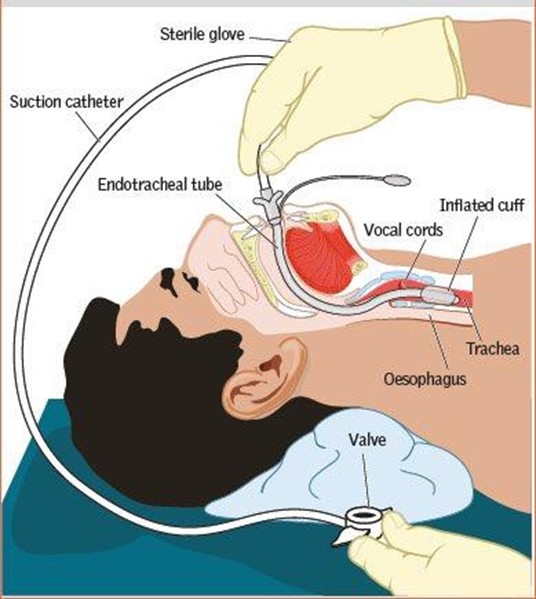
    - The purpose of sterile suctioning is to maintain airway patency, prevent infection, improve gas exchange, and promote comfort.

    - Sterile suctioning is indicated for patients who have excessive or thick secretions that obstruct the airway, or who are unable to clear their own secretions due to decreased level of consciousness, neuromuscular weakness, or respiratory distress.

    - Sterile suctioning is contraindicated for patients who have bleeding disorders, nasal or oral trauma, epiglottitis, croup, or laryngeal edema.

    - Sterile suctioning can cause complications such as hypoxia, hypotension, bradycardia, arrhythmias, bleeding, infection, mucosal damage, bronchospasm, atelectasis, and increased intracranial pressure.

    Nursing Test Bank

    Test Bank #1: RN Pharmacology Exams Test Bank #2: RN Medical-Surgical Exams Test Bank #3: RN Fundamentals Exams Test Bank #4: RN Maternal-Newborn Exams Test Bank #5: RN Anatomy and Physiology Exams Test Bank #6: RN Obstetrics and Pediatrics Exams Test Bank #7: RN Fluid and Electrolytes Exams Test Bank #9: RN Adult Health Test Bank #10: RN Dosage Calculation Test Bank #11: RN Community Health Exams Test Bank #12: RN Psychology Exams Test Bank #13: RN Nursing Care Of Children Test Bank #14: RN Foundations of Nursing Exams

    Naxlex Comprehensive Predictor Exams

    Exam #1: RN Comprehensive predictor 2023 proctored exam Exam #2: Ati rn vati comprehensive predictor proctored exam Exam #3: Ati Rn Comprehensive Predictor Proctored Exam 2023 Exam #4: Rn Comprehensive Predictor 2023 Proctored Exam - St. Joseph Exam #5: RN Comprehensive Predictor Proctored Exam (National U CA San Diego) Exam #6: Ati rn comprehensive predictor 2023 retake proctored exam Exam #7: RN Hesi Exit Proctored Exam Exam #8: Hesi RN Exit proctored exam Exam #9: Hesi rn exit proctored exam Exam #10: Hesi Rn compass exit B proctored exam

    Questions on Sterile suctioning

    Correct Answer is A

    Explanation

    Performing hand hygiene before and after the procedure is vital for infection control, but it is not the most crucial measure to prevent cross-contamination during sterile suctioning. While hand hygiene is essential for reducing the spread of infections, using PPE provides an additional layer of protection during the procedure.

    Correct Answer is A

    Explanation

    (Incorrect) Assessing the patient's response to suctioning is essential, but ensuring safety and repositioning take precedence immediately after the procedure.

    Correct Answer is A

    Explanation

    A catheter with a single opening is not ideal for suctioning thick secretions. It may not provide sufficient suctioning power and could lead to ineffective removal of secretions from the patient's airway.

    Correct Answer is D

    Explanation

    <p>The nurse should respond by acknowledging the discomfort and pausing the procedure to reposition the nasopharyngeal tube. Repositioning can help alleviate the discomfort while ensuring the oxygenation needs are still met.</p>

    Correct Answer is ["A","D","E"]

    Explanation

    Wearing gloves and a mask during suctioning helps protect the nurse from exposure to the patient's bodily fluids and potential infectious agents. Repeat steps 7 to 9 until no more secretions are obtained or until three passes are completed. Do not suction more than three times in a row to prevent complications. Allow at least one minute of rest between each suction pass to prevent fatigue and distress .

    Correct Answer is D

    Explanation

    When suctioning patients with an artificial airway, using disposable plastic catheters is preferred to reduce the risk of infection. Disposable catheters are single-use and discarded after each procedure, minimizing the potential for contamination and cross-infection between patients.

    Correct Answer is ["B","D","E"]

    Explanation

    <p>Rinsing the catheter and tubing with saline after each suction pass helps maintain patency and prevent the accumulation of secretions, ensuring effective suctioning during the procedure.</p>

    Correct Answer is ["A","B","C","D"]

    Explanation

    Glass suctioning catheters are not used for sterile suctioning due to the risk of breakage, which can lead to serious injuries and complications.

    Correct Answer is A

    Explanation

    Using an artificial airway at night, such as a tracheostomy tube, indicates that the patient may require suctioning to maintain airway patency. While having an artificial airway increases the risk of infection and other complications, it is not a contraindication for sterile suctioning if clinically indicated.

    Correct Answer is C

    Explanation

    Sterile suctioning is not performed to monitor vital signs. Although vital signs may be monitored during the procedure, it is not the primary purpose of suctioning.

    Correct Answer is ["B","C","E"]

    Explanation

    Providing encouragement and support to the client throughout the procedure is crucial for their comfort and cooperation. Suctioning can be uncomfortable, and the client may need reassurance during the process.

    Correct Answer is D

    Explanation

    <p>Changing the tracheostomy ties every 24 hours is the appropriate action. Regular changing of the ties helps prevent complications such as skin breakdown, ensures a secure fit of the tracheostomy tube, and reduces the risk of infection.</p>

    <p>Before performing sterile suctioning on a patient with an endotracheal tube (ETT), the nurse should preoxygenate the patient with 100% oxygen. Suctioning can temporarily decrease oxygen levels in the airway, and preoxygenation helps prevent hypoxia during the procedure.</p>

    <p>Increasing the suction pressure for one last pass is not necessary and may cause harm to the patient&#39;s airway. Proper suctioning technique involves limiting the suctioning time and pressure to avoid tissue damage and potential complications.</p>

    Inserting the catheter into the artificial airway using sterile technique is part of the procedure but should be preceded by wearing proper PPE to maintain a sterile environment.

    (Incorrect) Advising the patient to take slow deep breaths to increase oxygen levels may not be sufficient to address the oxygen saturation drop, which requires immediate intervention.

    <p>Preoxygenating the patient with 100% oxygen is not a step required before suctioning. Preoxygenation may be necessary before some procedures, but it is not specifically indicated for sterile suctioning.</p>

    <p>Suctioning more than three times in a row is not recommended because it can lead to hypoxia and tissue trauma. Frequent suctioning can reduce the oxygen levels in the airway and cause damage to the delicate tissues.<strong> </strong></p>

    Feeling lightheaded may be a common sensation during and after suctioning due to the stimulation of the gag reflex, but it does not necessarily contraindicate the procedure. It is essential to ensure adequate oxygenation and provide proper support during the procedure to minimize this discomfort.

    <p>Increasing the suction pass time is not recommended as it can exacerbate the patient&#39;s condition and lead to complications. The focus should be on stopping suctioning and providing appropriate interventions.</p>

    <p>Providing oral or nasal care after suctioning helps maintain the patient&#39;s airway, promote comfort, and prevent infections.</p>

    <p>Limiting the suctioning time to 5 seconds is too short to effectively clear secretions from the airway, especially in patients with excessive or tenacious secretions. Sufficient time is needed to ensure proper removal of respiratory secretions and maintain the patient&#39;s airway patency.</p>

    (Incorrect) Promising to suction quickly may not address the client's worry and might compromise the effectiveness of the procedure, as thorough suctioning is necessary.

    <p>Dismissing the patient&#39;s anxiety by stating that suctioning is routine may not effectively address the patient&#39;s feelings and may not be comforting.<br /> </p>
    Try Naxlex NCLEX-RN
    (14 Day Free-Trial)

    Search Here

    More on Nursing

    • Immunological System
    • Blood and Cardiovascular Disorders
    • Genito-Urinary System Disorders
    • Digestive System Disorders
    • Perioperative Nursing
    • Endocrine Systems
    • Communicable Diseases
    • Introduction
    • Musculoskeletal System

    Free Nursing Study Materials

    Access to all study guides and practice questions for nursing for free.

    • Free Nursing Study Trials
    • Free Nursing Video tutorials
    • Free Nursing Practice Tests
    • Free Exam and Study Modes
    • Free Nursing Revision Quizlets
    Join Us Today
    naxlex-logo-footer

    Designed to assess a student's preparedness for entering the health science fields.

    Email Address: [email protected]

    Study Resources

    • Naxlex Login
    • TEAS 7 Practice Tests
    • HESI A2 Prep
    • Nursing Test Banks
    • NCLEX Practice Questions

    Company

    • Pricing
    • Refund Policy
    • Terms And Conditions
    • Privacy Policy
    • Delivery Policy
    • Consumer and Data Privacy Policy

    © 2026 Naxlex.com