
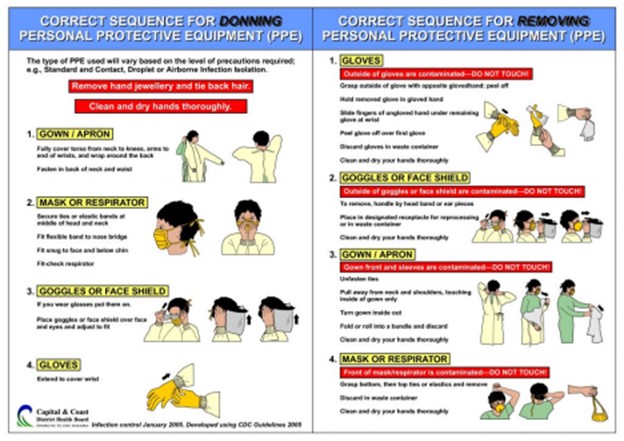
A nurse is caring for a client who is in contact isolation. When exiting the client's room, in what order should the nurse take the following steps when removing her personal protective equipment? (Move the nursing actions into the box on the right, placing them in the selected order of performance. All steps must be used.)
Remove gloves.
Remove protective eyewear.
Remove gown.
Remove mask
Perform hand hygiene.
The Correct Answer is A,B,C,D,E
When removing personal protective equipment (PPE) after caring for a client in contact isolation, the nurse should follow the steps in the following order:
1. Remove gloves.
2. Remove protective eyewear.
3. Remove gown.
4. Remove mask.
5. Perform hand hygiene.
By following this sequence, the nurse ensures that the removal of PPE is done in a way that minimizes the risk of contamination. Removing gloves first helps prevent the spread of potential contaminants on the hands. Removing protective eyewear next avoids any potential contact with the face or eyes during the removal process. Removing the gown comes next, followed by the mask. Lastly, performing hand hygiene after removing all PPE helps ensure the hands are thoroughly cleaned.
Nursing Test Bank
Naxlex Comprehensive Predictor Exams
Related Questions
Correct Answer is C,A,D,E,B
Explanation
To pour the sterile solution onto a piece of gauze, the nurse should perform the steps in the following order:
1. Pick up the bottle with the label facing his palm.
2. Remove the bottle cap.
3. Pour 1 to 2 mL into a receptacle.
4. Pour the solution onto the gauze.
5. Place the bottle cap inside up on a clean surface.
It is important to maintain sterility throughout the procedure to prevent contamination. By following this order, the nurse ensures that the solution is poured onto the gauze while minimizing the risk of contamination. Placing the bottle cap inside up on a clean surface after removing it helps maintain the sterility of the cap as well.
Correct Answer is ["A","D"]
Explanation
From the given statements, the nurse can identify the following statements as indicating the effectiveness of cimetidine treatment:
"I don't have as much heartburn after I eat anymore.": Cimetidine is a histamine-2 receptor antagonist commonly used to reduce stomach acid production. Decreased heartburn after eating suggests that the medication has been effective in reducing excessive acid production and relieving heartburn symptoms.
"I can sleep while lying flat again.": Cimetidine can help alleviate symptoms of gastroesophageal reflux disease (GERD) by reducing stomach acid. Improved ability to sleep while lying flat suggests that the medication has successfully reduced acid reflux and related symptoms.
The following statements do not directly indicate the effectiveness of cimetidine treatment: ● "I noticed that I have had less urge to smoke lately."
● "I occasionally have stomach pain and dark stools."
● "I have not been as dizzy as I was before."
These statements may be unrelated to the effects of cimetidine or may require further assessment to determine their significance. It's important for the nurse to address any concerns or symptoms mentioned by the client and evaluate their overall response to the medication
Whether you are a student looking to ace your exams or a practicing nurse seeking to enhance your expertise , our nursing education contents will empower you with the confidence and competence to make a difference in the lives of patients and become a respected leader in the healthcare field.
Visit Naxlex, invest in your future and unlock endless possibilities with our unparalleled nursing education contents today