
A nurse is planning care for a client who is pregnant and has HIV.
Which of the following actions should the nurse include in the plan of care?
Use a fetal scalp electrode during labor and delivery.
Bathe the newborn before initiating skin-to-skin contact.
Instruct the client to stop taking the antiretroviral medications at 32 weeks of gestation.
Administer a pneumococcal immunization to the newborn within 4 hours
The Correct Answer is B

Bathing the newborn before initiating skin-to-skin contact is an action that the nurse should include in the plan of care for a client who is pregnant and has HIV.
Choice A is incorrect because using a fetal scalp electrode during labor and delivery is not mentioned as an action that should be included in the plan of care for a client who is pregnant and has HIV in my sources.
Choice C is incorrect because instructing the client to stop taking antiretroviral medications at 32 weeks of gestation is not mentioned as an action that should be included in the plan of care for a client who is pregnant and has HIV in my sources.
Choice D is incorrect because administering a pneumococcal immunization to the newborn within 4 hours following birth is not mentioned as an action that should be included in the plan of care for a client who is pregnant and has HIV in my sources.
Nursing Test Bank
Naxlex Comprehensive Predictor Exams
Related Questions
Correct Answer is B
Explanation
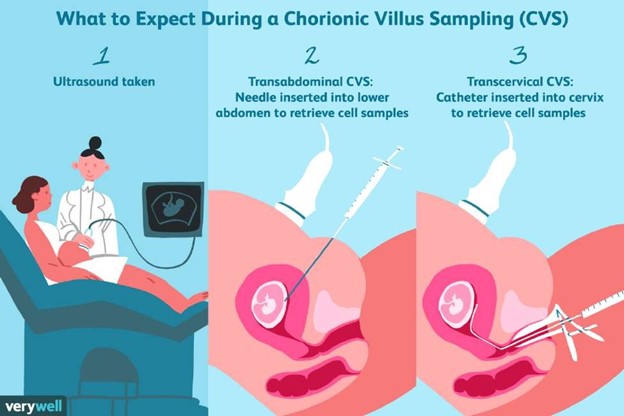
Chorionic villus sampling (CVS) is a prenatal test that involves taking a sample of tissue from the placenta to test for chromosomal abnormalities and certain other genetic problems.
As with all types of surgical procedures, infections can happen during or after CVS2.
Choice A is incorrect because anemia is not a known complication of CVS.
Choice C is incorrect because late decelerations are a type of fetal heart rate patern that can occur during labor and are not related to CVS.
Choice D is incorrect because placental insufficiency is a condition where the placenta is unable to provide enough oxygen and nutrients to the fetus and is not a known complication of CVS.
Correct Answer is B
Explanation
The nurse should demonstrate how to hold the newborn and allow the client to
practice.
This will help the mother learn how to properly hold her baby and feel more confident in her ability to care for her newborn.

Choice A is not the best answer because insisting that the mother pick up the
newborn to feed him may make her feel uncomfortable or pressured.
Choice C is not the best answer because persuading the client to breastfeed the newborn to promote bonding may not be appropriate if the mother has chosen to botle-feed her baby.
Choice D is not the best answer because offering to take the newborn to the nursery to finish his feeding may not address the mother’s concerns about holding her baby.
Whether you are a student looking to ace your exams or a practicing nurse seeking to enhance your expertise , our nursing education contents will empower you with the confidence and competence to make a difference in the lives of patients and become a respected leader in the healthcare field.
Visit Naxlex, invest in your future and unlock endless possibilities with our unparalleled nursing education contents today