
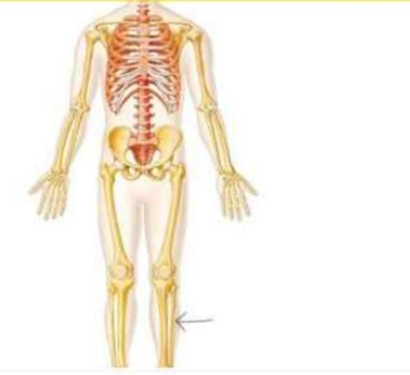
Identify the labelled structure
Tibia
Fibula
Patella
Femur
The Correct Answer is B
The marked structure is the fibula, one of the two bones of the lower leg located laterally to the tibia. It is a slender, non–weight-bearing long bone that runs parallel to the tibia and contributes to ankle stability. The fibula provides attachment for muscles involved in foot and ankle movement and forms part of the lateral malleolus at the ankle joint, which stabilizes the foot during ambulation.
A. Tibia: The tibia is the larger, medial weight-bearing bone of the lower leg. It forms the primary structural support for the body’s weight and articulates with the femur at the knee and the talus at the ankle. Compared to the fibula, it is thicker, stronger, and located medially, making it the main load-bearing bone rather than a stabilizing lateral bone.
B. Fibula: The fibula is the thin, lateral bone of the lower leg that runs parallel to the tibia. It does not bear significant body weight but provides important muscle attachment sites and forms the lateral malleolus of the ankle. This structure is essential for ankle stability and balance. Since the marked bone is slender and lateral, it corresponds to the fibula.
C. Patella: The patella is a sesamoid bone located within the tendon of the quadriceps femoris muscle at the anterior knee. It functions to improve leverage during knee extension and protects the knee joint from trauma. Unlike the fibula, it is not a long bone of the leg shaft but a small triangular bone situated in front of the knee joint.
D. Femur: The femur is the longest and strongest bone in the body, located in the thigh region between the hip and knee joints. It is a major weight-bearing bone involved in locomotion and muscle attachment for powerful lower limb movements. Compared to the fibula, it is much larger and located proximally in the thigh rather than the lower leg.
Nursing Test Bank
Naxlex Comprehensive Predictor Exams
Related Questions
Correct Answer is B
Explanation
The highlighted bones belong to the axial skeleton, which forms the central framework of the body. The axial skeleton includes the skull, vertebral column, and thoracic cage (ribs and sternum). Its primary function is to support and protect vital organs such as the brain, spinal cord, heart, and lungs. It also provides structural alignment for posture and serves as an attachment point for muscles involved in respiration and head/trunk movement.
A. Appendicular skeleton: The appendicular skeleton consists of the bones of the upper and lower limbs, including the shoulder girdle (clavicle and scapula) and pelvic girdle. Its main function is movement and locomotion rather than central support. Unlike the axial skeleton, it does not include the skull, vertebral column, or rib cage. Therefore, it does not correspond to the highlighted central bones.
B. Axial skeleton: The axial skeleton includes the skull, vertebral column, ribs, and sternum, forming the central axis of the body. It provides protection for critical organs such as the brain, heart, and lungs, and maintains posture and structural support. It also serves as the attachment site for muscles involved in respiration and head movement. Since the highlighted bones are part of this central framework, they belong to the axial skeleton.
C. Irregular skeleton: “Irregular skeleton” is not a recognized classification of the skeletal system. While irregular bones exist anatomically (such as vertebrae), they are individual bone shapes rather than a skeletal division. This option confuses bone shape classification with skeletal system organization. Therefore, it does not apply to the overall grouping of the highlighted bones.
D. Long bone group: The long bone group refers to bones that are longer than they are wide, such as the femur, humerus, tibia, and radius. These bones primarily function in movement and act as levers for muscle action. Unlike the axial skeleton, this is a shape-based classification rather than a structural division of the body.
Correct Answer is C
Explanation
The marked structure is the radius, one of the two long bones of the forearm located on the lateral side (thumb side). It articulates with the humerus at the elbow and with the carpal bones at the wrist, enabling forearm rotation movements such as pronation and supination. The radius works alongside the ulna to provide stability and mobility of the forearm and hand.
A. Humerus: The humerus is the long bone of the upper arm extending from the shoulder to the elbow joint. It serves as the primary structural bone of the upper limb and articulates with both the radius and ulna at the elbow. Compared to the radius, it is more proximal and located in the arm rather than the forearm.
B. Carpals: The carpals are a group of eight small bones forming the wrist joint between the forearm and the hand. They allow flexibility and fine movements of the wrist but do not extend along the forearm shaft. Unlike the radius, they are distal structures located at the wrist rather than a long forearm bone.
C. Radius: The radius is a long bone located on the lateral side of the forearm (thumb side). Proximally, it articulates with the capitulum of the humerus at the elbow, and distally it connects with the carpal bones at the wrist. It rotates around the ulna during pronation and supination, enabling rotational hand movements. This makes it essential for functional tasks such as turning a doorknob, writing, and lifting objects.
D. Ulna: The ulna is the medial forearm bone located on the little finger side. It forms the main hinge joint with the humerus at the elbow, providing stability during flexion and extension. Compared to the radius, it is more medial and less involved in wrist articulation and rotational movement.
Whether you are a student looking to ace your exams or a practicing nurse seeking to enhance your expertise , our nursing education contents will empower you with the confidence and competence to make a difference in the lives of patients and become a respected leader in the healthcare field.
Visit Naxlex, invest in your future and unlock endless possibilities with our unparalleled nursing education contents today