
An athlete comes into the hospital saying he was informed by the athletic trainer that he broke a bone in his appendicular skeleton.
Which of the following bones could he have broken?
Mandible.
Radius.
Sternum.
Sacrum.
The Correct Answer is B
The radius is a part of the upper limb, which is supported by the pectoral girdle.
The pectoral girdle and the pelvic girdle, along with the bones of the limbs, form the appendicular skeleton.
Choice A is incorrect because the mandible is a part of the skull, which forms the axial skeleton.
Choice C is incorrect because the sternum is a part of the thorax, which forms the axial skeleton.
Choice D is incorrect because the sacrum is a part of the vertebral column, which forms the axial skeleton.
Nursing Test Bank
Naxlex Comprehensive Predictor Exams
Related Questions
Correct Answer is D
Explanation
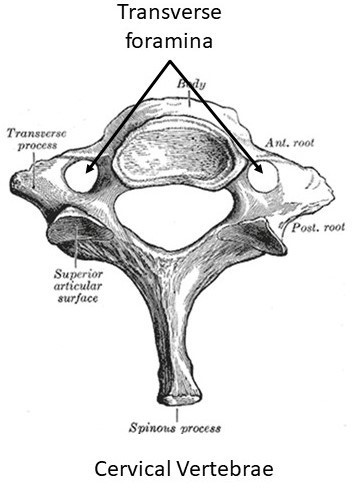
The transverse foramina are openings in the transverse processes of the cervical vertebrae that allow the passage of the vertebral arteries and veins.
They are not found on any other vertebrae.
Choice A is incorrect because spinous processes are bony projections on the posterior aspect of all vertebrae that serve as attachment sites for muscles and ligaments.
Choice B is incorrect because transverse processes are lateral projections on all vertebrae that serve as attachment sites for muscles and ribs.
Choice C is incorrect because costal facets are articular surfaces on the thoracic vertebrae that articulate with the heads of the ribs.
They are found on all thoracic vertebrae except T11 and T123.
Correct Answer is ["Radial flexion of the wrist"]
Explanation
Radial flexion of the wrist, also known as radial deviation, refers to the movement of the wrist towards the radial (thumb) side of the forearm.
This movement is achieved by the contraction of muscles on the lateral (thumb) side of the forearm.
The joint involved in radial flexion of the wrist is the radiocarpal joint, which is a condyloid joint formed by the articulation between the distal end of the radius bone and the carpal bones of the wrist.
This joint allows for a range of movements, including:
1. Ulnar flexion of the wrist: This refers to the movement of the wrist towards the ulnar (little finger) side of the forearm, which is achieved by the contraction of muscles on the medial (little finger) side of the forearm.
2. Extension of the wrist: This refers to the movement of the wrist backward, away from the palm of the hand.
This movement is achieved by the contraction of muscles on the back of the forearm.
3. Flexion of the wrist: This refers to the movement of the wrist forwards, towards the palm of the hand.
This movement is achieved by the contraction of muscles on the front of the forearm.
4. Adduction of the wrist: This refers to the movement of the wrist towards the midline of the body, which is achieved by the contraction of muscles on the medial (little finger) side of the forearm.
5. Abduction of the wrist: This refers to the movement of the wrist away from the midline of the body, towards the radial (thumb) side of the forearm, which is achieved by the contraction of muscles on the lateral (thumb) side of the forearm.
All of these movements of the radiocarpal joint are important for fine motor skills, such as writing, typing, and playing musical instruments, as well as for everyday activities such as lifting and carrying objects.
Whether you are a student looking to ace your exams or a practicing nurse seeking to enhance your expertise , our nursing education contents will empower you with the confidence and competence to make a difference in the lives of patients and become a respected leader in the healthcare field.
Visit Naxlex, invest in your future and unlock endless possibilities with our unparalleled nursing education contents today