
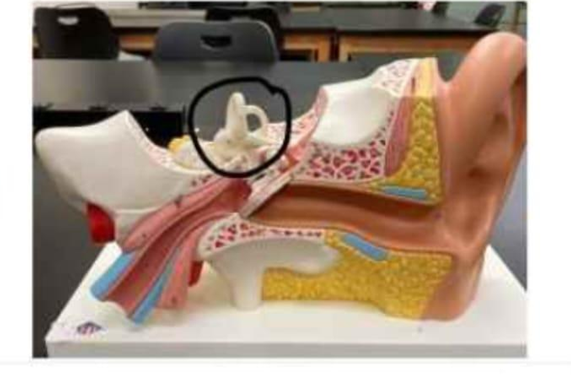
Identify the structure that is circled in the image below. Include the full name.
Vestibule
Cochlea
Semicircular canals
Auditory ossicles
The Correct Answer is C
The marked structure is the semicircular canals, which are three looped tubular structures (anterior, posterior, and lateral) located in the inner ear within the bony labyrinth of the temporal bone. They are oriented in three perpendicular planes, allowing detection of rotational movements of the head. The semicircular canals are filled with endolymph and contain the crista ampullaris within the ampullae, which houses hair cells responsible for sensing angular acceleration. This system is a key component of the vestibular apparatus involved in balance and spatial orientation.
A. Vestibule: The vestibule is the central part of the bony labyrinth of the inner ear, located between the cochlea and semicircular canals. It contains the utricle and saccule, which detect linear acceleration and head position relative to gravity. While it is part of the balance system, it is a single central chamber rather than looped structures. Unlike the semicircular canals, it does not detect rotational (angular) movement.
B. Cochlea: The cochlea is a spiral-shaped structure of the inner ear responsible for hearing. It contains the organ of Corti, where mechanical sound vibrations are converted into electrical signals. It is snail-shaped and involved in auditory transduction rather than balance. Compared to the semicircular canals, it is coiled rather than looped.
C. Semicircular canals: The semicircular canals are three looped structures oriented in perpendicular planes: anterior, posterior, and lateral. They detect angular or rotational movements of the head by sensing fluid displacement (endolymph) that bends hair cells in the crista ampullaris. This triggers vestibular nerve signals that help maintain balance and posture. Since the circled structure is looped and associated with equilibrium control, it corresponds to the semicircular canals.
D. Auditory ossicles: The auditory ossicles (malleus, incus, and stapes) are three small bones located in the middle ear. They transmit sound vibrations from the tympanic membrane to the oval window of the cochlea. They are involved in hearing amplification, not balance. Unlike the semicircular canals, they are solid bones in the middle ear rather than fluid-filled inner ear structures.
Nursing Test Bank
Naxlex Comprehensive Predictor Exams
Related Questions
Correct Answer is B
Explanation
The marked structure is the clavicle, also known as the collarbone, which is a long, S-shaped bone located at the anterior base of the neck. It connects the sternum medially to the scapula laterally, forming part of the shoulder girdle. The clavicle serves as a structural strut that stabilizes the upper limb and allows free movement away from the trunk while protecting neurovascular structures beneath it.
A. Scapula: The scapula is a flat, triangular bone located on the posterior aspect of the thoracic cage, commonly referred to as the shoulder blade. It provides attachment for multiple muscles that control shoulder and arm movement, including the rotator cuff muscles. Unlike the clavicle, it is positioned on the back of the body and does not form a direct bony link to the sternum.
B. Clavicle: The clavicle is an S-shaped long bone that acts as a strut between the sternum and scapula. It stabilizes shoulder positioning and allows the upper limb to maintain a wide range of motion away from the trunk. It is the only long bone that lies horizontally in the body. Since the marked structure is anterior and connecting the shoulder girdle to the axial skeleton, the clavicle is correct.
C. Sternum: The sternum is a flat midline bone located in the anterior thorax, consisting of the manubrium, body, and xiphoid process. It serves as an attachment site for the ribs and protects vital thoracic organs such as the heart and great vessels. Unlike the clavicle, it is centrally located and does not extend laterally toward the shoulder.
D. Humerus: The humerus is the long bone of the upper arm extending from the shoulder to the elbow. It forms the major structural component of the arm and articulates with the scapula at the shoulder joint. However, it does not form the shoulder girdle connection to the sternum, making it distinct from the clavicle.
Correct Answer is A
Explanation
Neural communication in the nervous system involves complex synaptic arrangements that allow integration and processing of information. One important organizational pattern is convergence, which enables multiple incoming signals to influence a single postsynaptic neuron. This arrangement is essential for integrating sensory input, coordinating motor responses, and refining neural processing. It allows the central nervous system to combine information from different sources into a unified output.
A. Axons from neurons in different parts of the nervous system contact the same neuron: convergence refers to multiple presynaptic neurons sending signals via their axons to a single postsynaptic neuron. This allows integration of information from various sources before a response is generated. It is a key mechanism in sensory processing, such as when multiple sensory inputs influence a single motor response. Convergence enhances the nervous system’s ability to interpret complex stimuli.
B. Dendrites from neurons in different parts of the nervous system contact the same neuron: dendrites are receptive structures on the postsynaptic neuron, not structures that originate from different neurons to form connections. While dendrites receive incoming signals, convergence specifically refers to multiple axons synapsing onto one neuron. This misidentifies the anatomical structures involved in synaptic integration.
C. One neuron sends impulses to multiple target neurons: This option describes divergence, not convergence. Divergence occurs when a single presynaptic neuron branches and transmits signals to multiple postsynaptic neurons, allowing one signal to influence multiple pathways. This mechanism amplifies and distributes information rather than integrating it.
D. Sensory impulses are amplified in a single synapse: convergence is not defined by amplification of signals at a single synapse. Synaptic strength may vary, but convergence specifically refers to multiple presynaptic inputs onto one postsynaptic neuron. Amplification can occur in neural pathways, but it is not the defining feature of convergence.
Whether you are a student looking to ace your exams or a practicing nurse seeking to enhance your expertise , our nursing education contents will empower you with the confidence and competence to make a difference in the lives of patients and become a respected leader in the healthcare field.
Visit Naxlex, invest in your future and unlock endless possibilities with our unparalleled nursing education contents today