
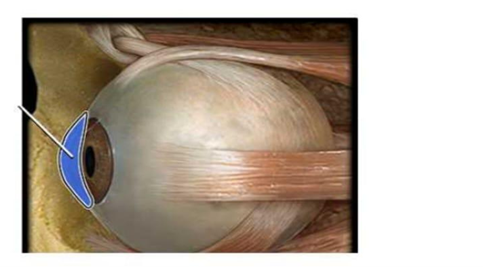
Identify the part of the eye indicated by the arrow in the image below.
Iris
Lens
Retina
Cornea
The Correct Answer is D
The marked structure is the cornea, the transparent, avascular anterior surface of the eye that forms the outermost layer of the eyeball. It is continuous with the sclera and acts as the eye’s primary refractive surface, contributing the majority of the eye’s focusing power. The cornea allows light to enter the eye while bending (refracting) it toward the lens and retina for image formation. It also serves as a protective barrier against mechanical injury, pathogens, and environmental exposure.
A. Iris: The iris is the colored, circular structure behind the cornea that controls pupil size and regulates the amount of light entering the eye. It contains smooth muscles (sphincter and dilator pupillae) that adjust pupil diameter in response to light intensity. Unlike the cornea, it is pigmented and not transparent, and it functions primarily in light regulation rather than refraction.
B. Lens: The lens is a transparent, biconvex structure located posterior to the iris. It fine-tunes focusing of light onto the retina through accommodation, changing shape via the ciliary muscles. While it contributes to refraction, it is deeper within the eye and not the outermost transparent surface, distinguishing it from the cornea.
C. Retina: The retina is the innermost neural layer of the eye lining the posterior globe. It contains photoreceptor cells (rods and cones) that convert light into electrical signals transmitted via the optic nerve to the brain. Unlike the cornea, it does not refract light but instead performs sensory transduction at the back of the eye.
D. Cornea: The cornea is the clear, dome-shaped anterior surface of the eye composed of stratified epithelium, stroma, and endothelium. It provides approximately two-thirds of the eye’s refractive power by bending incoming light toward the lens and retina. It is highly innervated for protective reflexes like blinking but lacks blood vessels to maintain transparency. Its external position and optical function make it the correct answer.
Nursing Test Bank
Naxlex Comprehensive Predictor Exams
Related Questions
Correct Answer is A
Explanation
The pH scale measures how acidic or basic a substance is, ranging from 0 to 14. Substances with a pH below 7 are classified as acids because they release hydrogen ions (H⁺) in solution. Acids are commonly found in many foods and biological fluids and play important roles in digestion, metabolism, and chemical reactions. In contrast, substances with a pH above 7 are bases (alkaline) and typically neutralize acids. Understanding pH classification is essential for distinguishing physiological and chemical properties of common substances.
A. Vinegar, grapes, tomatoes, and coffee: all listed substances have a pH below 7, indicating acidic properties. Vinegar (pH 2.2) contains acetic acid, grapes (pH 3.5–4.5) contain natural organic acids, tomatoes (pH 4.0–4.5) contain citric and malic acids, and coffee (pH 5.0) contains weak organic acids. These substances release hydrogen ions in solution, which is the defining characteristic of acids. Therefore, all items in this group fall within the acidic range.
B. Bleach, milk of magnesia, baking soda, and egg whites: all listed substances are basic (alkaline), not acidic. Bleach (pH 12.8) is a strong base, milk of magnesia (pH 10.6) is an antacid, baking soda (pH 8.3) is a weak base, and egg whites (pH 7.6–8.0) are slightly alkaline. These substances accept hydrogen ions rather than release them.
C. Baking soda, butter, white bread, and egg whites: This option includes a mix of neutral to basic substances. Baking soda is basic, butter is slightly acidic to near-neutral (pH 6.1–6.4), white bread is mildly acidic (pH 5.0–6.0), and egg whites are alkaline. Since not all items fall below pH 7, this group does not exclusively represent acids.
D. Battery acid, bleach, vinegar, and milk of magnesia: This option contains both strong acids and strong bases. Battery acid (pH 1.0) and vinegar (pH 2.2) are acidic, but bleach (pH 12.8) and milk of magnesia (pH 10.6) are strongly basic. A correct answer must include only acids, but this group is chemically mixed.
Correct Answer is D
Explanation
The marked structure is the lens, a transparent, biconvex, avascular structure located posterior to the iris and anterior to the vitreous body. It is suspended by zonular fibers (suspensory ligaments) attached to the ciliary body. The lens plays a critical role in vision by providing fine focusing of light onto the retina through the process of accommodation. Its curvature changes depending on whether the eye is focusing on near or distant objects, allowing precise image formation.
A. Cornea: The cornea is the transparent, dome-shaped anterior surface of the eye that provides most of the eye’s refractive power. It is the first structure that light passes through and contributes significantly to bending light toward the retina. Unlike the lens, it is external, fixed in shape, and continuous with the sclera, serving both protective and optical roles.
B. Retina: The retina is the innermost neural layer lining the posterior aspect of the eye. It contains photoreceptor cells (rods and cones) that convert light into electrical signals sent via the optic nerve to the brain. Unlike the lens, it does not focus light but instead processes visual information after image formation occurs.
C. Iris: The iris is the pigmented muscular structure located anterior to the lens and posterior to the cornea. It regulates pupil size to control the amount of light entering the eye through contraction and relaxation of its smooth muscles. Unlike the lens, it does not contribute to focusing light but only regulates light entry.
D. Lens: The lens is a transparent, flexible, biconvex structure located directly behind the iris. It fine-tunes the focusing of light rays onto the retina through accommodation, changing its curvature via the ciliary muscles. It plays a key role in sharp image formation at varying distances. Its central posterior position relative to the iris makes it the correct structure.
Whether you are a student looking to ace your exams or a practicing nurse seeking to enhance your expertise , our nursing education contents will empower you with the confidence and competence to make a difference in the lives of patients and become a respected leader in the healthcare field.
Visit Naxlex, invest in your future and unlock endless possibilities with our unparalleled nursing education contents today