
The nurse assesses a client's fingernails as seen in the photo. How should the nurse document the findings?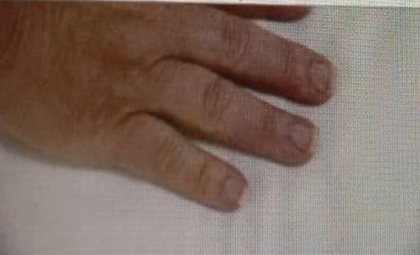
Fingernail pitting present.
Nail care needed.
Capillary refill less than 3 seconds.
Nailbeds pink.
The Correct Answer is D
Rationale:
A. Fingernail pitting present: Fingernail pitting appears as small depressions or pits on the nail surface, often seen in psoriasis. The client's nails in the photo are smooth and intact, showing no signs of pitting, so this option is not accurate.
B. Nail care needed: Nail care would be documented if there were overgrown, broken, dirty, or neglected nails. The nails shown are clean and neatly maintained, meaning nail care is not an immediate need for this client.
C. Capillary refill less than 3 seconds: Capillary refill time measures circulation but is not assessed just by observing nail color. It requires pressing the nail and timing how quickly color returns, which is not part of this static assessment.
D. Nailbeds pink: Pink nailbeds indicate good peripheral circulation and oxygenation. In the photo, the client's nailbeds are visibly pink without cyanosis, discoloration, or pallor, making this the correct documentation of the findings.
Nursing Test Bank
Naxlex Comprehensive Predictor Exams
Related Questions
Correct Answer is D
Explanation
Rationale:
A. Excess vellus hair: Vellus hair is fine, short, unpigmented hair that covers most of the body. It is not related to hair dye use and would not be a typical finding when assessing the scalp hair of someone who frequently dyes their hair.
B. Receding front hairline: A receding hairline is usually related to hormonal changes, aging, or genetic predisposition rather than the direct effects of frequent hair dyeing. Hair dye may damage hair texture, but it does not typically cause patterned hair loss at the hairline.
C. Fine, thin, limp texture: Fine and limp hair is often linked to factors like genetics, aging, or nutritional deficiencies. While hair dye can weaken hair, the more expected result from repeated chemical exposure is a coarse, dry, and brittle texture rather than a limp appearance.
D. Coarse, dry, brittle texture: Frequent chemical dyeing damages the hair cuticle, leading to dryness, roughness, and increased fragility. Palpating the client's scalp would likely reveal hair that feels coarse and brittle, consistent with the effects of long-term chemical processing.
Correct Answer is B
Explanation
Rationale:
A. Assist the client to stand at the bedside long enough to observe posture: Assisting the client to stand would violate the bedrest order, which is in place to prevent complications such as increased intracranial pressure or falls following a CVA. Standing could pose unnecessary risks and is not appropriate when safer alternatives are available.
B. Observe the client's ability to sit upright or unassisted while in the bed: Evaluating posture can still be done safely within the constraints of bedrest by assessing how well the client can maintain an upright seated position. This allows the nurse to assess muscle tone, balance, and neurological function without compromising safety.
C. Document that posture could not be evaluated due to prescribed bedrest: Bedrest limits standing or walking, but it does not prevent all forms of posture evaluation. The nurse still has a responsibility to assess posture in ways that align with safety protocols and should not omit this part of the neurological assessment.
D. Ask the client to describe normal posture while walking and standing: Relying on the client's verbal report does not replace direct observation. Objective assessment is necessary for accurate neurological evaluation, especially in post-CVA clients where deficits in muscle control and balance may not be fully recognized by the client.
Whether you are a student looking to ace your exams or a practicing nurse seeking to enhance your expertise , our nursing education contents will empower you with the confidence and competence to make a difference in the lives of patients and become a respected leader in the healthcare field.
Visit Naxlex, invest in your future and unlock endless possibilities with our unparalleled nursing education contents today