
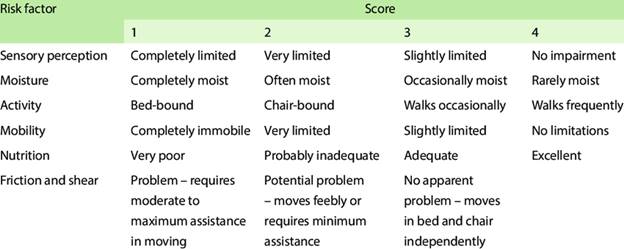
The nurse is completing a skin risk assessment using the Braden Scale. The patient has slight sensory impairment, has skin that is rarely moist, walks occasionally, and has slightly limited mobility, along with excellent intake of meals and no apparent problem with friction and shearing. Which score will the nurse document for this patient?
23
15
17
20
The Correct Answer is D
- Sensory perception: Slightly limited (score of 3)
- Moisture: Rarely moist (score of 4)
- Activity: Walks occasionally (score of 3)
- Mobility: Slightly limited (score of 3)
- Nutrition: Excellent intake (score of 4)
- Friction and shear: No apparent problem (score of 3)
Adding these scores together: 3 + 4 + 3 + 3 + 4 + 3 = 20
Therefore, the nurse should document a score of 20 for this patient.
Nursing Test Bank
Naxlex Comprehensive Predictor Exams
Related Questions
Correct Answer is A
Explanation
A. Left-sided heart failure: Left-sided heart failure causes pulmonary congestion leading to crackles, orthopnea (difficulty breathing while lying flat), and paroxysmal nocturnal dyspnea (waking up gasping for air).
B. Myocardial ischemia: Myocardial ischemia causes chest pain, shortness of breath, and fatigue, but it does not cause crackles in the lungs or fluid overload symptoms.
C. Right-sided heart failure: Right-sided heart failure results in systemic congestion (peripheral edema, weight gain, and jugular vein distention), not pulmonary symptoms like crackles.
D. Atrial fibrillation: Atrial fibrillation causes irregular heartbeats, palpitations, and fatigue, but it is not the primary cause of crackles or orthopnea.
Correct Answer is ["A","B","D","E"]
Explanation
A. Rectal: The rectal route provides a reliable measure of core body temperature because of its proximity to major blood vessels.
B. Urinary Bladder: A temperature-sensing urinary catheter can provide continuous monitoring of core temperature, especially in critical care settings.
C. Temporal Artery: While temporal artery thermometers are non-invasive and commonly used, they measure skin temperature, which is not a true core temperature.
D. Esophagus: Esophageal temperature monitoring is used in intubated patients and cardiac surgery patients to measure core temperature accurately.
E. Pulmonary Artery: A pulmonary artery catheter (Swan-Ganz catheter) directly measures blood temperature from the heart, making it the most accurate core temperature measurement.
Whether you are a student looking to ace your exams or a practicing nurse seeking to enhance your expertise , our nursing education contents will empower you with the confidence and competence to make a difference in the lives of patients and become a respected leader in the healthcare field.
Visit Naxlex, invest in your future and unlock endless possibilities with our unparalleled nursing education contents today