
The nurse observes some children in the playroom.
Which play situation exhibits the characteristics of parallel play?
Kimberly and Amanda sharing clay to each make things
Brian playing with his truck next to Kristina playing with her truck.
Adam playing a board game with Kyle, Steven, and Erich
Danielle playing with a music box on her mother’s lap
Danielle playing with a music box on her mother’s lap.
The Correct Answer is B
Brian playing with his truck next to Kristina playing with her truck. This is because parallel play is when children play side by side with similar toys but do not interact with each other. Parallel play is typical for toddlers and preschoolers.
Choice A is wrong because Kimberly and Amanda sharing clay to each make things is an example of cooperative play, which involves sharing, taking turns, and following
rules. Cooperative play is typical for school-age children.
Choice C is wrong because Adam playing a board game with Kyle, Steven, and Erich is also an example of cooperative play, as they are playing by the same rules and interacting with each other.
Choice D is wrong because Danielle playing with a music box on her mother’s lap is an example of solitary play, which is when a child plays alone and does not seek contact with others. Solitary play is typical for infants.
Nursing Test Bank
Naxlex Comprehensive Predictor Exams
Related Questions
Correct Answer is ["A","B","C","D"]
Explanation
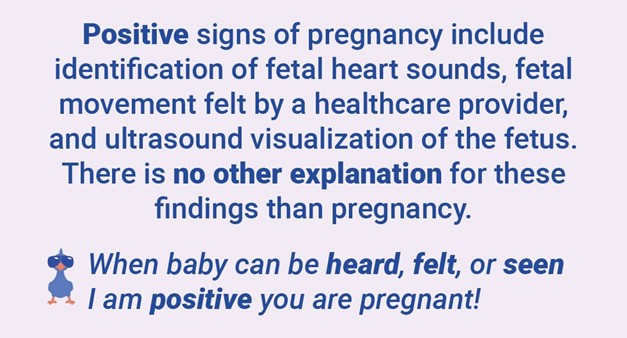
These are all positive signs of pregnancy, which are definitive and can only be explained by the presence of a fetus.A positive sign of pregnancy is fetal movement palpated by the nurse-midwife.
Choice E is wrong because a positive hCG test is a probable sign of pregnancy, not a positive one.A probable sign of pregnancy is strongly suggestive of pregnancy but could have other causes.A positive hCG test could be caused by medications, tumors, or other conditions that affect the level of hCG in the blood or urine.
Some other probable signs of pregnancy are uterine enlargement, Hegar’s sign (softening of the lower uterine segment), Goodell’s sign (softening of the cervix), Chadwick’s sign (bluish discoloration of the cervix), ballottement (rebound of the fetus when tapped by the examiner’s finger), Braxton Hicks contractions (painless, irregular uterine contractions), and positive pregnancy test.
Some other positive signs of pregnancy are identification of fetal heartbeat, visualization of the fetus by ultrasound or x-ray, and verification of fetal movement by an experienced clinician.
Correct Answer is B
Explanation

This is because oil peppermint can stimulate the micturition reflex and help the woman to void.
Some possible explanations for the other choices are:
Choice A is wrong because pouring water over the perineum may not be enough to trigger the micturition reflex and may cause discomfort or infection.
Choice C is wrong because analgesics may not address the underlying cause of urinary retention and may have side effects such as drowsiness or nausea.
Choice D is wrong because inserting a sterile catheter is an invasive procedure that carries risks such as trauma, infection, or bladder spasms. It should be used only as a last resort after other methods have failed.
Normal ranges for postpartum bladder function are:
- Urine output: 3000 to 5000 mL/day for the first 2 to 3 days after delivery.
- Urine specific gravity: 1.005 to 1.030.
- Urine pH: 4.6 to 8.0.
Whether you are a student looking to ace your exams or a practicing nurse seeking to enhance your expertise , our nursing education contents will empower you with the confidence and competence to make a difference in the lives of patients and become a respected leader in the healthcare field.
Visit Naxlex, invest in your future and unlock endless possibilities with our unparalleled nursing education contents today