
What are the steps involved in the scientific method?
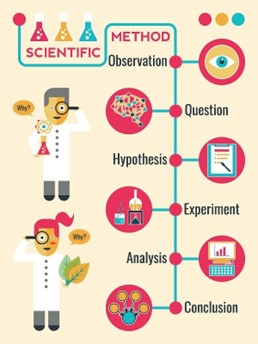
Observation, hypothesis, prediction, experimentation, analysis, conclusion.
Hypothesis, observation, prediction, experimentation, analysis, conclusion.
Prediction, observation, experimentation, analysis, conclusion, hypothesis.
Observation, data collection, analysis, experimentation, hypothesis, conclusion.
The Correct Answer is A
The scientific method is a systematic approach used to answer questions or test hypotheses about the natural world. The steps involved in the scientific method are:
- Observation: This is the first step in the scientific method. It involves observing a phenomenon or a problem and gathering information about it.
- Hypothesis: After making an observation, a scientist forms a hypothesis, which is a tentative explanation for the phenomenon or problem.
- Prediction: Based on the hypothesis, the scientist makes a prediction about what will happen in an experiment or what they will observe.
- Experimentation: The scientist designs and conducts an experiment to test the hypothesis and prediction.
- Analysis: The data collected from the experiment are analyzed to determine if they support or refute the hypothesis.
- Conclusion: Based on the analysis of the data, the scientist draws a conclusion about whether the hypothesis is supported or refuted.
Option b) is incorrect because it starts with hypothesis before observation.
Option c) is incorrect because prediction comes before experimentation.
Option d) is incorrect because hypothesis comes after observation and data collection.
Nursing Test Bank
Naxlex Comprehensive Predictor Exams
Related Questions
Correct Answer is A
Explanation
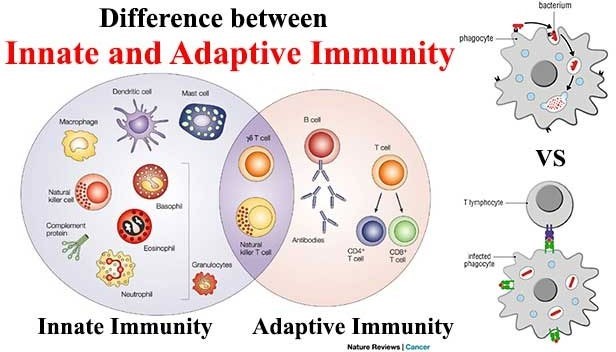
Innate immunity and adaptive immunity are two arms of the immune system that work together to protect the body from pathogens. Innate immunity is the first line of defense and is present at birth. It includes physical and chemical barriers such as the skin, mucous membranes, and antimicrobial peptides, as well as cells such as macrophages and natural killer cells that can quickly recognize and attack pathogens. Innate immunity is nonspecific, meaning it responds to a wide variety of pathogens in a similar way.
Adaptive immunity, on the other hand, is acquired after exposure to pathogens. It involves the production of antibodies and activation of T cells, which are specific to particular pathogens. Adaptive immunity takes longer to develop than innate immunity, but it provides a more specific and targeted response to pathogens. Once the adaptive immune system has been activated against a particular pathogen, it can provide long-term protection against future infections with that pathogen.
Option b) is incorrect because innate immunity is nonspecific while adaptive immunity is specific.
Option c) is incorrect because antibodies are a part of adaptive immunity while T cells can be a part of both innate and adaptive immunity.
Option d) is incorrect because adaptive immunity can provide long-term protection, while innate immunity provides immediate but short-lived protection.
Correct Answer is C
Explanation
Choice A reason: Movement of substances from an area of high concentration to an area of low concentration describes simple diffusion, not osmosis. Simple diffusion involves the passive movement of molecules (other than water) down their concentration gradient, directly across the cell membrane. This process doesn't require energy and isn't specific to water molecules. Substances like gases (oxygen and carbon dioxide) and small, nonpolar molecules often move in this way to reach equilibrium.
Choice B reason: Movement of substances against a concentration gradient with the help of transport proteins defines active transport, not osmosis. Active transport requires energy, typically in the form of ATP, to move molecules from an area of low concentration to an area of high concentration. This is the opposite of passive processes like diffusion and osmosis. Examples include the sodium-potassium pump that maintains the electrochemical gradient in nerve cells, and the transport of glucose into cells of the intestines and kidneys.
Choice C reason: This is the correct description of osmosis. Osmosis specifically refers to the movement of water molecules
through a selectively permeable membrane. The membrane allows water molecules to pass through while preventing the movement of solutes (like salts and sugars) to maintain a balance of water on both sides of the membrane. This process is crucial for maintaining cell turgor in plants, regulating fluid balance in tissues and organs, and facilitating nutrient absorption and waste removal in all living organisms. Osmosis is a vital physiological process because it helps cells maintain their shape and function by controlling internal water balance.
Choice D reason: Movement of substances into a cell by engulfing them with the plasma membrane is known as endocytosis, not osmosis. Endocytosis is an active process where cells internalize large particles, such as nutrients and pathogens, by engulfing them with the cell membrane to form a vesicle. There are two main types of endocytosis: phagocytosis ("cell eating") for large particles like bacteria, and pinocytosis ("cell drinking") for fluids and small molecules. This process requires energy and is used by cells to intake essential nutrients, clear away debris, and defend against pathogens.
Whether you are a student looking to ace your exams or a practicing nurse seeking to enhance your expertise , our nursing education contents will empower you with the confidence and competence to make a difference in the lives of patients and become a respected leader in the healthcare field.
Visit Naxlex, invest in your future and unlock endless possibilities with our unparalleled nursing education contents today