
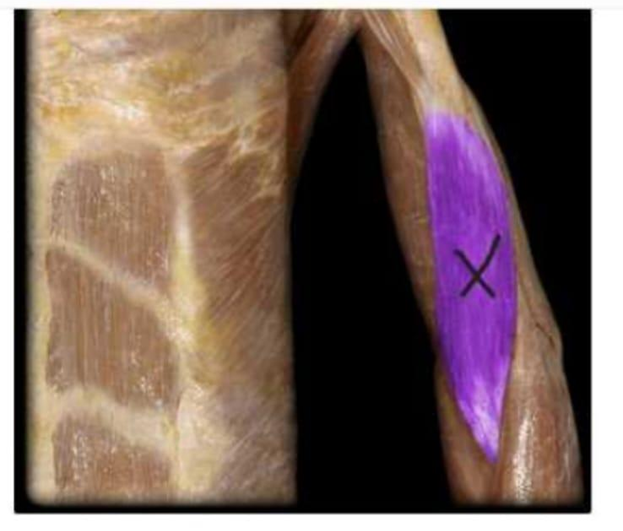
Which muscle is indicated by the X in the image below
Biceps brachii
Brachialis
Triceps brachii
Deltoid
The Correct Answer is C
The muscles of the arm are organized into anterior and posterior compartments, each serving distinct functional roles in movement at the elbow and shoulder joints. The posterior compartment of the arm is dominated by the triceps brachii, a large muscle group essential for extending the forearm at the elbow. Visualizing this muscle's location on the posterior aspect of the humerus is key to understanding the biomechanics of pushing motions and the stabilization of the elbow joint.
A. The biceps brachii is a prominent muscle located in the anterior compartment of the arm. It is primarily responsible for forearm flexion and supination. Given that the muscle marked with an "X" is situated on the posterior aspect of the limb, it is functionally and anatomically distinct from the anterior-positioned biceps brachii.
B. The brachialis is also located in the anterior compartment of the arm, deep to the biceps brachii. It serves as a powerful flexor of the elbow joint. Because the highlighted muscle is located on the back of the arm, it is clearly not the brachialis, which resides in the anterior, rather than the posterior, muscle group.
C. The triceps brachii is the correct identification for the highlighted muscle. It occupies the entire posterior compartment of the arm and is named for its three heads (long, lateral, and medial). The muscle marked with the "X" is positioned on the posterior humerus, which is the characteristic site for the bulk of the triceps muscle mass.
D. The deltoid is a large, triangular muscle that caps the shoulder joint, serving as the primary abductor of the arm. It is located superior to the triceps brachii, covering the shoulder and upper part of the arm. The muscle marked with the "X" is located further down the length of the arm, well below the anatomical span of the deltoid.
Nursing Test Bank
Naxlex Comprehensive Predictor Exams
Related Questions
Correct Answer is C
Explanation
Mitosis is the process of somatic cell division that ensures genetic continuity between a parent cell and its daughter cells. It is followed by cytokinesis, which physically separates the cytoplasm into two distinct cells. Together, these processes produce two genetically identical daughter cells. This is essential for growth, tissue repair, and maintenance in multicellular organisms, as it preserves the diploid chromosome number in each new cell.
A. At the end of cytokinesis there are two daughter cells with half the number of chromosomes as the parent cell: mitosis and cytokinesis produce daughter cells that are genetically identical to the parent cell, maintaining the same diploid chromosome number. Halving of chromosome number occurs in meiosis, not mitosis. Cytokinesis only divides the cytoplasm; it does not reduce genetic content.
B. At the end of mitosis there are two daughter cells with half the number of chromosomes as the parent cell: mitosis preserves the full diploid chromosome number. Each daughter cell receives an identical set of chromosomes as the parent cell. Reduction of chromosome number only occurs during meiosis I. Therefore, this statement incorrectly confuses mitosis with reductional division.
C. At the end of mitosis there are two daughter cells with the same number of chromosomes as the parent cell: mitosis produces two genetically identical daughter cells. During mitosis, sister chromatids are separated equally so that each daughter cell receives an identical diploid set of chromosomes. Cytokinesis then divides the cytoplasm, completing the formation of two separate but genetically identical cells. This ensures genetic stability in somatic tissues.
D. At the end of cytokinesis there is one daughter cell with the same number of chromosomes as the parent cell: cytokinesis results in the physical separation of one parent cell into two distinct daughter cells. Each resulting cell contains a full set of chromosomes identical to the parent cell. Therefore, cytokinesis does not produce a single cell but instead completes the formation of two daughter cells.
Correct Answer is A
Explanation
Skeletal muscle movements are produced through coordinated interactions between different muscle groups. These muscles work in pairs or groups to create smooth, controlled motion at joints. Each muscle in a functional group has a specific role depending on whether it produces, assists, or opposes a movement. Understanding these roles is essential for interpreting biomechanics and musculoskeletal physiology.
A. Antagonist: The antagonist is the muscle that opposes or reverses the action of the agonist during movement. When one muscle contracts to produce movement, the antagonist typically relaxes to allow smooth motion, and may contract to control or decelerate the movement. For example, during elbow flexion, the triceps brachii acts as the antagonist to the biceps brachii. This opposing function helps maintain joint stability and coordinated movement.
B. Agonist: The agonist is the muscle primarily responsible for generating a specific movement. It is the main active muscle during a particular action, such as the biceps brachii during elbow flexion. The agonist contracts to produce the desired motion at a joint. Since it produces rather than opposes movement, it is not the correct answer.
C. Prime mover: The prime mover is another term for the agonist muscle, referring to the main muscle responsible for a specific movement. It generates the majority of the force required for the action. For example, the quadriceps act as the prime mover during knee extension. Because it is synonymous with agonist and not an opposing muscle, it is incorrect.
D. Synergist: A synergist is a muscle that assists the agonist in producing a movement by adding extra force or stabilizing joints. It may also prevent unwanted movements that could interfere with the primary action. For example, forearm muscles may act as synergists during hand movements. Synergists assist rather than oppose movement.
Whether you are a student looking to ace your exams or a practicing nurse seeking to enhance your expertise , our nursing education contents will empower you with the confidence and competence to make a difference in the lives of patients and become a respected leader in the healthcare field.
Visit Naxlex, invest in your future and unlock endless possibilities with our unparalleled nursing education contents today