
Which of the following medication should be administered whole (e.g., not divided or crushed for administration)?
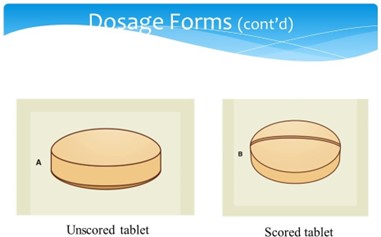
A scored tablet
A capsule
An unscored tablet
A lozenge
The Correct Answer is C
A scored tablet has a line or groove that allows it to be easily split into two or more parts. A capsule can be opened and its contents can be mixed with food or liquid for administration. A lozenge is designed to dissolve slowly in the mouth. An unscored tablet, on the other hand, is not designed to be divided or crushed and should be administered whole.
A. A scored tablet is incorrect because it can be split into two or more parts.
B. A capsule is incorrect because it can be opened and its contents can be mixed with food or liquid for administration.
C. An unscored tablet is the correct answer.
D. A lozenge is incorrect because it is designed to dissolve slowly in the mouth.
Nursing Test Bank
Naxlex Comprehensive Predictor Exams
Related Questions
Correct Answer is D
Explanation
The patient received heparin at a rate of 12 mL/hr for 2 hours (from 9:00 am to 11:00 am) and then at a rate of 10 mL/hr for 3 hours (from 11:00 am to 2:00 pm). The total volume of heparin solution infused is (12 mL/hr x 2 hr) + (10 mL/hr x 3 hr) = 54 mL. Since there are 25,000 units of heparin in 250 mL of solution, the concentration of heparin is 25,000 units / 250 mL = 100 units/mL. Therefore, the total amount of heparin received by the patient is 54 mL x 100 units/mL = **8900 units**.
A. 5400 units is not the correct answer because it does not account for the change in infusion rate at 11:00 am.
B. 6800 units is not the correct answer because it does not account for the change in infusion rate at 11:00 am.
C. 7200 units is not the correct answer because it does not account for the change in infusion rate at 11:00 am.
Correct Answer is C
Explanation
To determine the correct answer, we need to calculate the number of tablets per dose based on the prescribed dosage and the available tablet strength.
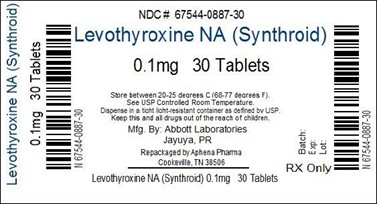
The doctor orders 0.1 mg of Synthroid (levothyroxine), and 50 mcg tablets are available.
First, we need to convert the prescribed dosage from milligrams (mg) to micrograms (mcg) to match the tablet strength:
0.1 mg = 100 mcg
Next, we need to calculate the number of tablets per dose:
Number of tablets per dose = Prescribed dosage / Tablet strength Number of tablets per dose = 100 mcg / 50 mcg
Number of tablets per dose = 2 tablets
Therefore, the correct answer is c. 2 tablets. The nurse should administer 2 tablets per dose to the patient to achieve the prescribed dosage of 0.1 mg.
Whether you are a student looking to ace your exams or a practicing nurse seeking to enhance your expertise , our nursing education contents will empower you with the confidence and competence to make a difference in the lives of patients and become a respected leader in the healthcare field.
Visit Naxlex, invest in your future and unlock endless possibilities with our unparalleled nursing education contents today