
Which statement best describes a subdural hematoma?
Bleeding occurs between the dura and the skull.
Bleeding is generally arterial, and brain compression occurs rapidly.
Bleeding occurs between the dura and the cerebrum.
The hematoma commonly occurs in the pretemporal region.
The Correct Answer is A
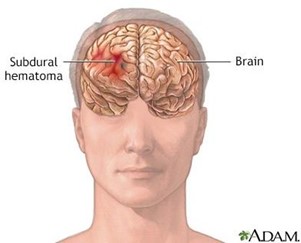
A subdural hematoma is a type of intracranial bleeding that occurs between the dura mater (the
outermost layer of the meninges) and the skull. The dura mater is a tough membrane that covers
and protects the brain. When a subdural hematoma occurs, blood collects between the dura mater
and the skull, resulting in increased pressure on the brain.
Bleeding is generally arterial, and brain compression occurs rapidly in (Option B) is incorrect because
while bleeding in a subdural hematoma can be arterial, it can also be venous. The rate of bleeding
and brain compression can vary depending on the size and severity of the hematoma.
Bleeding occurs between the dura and the cerebrum in (Option C) is incorrect because the bleeding
in a subdural hematoma does not occur between the dura and the cerebrum (the largest part of the
brain). It specifically occurs between the dura and the skull.
The hematoma commonly occurs in the pretemporal region in (Option D) is incorrect because the
location of a subdural hematoma can vary. While pretemporal region is a possible location, subdural
hematomas can occur in different areas of the brain, depending on the site of injury.
Nursing Test Bank
Naxlex Comprehensive Predictor Exams
Related Questions
Correct Answer is B
Explanation
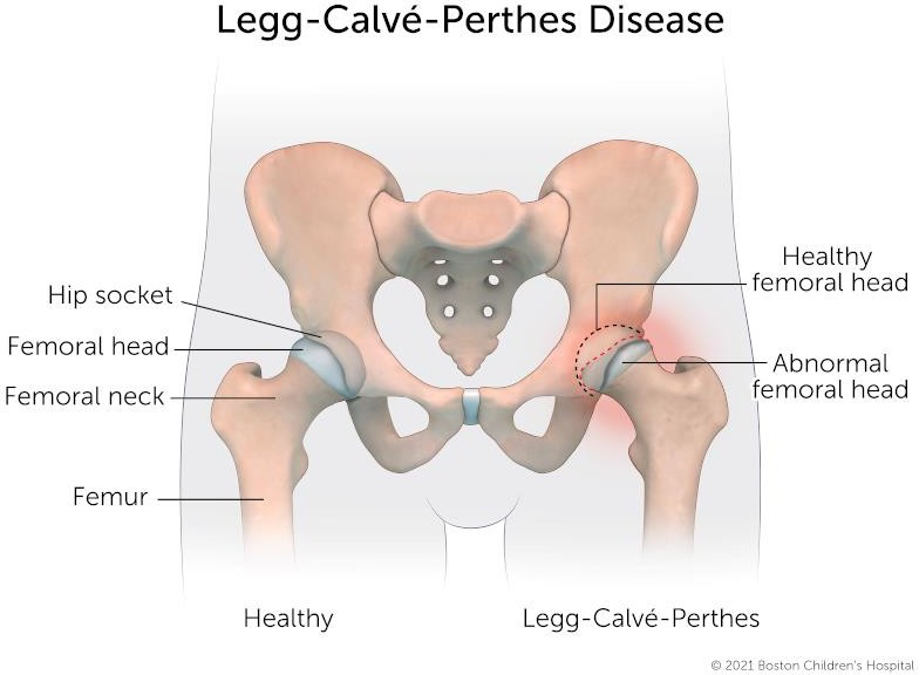
Legg-Calve-Perthes disease, also known as Perthes disease, is a childhood condition that affects the hip joint. It occurs due to a disruption in the blood supply to the femoral head (epiphysis), which can lead to bone death (avascular necrosis) and subsequent deformity of the femoral head.
It is essential for parents to understand that Legg-Calve-Perthes disease is not an acute illness that lasts for a short duration (Option A). It is a chronic condition that typically progresses over a period of months or years.
stating that it is caused by a virus, in (option C) is incorrect. The exact cause of Legg-Calve- Perthes disease is not fully understood, but it is not caused by a viral infection. It is believed to be related to multifactorial factors, including genetic and vascular factors.
stating that it primarily affects adults, in (option D) is incorrect. Legg-Calve-Perthes disease predominantly affects children, typically between the ages of 4 and 8 years old, during the period of rapid growth.
Correct Answer is A
Explanation
The scenario describes a 14-year-old male who seems to be always eating, but his weight is appropriate for his height. In this case, it is important to reassure the parents that the behaviour may not necessarily be a cause for concern.
Option A provides an accurate response by explaining that for weight gain to occur, the individual would need to consume an excessive number of calories. Since the adolescent's weight is appropriate for his height, it suggests that his caloric intake is likely balanced and not excessive.
suggesting that he is substituting food for unfilled needs in (option B) is incorrect because it, is speculative and may not be accurate without further assessment or evidence. It is important to avoid making assumptions about underlying psychological or emotional reasons for increased eating without more information.
stating that this is normal due to an increase in body mass during this time in (option C) is incorrect because it, is not necessarily applicable to the scenario. While it is true that adolescents experience growth and changes in body composition during this period, it does not directly explain the constant eating behaviour described.
suggesting that this behaviour is abnormal and indicative of possible future obesity in (option D) is incorrect because it, may be premature and unsupported based solely on the information provided. It is essential to avoid making predictions or assumptions about future health outcomes without proper evaluation.
By providing the parents with information about the caloric intake required for weight gain and reassuring them that their son's eating behaviour may be within a normal range, the nurse can address their concerns and provide accurate guidance. If the parents have further concerned or questions, it may be appropriate to refer them to a healthcare provider for a more comprehensive assessment.
Whether you are a student looking to ace your exams or a practicing nurse seeking to enhance your expertise , our nursing education contents will empower you with the confidence and competence to make a difference in the lives of patients and become a respected leader in the healthcare field.
Visit Naxlex, invest in your future and unlock endless possibilities with our unparalleled nursing education contents today