
A nurse is teaching parents about diarrhea. Which statement by the parents indicates understanding of the teaching?
Organisms destroy intestinal mucosal cells, resulting in an increased intestinal surface area.
Malabsorption results in metabolic alkalosis.
Increased motility results in impaired absorption of fluid and nutrients.
Diarrhea results from a fluid deficit in the small intestine.
The Correct Answer is C
Diarrhea is characterized by increased motility of the intestines, which leads to a decreased absorption of fluid and nutrients. This statement correctly indicates an understanding of the teaching regarding diarrhea.
Organisms destroy intestinal mucosal cells, resulting in an increased intestinal surface area in (Option A) is incorrect because organisms causing diarrhea can lead to damage or inflammation of the intestinal mucosal cells, but they do not destroy them to increase the intestinal surface area.
Malabsorption results in metabolic alkalosis in (Option B) is incorrect because malabsorption does not result in metabolic alkalosis. Malabsorption refers to the impaired absorption of nutrients, but it does not directly affect the acid-base balance in the body.
Diarrhea results from a fluid deficit in the small intestine in (Option D) is incorrect because diarrhea does not result from a fluid deficit in the small intestine. Diarrhea is characterized by an increased volume of fluid in the intestines and increased frequency of bowel movements.
Nursing Test Bank
Naxlex Comprehensive Predictor Exams
Related Questions
Correct Answer is B
Explanation
These symptoms are indicative of hypoglycaemia, which occurs when the blood sugar levels drop too low. Providing a source of fast-acting carbohydrates, such as orange juice, can quickly raise the child's blood sugar levels and alleviate the symptoms.
Administering insulin (Option A) is incorrect because it is not appropriate in this situation because it would further lower the child's blood sugar levels.
Offering water (Option C) is incorrect because it would not effectively address the low blood sugar.
Glucagon (Option D) is incorrect because it is typically used in severe cases of hypoglycaemia when the child is unconscious or unable to swallow, and it requires a prescription. In this case, providing orange juice is the safest and most appropriate initial intervention. However, it is important to seek medical attention and inform the child's healthcare provider about the incident.
Correct Answer is A
Explanation
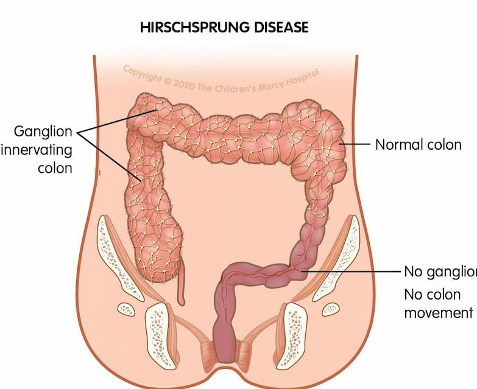
The assessment finding that the nurse should expect in an infant with Hirschsprung disease is option A, constipation with the passage of foul-smelling, ribbon-like stools. Hirschsprung disease is a congenital condition characterized by the absence of ganglion cells in the distal part of the colon, leading to functional obstruction. The affected segment of the colon lacks the normal peristaltic movements, resulting in an accumulation of faecal matter. The stools passed by infants with Hirschsprung disease are often constipated, and the narrow, ribbon- like appearance is a result of the narrowed segment of the colon.
diarrhea (option B) is incorrect because it, is not typically associated with Hirschsprung disease. Instead, the condition presents with constipation due to the obstructed bowel.
foul-smelling, fatty stools in (option C) is incorrect because it, is not characteristic of Hirschsprung disease. This finding may be associated with malabsorption disorders such as cystic fibrosis or celiac disease, but not specifically with Hirschsprung disease.
"currant jelly" stools in (option D) is incorrect because it, is a term commonly used to describe the stools seen in intussusception, which is a different condition involving the telescoping of one segment of the bowel into another. It is not an expected finding in Hirschsprung disease.
Whether you are a student looking to ace your exams or a practicing nurse seeking to enhance your expertise , our nursing education contents will empower you with the confidence and competence to make a difference in the lives of patients and become a respected leader in the healthcare field.
Visit Naxlex, invest in your future and unlock endless possibilities with our unparalleled nursing education contents today