
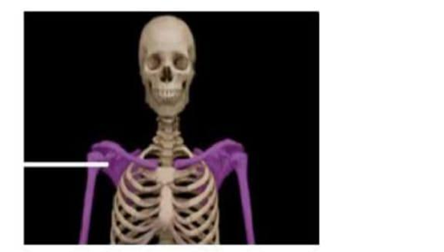
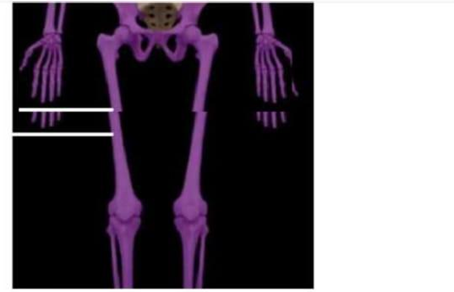
Which structure is highlighted?
sacrum
axial skeleton
cranial cavity
appendicular skeleton
The Correct Answer is D
The marked structure is the appendicular skeleton, which includes all bones of the upper and lower limbs as well as the pectoral (shoulder) and pelvic girdles. It is functionally designed for movement, locomotion, and manipulation of the environment. Unlike the axial skeleton, which provides central support and protection for vital organs, the appendicular skeleton is responsible for mobility and mechanical interaction with the external environment. It connects to the axial skeleton at the shoulder and pelvic regions.
A. Sacrum: The sacrum is a single, triangular bone formed by the fusion of five sacral vertebrae at the base of the vertebral column. It forms part of the axial skeleton and contributes to pelvic stability by articulating with the iliac bones. Unlike the appendicular skeleton, it is a central structural bone rather than a collection of limb bones involved in movement.
B. Axial skeleton: The axial skeleton includes the skull, vertebral column, ribs, and sternum. Its primary role is protection of the brain, spinal cord, and thoracic organs, as well as providing structural support. Compared to the appendicular skeleton, it does not include limbs or girdles and is focused on central body stability rather than movement.
C. Cranial cavity: The cranial cavity is a space within the skull that houses the brain. It is formed by several cranial bones and protects the central nervous system. Unlike the appendicular skeleton, it is not a bone group but an internal space within the axial skeleton and has no role in limb movement.
D. Appendicular skeleton: The appendicular skeleton consists of the bones of the upper and lower limbs plus the shoulder and pelvic girdles. It is responsible for movement, balance, and interaction with the environment through locomotion and manipulation. It connects to the axial skeleton and allows a wide range of motion due to its joint structures. Since the highlighted region represents limb-related structures, it corresponds to the appendicular skeleton.
Nursing Test Bank
Naxlex Comprehensive Predictor Exams
Related Questions
Correct Answer is B
Explanation
Homeostasis is a fundamental physiological principle that describes how the human body maintains a relatively stable internal environment despite continuous changes in the external environment. This stability is essential for normal cellular function and survival, as enzymes, metabolic processes, and cellular activities operate within narrow optimal ranges. The body achieves homeostasis through coordinated feedback mechanisms involving the nervous and endocrine systems. These regulatory systems continuously monitor and adjust variables such as temperature, blood glucose, pH, and fluid balance.
A. The changing external conditions of the environment: This option describes environmental variability rather than internal regulation. Homeostasis is not about external changes themselves but about the body’s response to those changes. External conditions such as temperature, humidity, or atmospheric pressure may fluctuate, but homeostasis refers specifically to how the internal environment remains stable despite these fluctuations.
B. The maintenance of stable internal conditions: homeostasis refers to the body’s ability to maintain a constant internal environment within narrow physiological limits. This includes regulation of core temperature, blood glucose levels, blood pressure, and electrolyte balance. These processes are controlled through negative feedback mechanisms involving the nervous and endocrine systems. Stability of the internal environment is essential for proper cellular and organ function.
C. The breakdown of nutrients for energy production: This option describes metabolism, specifically catabolism, which involves the chemical breakdown of nutrients to release energy in the form of ATP. While metabolism is essential for life and is regulated in part by homeostatic mechanisms, it is not the definition of homeostasis itself. Therefore, this statement refers to a specific physiological process rather than the overall regulatory balance of the internal environment.
D. The transmission of electrical signals in neurons: This describes neural conduction, which is the process by which neurons transmit electrical impulses through action potentials. It is a key function of the nervous system involved in communication and coordination. However, it does not define the regulation of internal physiological stability.
Correct Answer is C
Explanation
During embryonic development, the central nervous system originates from three primary brain vesicles: the forebrain (prosencephalon), midbrain (mesencephalon), and hindbrain (rhombencephalon). Each of these vesicles differentiates into specific structures of the mature brain. The forebrain is the most complex and gives rise to higher-order processing centers involved in cognition, sensory integration, and autonomic regulation. It ultimately forms both the cerebrum and diencephalon, which are essential for conscious thought and homeostatic control.
A. Medulla oblongata and spinal cord: these structures develop from the hindbrain (rhombencephalon) and neural tube, not the forebrain. The medulla oblongata is part of the brainstem and is responsible for autonomic functions such as respiration and heart rate regulation. The spinal cord arises caudal to the brainstem from the neural tube. Therefore, they are not derivatives of the forebrain.
B. Cerebellum and pons: both the cerebellum and pons arise from the hindbrain, specifically the metencephalon. The cerebellum is responsible for coordination and balance, while the pons acts as a relay center between different parts of the brain. These structures are not derived from the embryonic forebrain.
C. Cerebrum and diencephalon: the embryonic forebrain (prosencephalon) differentiates into the telencephalon and diencephalon. The telencephalon develops into the cerebrum, which is responsible for higher cognitive functions, voluntary movement, and sensory perception. The diencephalon forms structures such as the thalamus and hypothalamus, which are involved in sensory relay and autonomic regulation. These structures collectively represent the mature derivatives of the forebrain.
D. Midbrain and medulla oblongata: the midbrain develops from the mesencephalon (midbrain vesicle), and the medulla oblongata develops from the hindbrain. The forebrain does not contribute to either of these structures.
Whether you are a student looking to ace your exams or a practicing nurse seeking to enhance your expertise , our nursing education contents will empower you with the confidence and competence to make a difference in the lives of patients and become a respected leader in the healthcare field.
Visit Naxlex, invest in your future and unlock endless possibilities with our unparalleled nursing education contents today