
A nurse is caring for a client who is in the latent phase of the first stage of labor and is in pain.
Which of the following nursing interventions are appropriate to reduce pain? (Select all that apply.)
Perform Leopold maneuvers.
Apply counterpressure to the sacral area
Ambulate the client in the hallway
Administer 70-90% nitrous oxide mixed with oxygen
Correct Answer : B,C,D,E
Applying counterpressure to the sacral area can help alleviate back pain during labor.
Ambulating the client in the hallway can help with pain management and facilitate labor progress.
Administering nitrous oxide mixed with oxygen can provide pain relief during labor.
Having the client sit upright can help with pain management and facilitate labor progress.
Choice A is incorrect because performing Leopold maneuvers is a technique used to assess fetal position and presentation and is not a pain management technique.
Nursing Test Bank
Naxlex Comprehensive Predictor Exams
Related Questions
Correct Answer is B
Explanation
Chorionic villus sampling (CVS) is a prenatal test that involves taking a sample of tissue from the placenta to test for chromosomal abnormalities and certain other genetic problems.
As with all types of surgical procedures, infections can happen during or after CVS2.
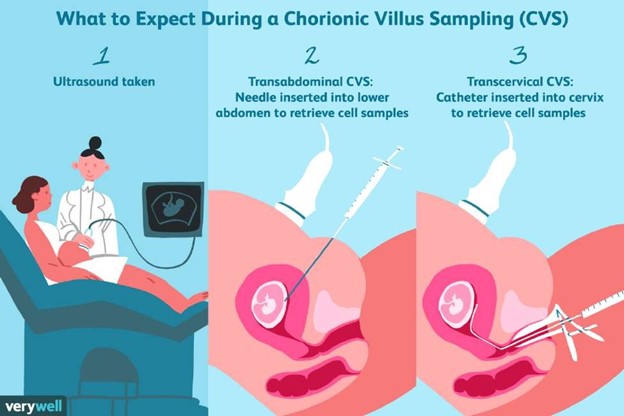
Choice A is incorrect because anemia is not a known complication of CVS.
Choice C is incorrect because late decelerations are a type of fetal heart rate patern that can occur during labor and are not related to CVS.
Choice D is incorrect because placental insufficiency is a condition where the placenta is unable to provide enough oxygen and nutrients to the fetus and is not a known complication of CVS.
Correct Answer is E
Explanation
None of the choices provided indicate that suctioning of the nasopharynx is needed for a newborn.
Nasopharyngeal suctioning is performed to remove mucus or saliva from the back of the throat when a newborn is unable to cough or swallow. It is commonly used in infants with bronchiolitis.
Choice A, “The newborn’s respiratory rate is 32/min,” is not an answer because a respiratory rate of 32/min is within the normal range for a newborn.
Choice B, “The newborn’s respiratory rate is irregular,” is not an answer because irregular breathing paterns are common in newborns.
Choice C, “The newborn is beginning to cough,” is not an answer because coughing is a normal reflex that helps clear the airway.
Choice D, “The newborn’s pulse oximetry is 91,” is not an answer because pulse oximetry measures oxygen saturation and does not indicate the need for nasopharyngeal suctioning.
Whether you are a student looking to ace your exams or a practicing nurse seeking to enhance your expertise , our nursing education contents will empower you with the confidence and competence to make a difference in the lives of patients and become a respected leader in the healthcare field.
Visit Naxlex, invest in your future and unlock endless possibilities with our unparalleled nursing education contents today