
Compared to the nervous system, the endocrine system:
Is not essential to life.
Takes only seconds.
May have a longer-lasting effect.
Does not use receptors.
The Correct Answer is C
The endocrine system may have a longer-lasting effect than the nervous system because the hormones it produces can circulate in the bloodstream for a long time and affect many organs and tissues.
The nervous system, on the other hand, uses nerve impulses and neurotransmitters for communication, which are faster but more short-lived.
Choice A is wrong because the endocrine system is essential to life.
It regulates many vital functions such as metabolism, growth, reproduction, mood, sleep, and blood pressure.
Choice B is wrong because the endocrine system takes longer than the nervous system to deliver its messages.
The hormones have to travel through the bloodstream to reach their target cells, while the nerve impulses can travel along the nerve fibers at high speeds.
Choice D is wrong because the endocrine system does use receptors.
The hormones bind to specific receptors on the target cells to trigger a response.
Nursing Test Bank
Naxlex Comprehensive Predictor Exams
Related Questions
Correct Answer is A
Explanation
The mitral valve lies between the left atrium and left ventricle and prevents the regurgitation of blood from the ventricle back into the atrium.
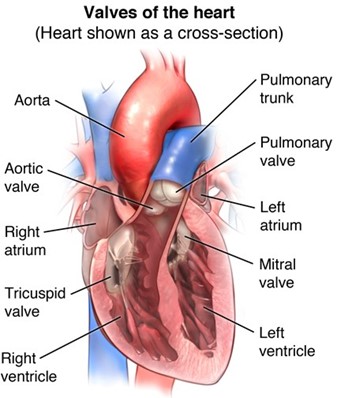
It has two leaflets that open and close to allow blood to flow from the lungs into the left atrium and then to the left ventricle.
Choice B is wrong because the tricuspid valve lies between the right atrium and right ventricle and prevents the regurgitation of blood from the ventricle back into the atrium.
It has three leaflets that open and close to allow blood to flow from the body into the right atrium and then to the right ventricle.
Choice C is wrong because the pulmonary valve lies between the right ventricle and the pulmonary artery and prevents the regurgitation of blood from the artery back into the ventricle.
It has three leaflets that open and close to allow blood to flow from the right ventricle to the lungs, where it picks up oxygen.
Choice D is wrong because the aortic valve lies between the left ventricle and the aorta and prevents the regurgitation of blood from the aorta back into the ventricle.
It has three leaflets that open and close to allow blood to flow from the left ventricle to the rest of the body.
Correct Answer is A
Explanation
The cell is the basic unit of structure and function of all known living organisms.
The cell theory states that all living things are composed of cells and that new cells are made from preexisting cells.
Cells are organized from atoms, molecules, and macromolecules, and contain organelles that perform specialized functions.
Choice B is wrong because a molecule is a group of atoms bonded together, not a living unit.
Choice C is wrong because an atom is the smallest unit of matter, not a living unit.
Choice D is wrong because a macromolecule is a large molecule composed of smaller molecules, not a living unit.
Whether you are a student looking to ace your exams or a practicing nurse seeking to enhance your expertise , our nursing education contents will empower you with the confidence and competence to make a difference in the lives of patients and become a respected leader in the healthcare field.
Visit Naxlex, invest in your future and unlock endless possibilities with our unparalleled nursing education contents today