
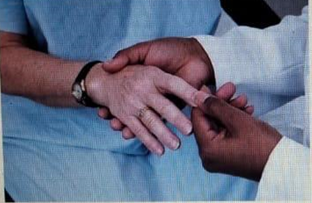
During an assessment the nurse performs the action shown in this image. What is the purpose of this action?
Measure nerve function in the fingers
Monitor oxygen status
Determine capillary refill
Assess finger range of motion
The Correct Answer is C
A. Measure nerve function in the fingers:
Measuring nerve function typically involves different assessments, such as checking sensation or performing nerve conduction studies. The action in the image is not indicative of a nerve function test.
B. Monitor oxygen status:
Monitoring oxygen status is usually done with a pulse oximeter, which is placed on the finger but does not involve the manual action shown in the image. The image depicts a manual technique, not a pulse oximetry procedure.
C. Determine capillary refill:
The action shown in the image is a technique used to determine capillary refill time. The nurse presses on the nail bed until it blanches and then releases it to see how quickly the color returns. This assesses peripheral perfusion and can indicate circulatory status.
D. Assess finger range of motion:
Assessing finger range of motion involves moving the fingers through their full range of motion, such as flexing, extending, abducting, and adducting them. The action in the image does not reflect these movements and is more indicative of assessing capillary refill.
Nursing Test Bank
Naxlex Comprehensive Predictor Exams
Related Questions
Correct Answer is C
Explanation
The Body Mass Index (BMI) is calculated using the formula:
BMI = weight(kg) / height(m)2
First, we need to convert the height from feet and inches to meters.
There are approximately 0.3048 meters in a foot and 0.0254 meters in an inch.
So, 5 feet 5 inches is approximately 1.65 meters.
Substituting the given values into the formula:
BMI = 60 / (1.65)2
This gives us a BMI of approximately 22 when rounded to the nearest whole number.
Therefore, the correct answer is 22 BMI.
Correct Answer is A
Explanation
A. Mucous Membranes:
In clients with dark skin, mucous membranes such as the lips, tongue, and gums are the best sites to assess for cyanosis. These areas have less pigmentation and are more vascular, allowing for a more accurate evaluation of oxygenation and the presence of cyanosis.
B. Dorsal surface of the hand:
The dorsal surface of the hand can be used to assess for cyanosis in lighter-skinned individuals, but it is less reliable in dark-skinned clients due to the higher melanin content, which can obscure the bluish tint indicative of cyanosis.
C. Dorsal surface of the foot:
Similar to the dorsal surface of the hand, the dorsal surface of the foot is not an ideal site for assessing cyanosis in clients with dark skin. The presence of melanin can make it difficult to detect changes in skin color.
D. Pinnae of the ears:
The pinnae of the ears are also not the best sites for assessing cyanosis in dark-skinned clients. These areas can be highly pigmented, which can mask the bluish discoloration associated with cyanosis. The mucous membranes remain the most reliable site for this assessment.
Whether you are a student looking to ace your exams or a practicing nurse seeking to enhance your expertise , our nursing education contents will empower you with the confidence and competence to make a difference in the lives of patients and become a respected leader in the healthcare field.
Visit Naxlex, invest in your future and unlock endless possibilities with our unparalleled nursing education contents today