
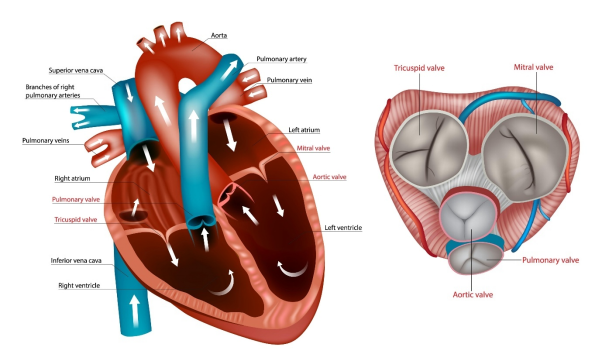
During the cardiac cycle, which heart valve prevents backflow of blood into the left atrium?
Tricuspid valve
Pulmonary valve
Mitral valve
Aortic valve
The Correct Answer is C
A. Tricuspid valve: The tricuspid valve is located on the right side of the heart. It prevents blood from flowing backward from the right ventricle into the right atrium during contraction (systole).
B. Pulmonary valve: The pulmonary valve is a semilunar valve located between the right ventricle and the pulmonary artery. It prevents blood from flowing back into the right ventricle after it has been pumped to the lungs.
C. Mitral valve: Also known as the bicuspid valve, this valve is located between the left atrium and the left ventricle. During ventricular contraction (systole), it closes tightly to prevent blood from regurgitating (flowing back) into the left atrium, ensuring blood exits through the aorta.
D. Aortic valve: The aortic valve is located between the left ventricle and the aorta. It prevents blood from flowing back into the left ventricle after it has been pumped out to the rest of the body.
Nursing Test Bank
Naxlex Comprehensive Predictor Exams
Related Questions
Correct Answer is ["A","E"]
Explanation
A. Parathyroid hormone (PTH):PTH is the principal hormone that raises blood calcium. It increases bone resorption (releasing Ca²⁺), enhances renal calcium reabsorption, and stimulates activation of vitamin D (calcitriol) in the kidney, which increases intestinal calcium absorption.
B. Thyroxine:Thyroxine (T4) regulates metabolic rate and growth. It does not play a primary role in acute regulation of serum calcium, although chronic thyroid disease can influence bone turnover indirectly.
C. Cortisol:Cortisol (a glucocorticoid) can affect bone metabolism and calcium balance with long-term excess (promotes bone resorption and can reduce calcium absorption), but it is nota primary hormone for short-term physiologic regulation of serum calcium.
D. Insulin:Insulin primarily regulates glucose uptake and metabolism; it does not directly regulate serum calcium levels.
E. Calcitonin:Secreted by the thyroid C cells, calcitonin lowers blood calcium by inhibiting osteoclast activity and decreasing bone resorption. Its role in humans is less critical than PTH for everyday calcium homeostasis, but it is a classical calcium-lowering hormone.
F. Glucagon:Glucagon primarily raises blood glucose by stimulating glycogenolysis and gluconeogenesis. It does not have a primary role in calcium regulation.
Correct Answer is B
Explanation
A. Kyphosis; excessive outward curvature:Kyphosis describes an excessive outward curvature (increased thoracic convexity, producing a “hunchback” appearance). This is a curvature abnormality, but it refers specifically to exaggerated thoracic outward curvature. (True statement, but the option names a specific type - see B for lateral curvature.)
B. Scoliosis; lateral curvature:Scoliosis is an abnormal lateral (side-to-side) curvature of the spine and is the correct classification when a practitioner notes a lateral curvature.
C. Lordosis; inward curvature:Lordosis is an excessive inward curvature of the lumbar spine (swayback). It is a curvature abnormality but indicates inward (anterior) curve, not lateral.
D. Osteopenia; reduced bone mass:Osteopenia describes reduced bone mineral density (less severe than osteoporosis) and affects bone strength, not the curvature shape of the spine.
Whether you are a student looking to ace your exams or a practicing nurse seeking to enhance your expertise , our nursing education contents will empower you with the confidence and competence to make a difference in the lives of patients and become a respected leader in the healthcare field.
Visit Naxlex, invest in your future and unlock endless possibilities with our unparalleled nursing education contents today