
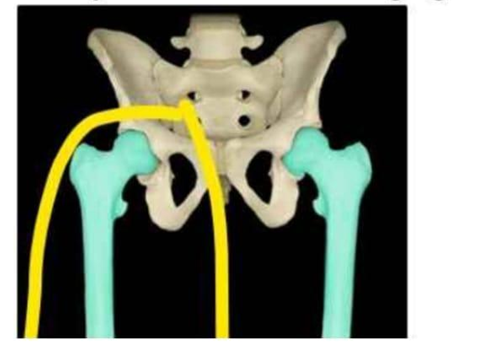
Identify the bone circled and highlighted in the image below.
Tibia
Patella
Fibula
Femur
The Correct Answer is D
The marked structure is the femur, which is the longest and strongest bone in the human body, located in the thigh. It extends from the hip joint proximally to the knee joint distally, forming the primary weight-bearing structure of the lower limb. The femur plays a crucial role in locomotion, balance, and force transmission from the pelvis to the leg. It also provides extensive attachment sites for muscles involved in hip and knee movement.
A. Tibia: The tibia is the larger, medial bone of the lower leg that carries most of the body’s weight. It articulates with the femur at the knee joint and with the talus at the ankle joint. Compared to the femur, it is located distal to the thigh and is part of the leg rather than the upper portion of the lower limb.
B. Patella: The patella is a small sesamoid bone embedded within the quadriceps tendon at the front of the knee. Its primary function is to improve leverage during knee extension and protect the knee joint. Unlike the femur, it is a small, anterior bone rather than a long weight-bearing shaft.
C. Fibula: The fibula is the slender lateral bone of the lower leg that runs parallel to the tibia. It contributes to ankle stability and muscle attachment but does not bear significant body weight. Compared to the femur, it is much thinner and located in the lower leg rather than the thigh.
D. Femur: The femur is the proximal long bone of the lower limb, extending from the hip to the knee joint. It supports body weight during standing, walking, and running through its articulation with the pelvis and tibia. It also provides major muscle attachment sites for hip flexors, extensors, and adductors. The marked structure is a large, central thigh bone, it corresponds to the femur.
Nursing Test Bank
Naxlex Comprehensive Predictor Exams
Related Questions
Correct Answer is B
Explanation
The skin is composed of three main layers: the epidermis, dermis, and hypodermis. The dermis is the middle layer and provides the skin with strength, elasticity, and structural support. It contains blood vessels, nerves, hair follicles, and glands embedded within a supportive extracellular matrix. The dominant tissue type in the dermis is a specialized connective tissue that allows the skin to resist mechanical stress from multiple directions.
A. Adipose tissue: Adipose tissue is primarily found in the hypodermis (subcutaneous layer) rather than the dermis. Its main functions include energy storage, insulation, and cushioning of underlying structures. While small amounts of fat may extend into deeper dermal regions, it does not form the structural framework of the dermis. Therefore, adipose tissue is not the primary dermal component.
B. Dense irregular connective tissue: the dermis is mainly composed of dense irregular connective tissue. This tissue contains thick bundles of collagen fibers arranged in multiple directions, allowing the skin to withstand tension and mechanical stress from various angles. It also contains elastin fibers that provide elasticity and fibroblasts that maintain the extracellular matrix. This structural composition gives the dermis its strength and flexibility.
C. Simple squamous epithelium: Simple squamous epithelium is a thin, single layer of flat cells found in structures such as alveoli of the lungs, blood vessel linings (endothelium), and serous membranes. It is specialized for diffusion and filtration rather than structural support. It is not found in the dermis, which is composed primarily of connective tissue rather than epithelial tissue.
D. Hyaline cartilage: Hyaline cartilage is a flexible connective tissue found in structures such as the trachea, nose, larynx, and articular surfaces of joints. It provides support and smooth surfaces for movement but is not a component of skin structure. The dermis does not contain cartilage tissue, making this option anatomically and histologically incorrect.
Correct Answer is A
Explanation
The acetabulum is a key anatomical structure of the pelvic girdle that forms part of the hip joint. It is a deep, cup-shaped socket located on the lateral aspect of the os coxae, where the ilium, ischium, and pubis fuse. Its primary role is to articulate with the head of the femur, forming a stable ball-and-socket joint. This arrangement allows a wide range of lower limb movements while maintaining strong weight-bearing stability during standing, walking, and running.
A. A depression in the hip bone that receives the head of the femur: the acetabulum is a concave socket on the lateral surface of the hip bone. It is formed by the fusion of the ilium, ischium, and pubis, and serves as the articulating surface for the femoral head. This configuration creates the hip joint, which is a ball-and-socket joint designed for both mobility and stability. The acetabulum is deepened by a fibrocartilaginous rim called the acetabular labrum, which enhances joint stability.
B. The anterior portion of the hip bone: the anterior portion of the hip bone is primarily formed by the pubis. While the pubis contributes to the structure of the acetabulum, it does not define or represent the entire socket. The acetabulum is a specific concavity formed by all three pelvic bones, not just the anterior segment.
C. The posterior projection of the ilium: the ilium is the superior part of the hip bone, and its posterior region includes landmarks such as the posterior superior and posterior inferior iliac spines. These structures serve as muscle attachment sites but do not form the acetabulum. The acetabulum is a central lateral structure formed by all three bones, not a projection of the ilium.
D. A ligament that stabilizes the hip joint: the acetabulum is a bony structure, not a ligament. Ligaments such as the iliofemoral, pubofemoral, and ischiofemoral ligaments help stabilize the hip joint by connecting bones. However, the acetabulum itself is a socket within the hip bone that articulates with the femur.
Whether you are a student looking to ace your exams or a practicing nurse seeking to enhance your expertise , our nursing education contents will empower you with the confidence and competence to make a difference in the lives of patients and become a respected leader in the healthcare field.
Visit Naxlex, invest in your future and unlock endless possibilities with our unparalleled nursing education contents today