
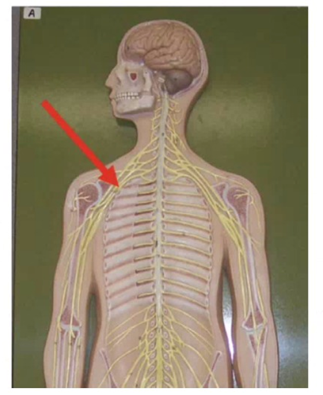
In the diagram, the arrow pointing to the nerve in the shoulder area indicates which division of the nervous system?
Central Nervous System (CNS)
Peripheral Nervous System (PNS)
Autonomic Nervous System (ANS)
Somatic Nervous System
The Correct Answer is B
A. Central Nervous System (CNS): The CNS consists of the brain and spinal cord only. Since the arrow points to a nerve in the shoulder region, this is outside the CNS.
B. Peripheral Nervous System (PNS): The PNS includes all nerves outside the brain and spinal cord. The shoulder nerve shown is part of the PNS, transmitting signals between the CNS and the body.
C. Autonomic Nervous System (ANS): The ANS is a subdivision of the PNS that controls involuntary functions (e.g., heart rate, digestion). While the ANS is part of the PNS, the arrow is pointing to a somatic peripheral nerve, not specifically autonomic.
D. Somatic Nervous System: The somatic nervous system is also a subdivision of the PNS, responsible for voluntary control of skeletal muscles. Although the shoulder nerve could be somatic, the question asks broadly whether it belongs to CNS or PNS, making PNS the best answer.
Nursing Test Bank
Naxlex Comprehensive Predictor Exams
Related Questions
Correct Answer is B
Explanation
A. Simple squamous epithelium: Found in alveoli for gas exchange, not in the nasal cavity.
B. Pseudostratified ciliated columnar epithelium: This tissue lines the respiratory tract, including the nasal cavity. It appears stratified because the nuclei are at different levels, but all cells rest on the basement membrane. The cilia move mucus and trapped particles toward the pharynx, while goblet cells secrete mucus to humidify and protect the airway. This specialized tissue is essential for filtering, warming, and moistening inhaled air.
C. Transitional epithelium: Found in the urinary bladder, specialized for stretching, not respiratory passages.
D. Stratified cuboidal epithelium: Found in ducts of sweat glands and salivary glands, not in the nasal cavity.
Correct Answer is B
Explanation
A. Osteoblasts: Osteoblasts are bone-forming cells found on the surface of bone tissue. They secrete bone matrix but are not housed within lacunae.
B. Osteocytes within lacunae: The black structures represent osteocytes, which are mature bone cells located inside small spaces called lacunae. These cells maintain the bone matrix and are arranged concentrically around central canals, forming osteons.
C. Osteoclasts: Osteoclasts are large, multinucleated cells responsible for bone resorption. They are found on bone surfaces in resorption bays, not within lacunae.
D. Central (Haversian) canal: The central canal is a large, open passageway in the middle of an osteon that contains blood vessels and nerves. The black dots are much smaller and represent lacunae housing osteocytes, not the canal itself.
Whether you are a student looking to ace your exams or a practicing nurse seeking to enhance your expertise , our nursing education contents will empower you with the confidence and competence to make a difference in the lives of patients and become a respected leader in the healthcare field.
Visit Naxlex, invest in your future and unlock endless possibilities with our unparalleled nursing education contents today