
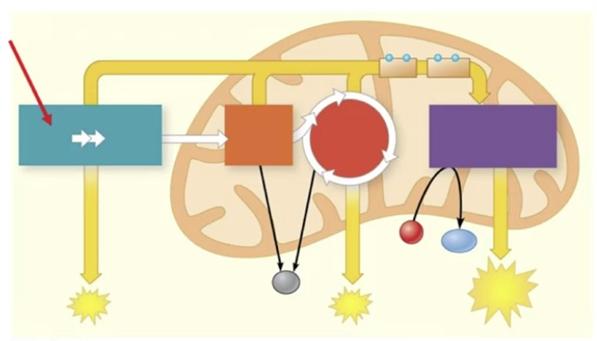
What stage of cellular respiration is indicated by the arrow?
Glycolysis
Pyruvate Oxidation
Citric Acid Cycle (Krebs Cycle)
Oxidative Phosphorylation
The Correct Answer is A
A. Glycolysis: This is the first stage of cellular respiration. As shown in the diagram, it occurs in the cytosol outside of the mitochondria and results in a small yield of ATP (indicated by the yellow starburst at the bottom).
B. Pyruvate Oxidation: This is the "transition" step represented by the smaller orange box where pyruvate enters the mitochondrial matrix to be converted into Acetyl-CoA.
C. Citric Acid Cycle (Krebs Cycle): This stage is represented by the red circular flow within the mitochondrial matrix, where electron carriers (NADH and $FADH_2$) are primarily generated.
D. Oxidative Phosphorylation: Indicated by the purple box on the right, this final stage occurs on the inner mitochondrial membrane (cristae) and produces the largest amount of ATP using the electron transport chain and chemiosmosis.
Nursing Test Bank
Naxlex Comprehensive Predictor Exams
Related Questions
Correct Answer is B
Explanation
A. DNA: DNA contains the bases adenine (A), thymine (T), cytosine (C), and guanine (G). The presence of uracil (U) in the model rules out DNA, since uracil is unique to RNA.
B. RNA: The model shows nucleotides labeled G (guanine), U (uracil), and C (cytosine), which are components of RNA. The entire structure represents a strand of RNA being synthesized or processed.
C. Protein: Proteins are composed of amino acids, not nucleotide bases. The colored blocks labeled with letters (G, U, C) clearly indicate nucleotides, not amino acids.
D. Transfer RNA (tRNA): While tRNA is a type of RNA, the model depicts a linear strand of RNA bases rather than the folded cloverleaf structure characteristic of tRNA.
Correct Answer is D
Explanation
A. Stratified squamous epithelium: Found in areas subject to friction (skin, esophagus), not in alveoli.
B. Transitional epithelium: Found in the urinary bladder, specialized for stretching, not gas exchange.
C. Cuboidal epithelium: Found in kidney tubules and glandular tissue, not in alveoli.
D. Simple squamous epithelium: The alveoli of the lungs are lined with simple squamous epithelium. These cells are extremely thin and flat, allowing for rapid diffusion of gases (oxygen and carbon dioxide) between the alveolar air and the surrounding capillaries. Their delicate structure is essential for efficient gas exchange, which is the primary function of the lungs.
Whether you are a student looking to ace your exams or a practicing nurse seeking to enhance your expertise , our nursing education contents will empower you with the confidence and competence to make a difference in the lives of patients and become a respected leader in the healthcare field.
Visit Naxlex, invest in your future and unlock endless possibilities with our unparalleled nursing education contents today