
The nurse has documented the following wound assessment: “Shallow, open, reddened ulcer with no drainage on the center of the right heel.” What stage is the wound?
Stage 1
Stage 2
Stage 3
Stage 4
The Correct Answer is B
Choice A reason: Stage 1 is a wound that involves only the epidermis, the outermost layer of the skin. It appears as a nonblanchable redness, warmth, or hardness on intact skin. It does not have any breakage or ulceration of the skin.
Choice B reason: Stage 2 is a wound that involves the epidermis and the dermis, the second layer of the skin. It appears as a shallow, open, reddened ulcer with a partialthickness loss of skin. It may have some serous exudate, but no slough or eschar. It may also present as a blister or abrasion.
Choice C reason: Stage 3 is a wound that involves the epidermis, the dermis, and the subcutaneous tissue, the third layer of the skin. It appears as a deep, open, reddened ulcer with a fullthickness loss of skin. It may have some slough or eschar, but no exposed bone, tendon, or muscle. It may also have tunneling or undermining of the wound edges.
Choice D reason: Stage 4 is a wound that involves the epidermis, the dermis, the subcutaneous tissue, and the underlying structures, such as bone, tendon, or muscle. It appears as a deep, open, reddened ulcer with a fullthickness loss of skin and tissue. It has exposed bone, tendon, or muscle, which may be visible or palpable. It may also have slough, eschar, necrosis, infection, or osteomyelitis.
Nursing Test Bank
Naxlex Comprehensive Predictor Exams
Related Questions
Correct Answer is C
Explanation
Choice A reason: "Tell me about what medications you are taking." is not the most appropriate statement by the nurse, because it is not related to the psychosocial assessment. Medications are part of the physical or pharmacological assessment, which focuses on the type, dose, frequency, and effectiveness of the drugs that the client is taking for rheumatoid arthritis. Medications may have some psychosocial implications, such as side effects, costs, or adherence, but they are not the main focus of the psychosocial assessment.
Choice B reason: "What physical limitations are you experiencing?" is not the most appropriate statement by the nurse, because it is not related to the psychosocial assessment. Physical limitations are part of the functional or mobility assessment, which focuses on the range of motion, strength, endurance, and coordination of the joints and muscles that are affected by rheumatoid arthritis. Physical limitations may have some psychosocial implications, such as pain, disability, or dependence, but they are not the main focus of the psychosocial assessment.
Choice C reason: "How does this impact your role in your family?" is the most appropriate statement by the nurse, because it is related to the psychosocial assessment. Role in the family is part of the social or relational assessment, which focuses on the interactions, responsibilities, and expectations of the client and their family members in relation to rheumatoid arthritis. Role in the family may have significant psychosocial implications, such as role changes, role conflicts, role strain, or role loss, which can affect the client's selfesteem, identity, and coping.
Choice D reason: "What therapies are you using to reduce swelling?" is not the most appropriate statement by the nurse, because it is not related to the psychosocial assessment. Therapies are part of the physical or nonpharmacological assessment, which focuses on the modalities, techniques, or devices that the client is using to manage the symptoms of rheumatoid arthritis. Therapies may have some psychosocial implications, such as availability, accessibility, or preference, but they are not the main focus of the psychosocial assessment.
Correct Answer is C
Explanation
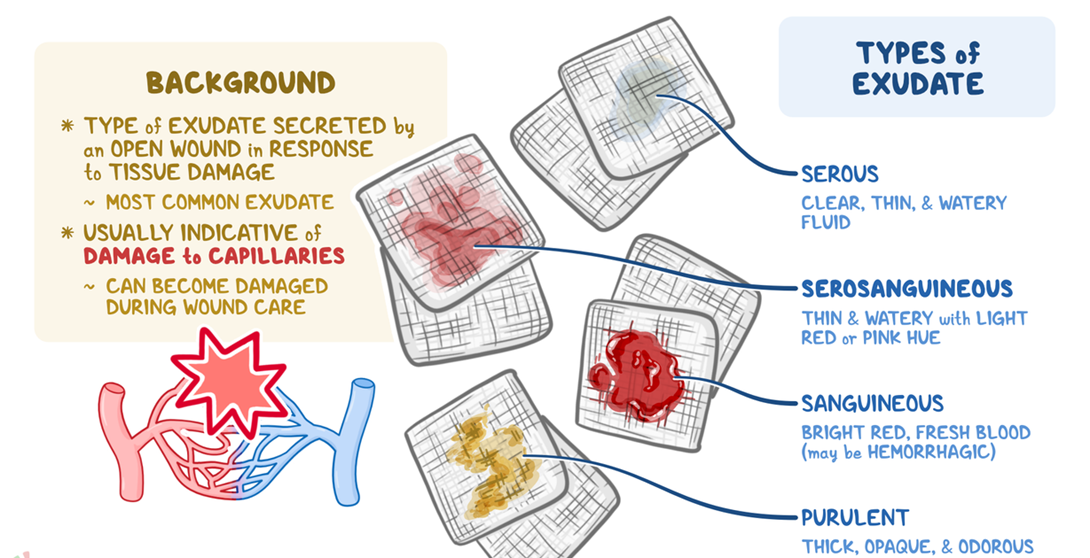
Choice A reason: Purulent exudate is a thick, yellowgreen, or brown pus that indicates infection. It is not bloodtinged and does not drip from the wound.
Choice B reason: Serous exudate is a clear, thin, and watery fluid that is normal in the inflammatory stage of wound healing. It does not contain blood cells and is not red in color.
Choice C reason: Serosanguineous exudate is a pink or red fluid that contains both serum and blood. It is common in the proliferative stage of wound healing and may drip from the wound due to increased capillary permeability.
Choice D reason: Sanguineous exudate is a bright or dark red fluid that consists mostly of blood. It indicates active bleeding and is usually seen in traumatic or surgical wounds. It is not diluted with serum and is more viscous than serosanguineous exudate.
Whether you are a student looking to ace your exams or a practicing nurse seeking to enhance your expertise , our nursing education contents will empower you with the confidence and competence to make a difference in the lives of patients and become a respected leader in the healthcare field.
Visit Naxlex, invest in your future and unlock endless possibilities with our unparalleled nursing education contents today