
The nurse notes documentation that a client is exhibiting Cheyne-Stokes respirations. On assessment, what finding would the nurse expect?
Regular deep respirations interspersed with periods of apnea
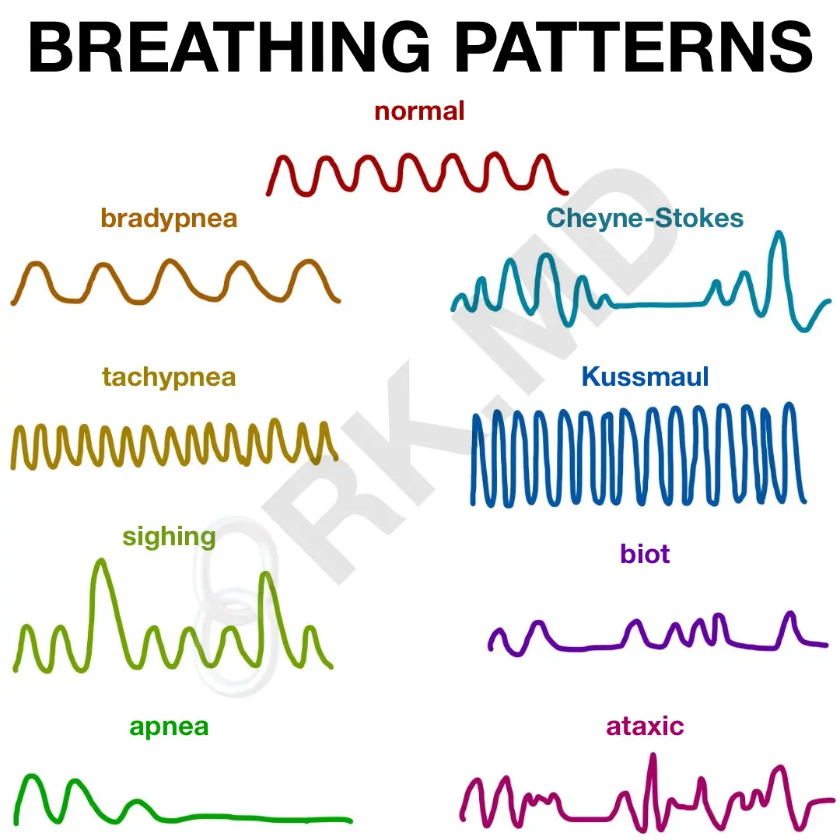
A pattern of crescendo-decrescendo respirations followed by a period of apnea
Patient breathing less than 10 breaths per minute
Patient breathing shallow and more than 24 breaths per minute
The Correct Answer is B
A. Regular deep respirations interspersed with periods of apnea:
This describes periodic breathing, which is different from Cheyne-Stokes respirations. Periodic breathing consists of regular cycles of deep respirations followed by periods of apnea.
B. A pattern of crescendo-decrescendo respirations followed by a period of apnea
Cheyne-Stokes respirations are characterized by a pattern of crescendo-decrescendo respirations, meaning that the depth and rate of breathing gradually increase and then decrease. This is followed by a period of apnea, during which there is a temporary cessation of breathing. The cycle then repeats.
C. Patient breathing less than 10 breaths per minute:
This describes bradypnea, which is an abnormally slow respiratory rate. Cheyne-Stokes respirations involve rhythmic, cyclical changes in respiratory rate and depth.
D. Patient breathing shallow and more than 24 breaths per minute:
This describes tachypnea, which is an abnormally fast respiratory rate. Cheyne-Stokes respirations are characterized by a distinct pattern of alternating crescendo-decrescendo respirations followed by apnea.
Nursing Test Bank
Naxlex Comprehensive Predictor Exams
Related Questions
Correct Answer is ["2"]
Explanation
To administer the ordered dose of digoxin, you need to calculate how many tablets of the available strength are equivalent to 0.25 mg. You can use the formula:
Ordered dose / Available dose = Number of tablets
Plugging in the values, you get:
0.25 mg / 0.125 mg = 2 tablets
Therefore, you need to administer two tablets of digoxin 0.125 mg to give the ordered dose of 0.25 mg.
Correct Answer is D
Explanation
A. The client attempted to climb over the side rails and fell:
This statement includes an interpretation of the client's actions. It's important to focus on factual information without making assumptions about the client's intentions or actions.
B. The client was restless and trying to get out of bed all evening:
Describing the client as restless and trying to get out of bed is a subjective interpretation of the client's behavior. Factual and objective observations are preferred when documenting incidents.
C. The presence of a bed alarm could have prevented the client from falling:
This statement includes an interpretation and a suggestion for prevention. While prevention strategies are important to consider, an incident report should primarily focus on describing what actually occurred rather than suggesting what could have prevented it.
D. The client was lying on the floor next to his bed:
This statement provides a clear and objective description of the situation without making assumptions or interpretations. It is important to document the actual events and the client's current condition.
Whether you are a student looking to ace your exams or a practicing nurse seeking to enhance your expertise , our nursing education contents will empower you with the confidence and competence to make a difference in the lives of patients and become a respected leader in the healthcare field.
Visit Naxlex, invest in your future and unlock endless possibilities with our unparalleled nursing education contents today