
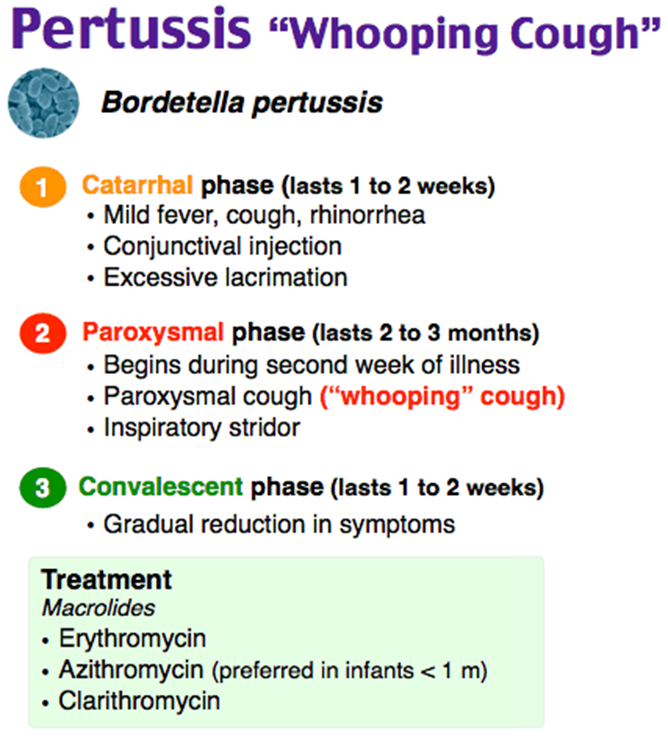
The nurse provides home care instructions to the parents of a child hospitalized with pertussis who is in the convalescent stage and is being prepared for discharge. Which statement by a parent indicates a need for further instruction?
Coughing spells may be triggered by dust or smoke."
We need to maintain droplet precautions and a quiet environment for at least 2 weeks.
"We need to encourage our child to drink fluids.
Vomiting may occur when our child has coughing episodes."
The Correct Answer is B
A. Coughing spells may be triggered by dust or smoke:
Incorrect: This is a correct statement. Irritants like dust or smoke can trigger coughing spells in a child recovering from pertussis.
B. We need to maintain droplet precautions and a quiet environment for at least 2 weeks.
Correct Answer: Pertussis is highly contagious during the catarrhal and paroxysmal stages, but once the child has reached the convalescent stage (usually after 2-4 weeks of illness), the risk of spreading the infection decreases significantly. Continuing strict droplet precautions and a quiet environment for two weeks after the convalescent stage is not necessary.
C. "We need to encourage our child to drink fluids":
Incorrect: This is a correct statement. Encouraging fluid intake is important to prevent dehydration, especially during coughing spells.
D. Vomiting may occur when our child has coughing episodes:
Incorrect: This is a correct statement. Vomiting can be a common occurrence during coughing episodes in pertussis due to the forceful nature of the cough. Parents should be aware of this symptom.
Nursing Test Bank
Naxlex Comprehensive Predictor Exams
Related Questions
Correct Answer is C
Explanation
A. Meningococcal polysaccharide vaccine
Explanation: Meningococcal vaccine is recommended for adolescents, particularly before starting college, as it helps protect against meningococcal disease. The conjugate form of the vaccine is usually preferred over the polysaccharide form.
B. Pneumococcal polysaccharide vaccine
Explanation: Pneumococcal vaccine is generally recommended for older adults and individuals with specific medical conditions, but it may not be part of routine immunizations for healthy adolescents.
C. Influenza vaccine
Explanation:
Influenza vaccine is recommended annually for adolescents as part of routine immunizations. It helps protect against the seasonal flu, which can cause significant illness and complications.
D. Bacille Calmette-Guerin (BCG) vaccine
Explanation: BCG vaccine is primarily used in some countries to prevent tuberculosis. It is not routinely administered in the United States as part of standard immunization schedules for adolescents.
Correct Answer is ["5.3"]
Explanation
To calculate the dose of acetaminophen, you can use the following formula:
Dose (in mg)= Weight (in kg) × Dose (mg/kg)
First, convert the weight from pounds to kilograms:
Weight (in kg)= Weight (in lb)/ 2.2
Weight (in kg)=28 lb/ 2.2 ≈ 12.73kg
Now, calculate the dose:
Dose (in mg) =12.73 kg × 10 mg/kg ≈ 127.3 mg
Next, determine how many milliliters (mL) of the available acetaminophen solution (120 mg/5 mL) contain the calculated dose:
Volume (in mL)=Dose (in mg)/Concentration (in mg/mL)
Volume (in mL) =127.3 mg/( 120 mg/5 mL)
Volume (in mL)≈127.3 mg / 24 mg/mL ≈ 5.304 mL
Therefore, the nurse should administer approximately 5.3 mL of acetaminophen.
Whether you are a student looking to ace your exams or a practicing nurse seeking to enhance your expertise , our nursing education contents will empower you with the confidence and competence to make a difference in the lives of patients and become a respected leader in the healthcare field.
Visit Naxlex, invest in your future and unlock endless possibilities with our unparalleled nursing education contents today