
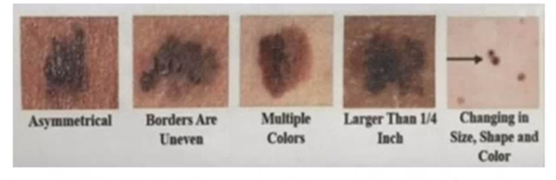
What is the most severe type of skin cancer? (the picture is the same type of skin cancer all the way across)
Basal Cell Carcinoma
Squamous Cell Carcinoma
Melanoma
Actinic Keratosis
The Correct Answer is C
A. Basal Cell Carcinoma: This is the most common and least likely to spread (metastasis). It typically appears as a pearly or waxy bump, unlike the pigmented, irregular lesions shown.
B. Squamous Cell Carcinoma: While more aggressive than basal cell, it is usually less dangerous than melanoma. It often presents as a firm, red nodule or a flat lesion with a scaly surface.
C. Melanoma: This is the most severe and deadly form of skin cancer because it is highly likely to spread to other organs. The image displays the classic warning signs: Asymmetry, irregular Borders, multiple Colors, large Diameter, and Evolving/Changing.
D. Actinic Keratosis: This is a precancerous skin growth caused by sun damage. It is not yet a malignant cancer, though it can develop into squamous cell carcinoma if left untreated.
Nursing Test Bank
Naxlex Comprehensive Predictor Exams
Related Questions
Correct Answer is A
Explanation
A. Stratum corneum: The stratum corneum is composed of dead, keratinized cells that form a tough, protective barrier. Its main function is to prevent water loss, protect against mechanical injury, and serve as the first line of defense against pathogens. Because it is the most superficial layer of the epidermis, it is the correct structure indicated by the arrow.
B. Stratum basale: This is the deepest layer of the epidermis, responsible for cell division and regeneration, not the outermost layer.
C. Dermal papillae: These are found in the dermis, not the epidermis. They interlock with the epidermis to strengthen the connection between the two layers.
D. Sebaceous gland: This gland is located in the dermis, associated with hair follicles, and secretes sebum. It is not part of the epidermis.
Correct Answer is B
Explanation
A. Messenger RNA (mRNA): mRNA carries the genetic code from the DNA in the nucleus to the ribosome. It consists of a single linear strand of codons, rather than the "cloverleaf" shape seen here.
B. Transfer RNA (tRNA): This molecule is responsible for bringing the correct amino acid to the ribosome during translation. Its structure features an anticodon at one end to pair with an mRNA codon and an amino acid attachment site at the other.
C. Ribosomal RNA (rRNA): rRNA is a structural component of ribosomes. While it is made of RNA, it does not function as an adapter molecule carrying specific amino acids via an anticodon.
D. DNA Polymerase: This is an enzyme, not a nucleic acid. Its role is to synthesize new DNA strands during replication, not to transport amino acids during protein synthesis.
Whether you are a student looking to ace your exams or a practicing nurse seeking to enhance your expertise , our nursing education contents will empower you with the confidence and competence to make a difference in the lives of patients and become a respected leader in the healthcare field.
Visit Naxlex, invest in your future and unlock endless possibilities with our unparalleled nursing education contents today