
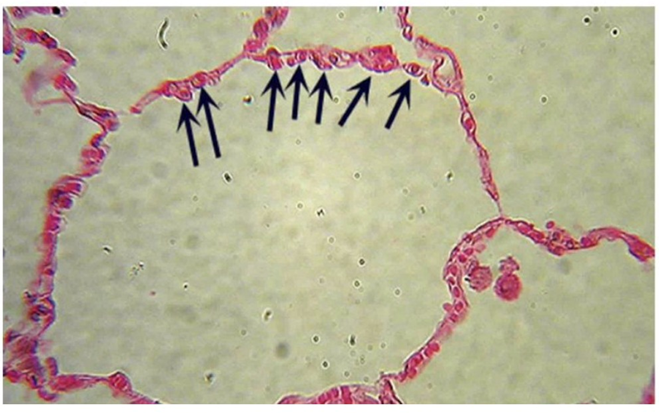
What type of tissue are the arrows pointing to?
Stratified squamous epithelium
Transitional epithelium
Cuboidal epithelium
Simple squamous epithelium
The Correct Answer is D
A. Stratified squamous epithelium: Found in areas subject to friction (skin, esophagus), not in alveoli.
B. Transitional epithelium: Found in the urinary bladder, specialized for stretching, not gas exchange.
C. Cuboidal epithelium: Found in kidney tubules and glandular tissue, not in alveoli.
D. Simple squamous epithelium: The alveoli of the lungs are lined with simple squamous epithelium. These cells are extremely thin and flat, allowing for rapid diffusion of gases (oxygen and carbon dioxide) between the alveolar air and the surrounding capillaries. Their delicate structure is essential for efficient gas exchange, which is the primary function of the lungs.
Nursing Test Bank
Naxlex Comprehensive Predictor Exams
Related Questions
Correct Answer is B
Explanation
A. Compact Bone: This is the dense, outer layer of bone organized into subunits called osteons (visible as the tall "towers" on top of the model). The arrow points to a different, porous region.
B. Spongy (Cancellous) Bone: The arrow points to the honeycomb-like network of bone called trabeculae. This tissue is found at the ends of long bones and lining the medullary cavity, providing structural support while keeping the skeleton lightweight.
C. Hyaline Cartilage: While often found at the ends of bones, hyaline cartilage is a smooth, glass-like connective tissue, not the porous, mineralized bone tissue shown here.
D. Periosteum: This is the fibrous membrane that covers the outer surface of bones. The arrow is pointing deep into the internal structure of the bone rather than the external surface.
Correct Answer is B
Explanation
A. Sweat gland: Sweat glands are coiled tubular structures located deeper in the dermis or subcutaneous tissue. They do not appear as bulbous sacs attached directly to hair follicles.
B. Sebaceous gland: Sebaceous glands are sac-like structures that secrete sebum (oil) into the hair follicle. They are typically found adjacent to hair follicles, appearing as rounded, bulbous structures like the one indicated by the arrow.
C. Hair follicle root: The hair follicle root is the portion of the hair embedded in the dermis, extending downward into the follicular bulb. It is elongated, not bulbous, and is distinct from the glandular structure shown.
D. Arrector pili muscle: The arrector pili muscle is a thin band of smooth muscle attached to the hair follicle. It is not a glandular structure and does not have the rounded appearance of the sebaceous gland.
Whether you are a student looking to ace your exams or a practicing nurse seeking to enhance your expertise , our nursing education contents will empower you with the confidence and competence to make a difference in the lives of patients and become a respected leader in the healthcare field.
Visit Naxlex, invest in your future and unlock endless possibilities with our unparalleled nursing education contents today