
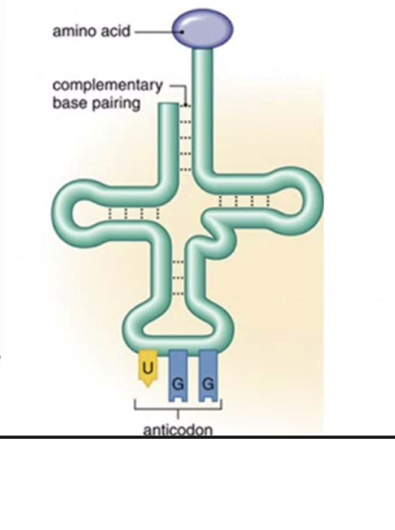
This is a representative of what molecule?
Messenger RNA (mRNA)
Transfer RNA (tRNA)
Ribosomal RNA (rRNA)
DNA Polymerase
The Correct Answer is B
A. Messenger RNA (mRNA): mRNA carries the genetic code from the DNA in the nucleus to the ribosome. It consists of a single linear strand of codons, rather than the "cloverleaf" shape seen here.
B. Transfer RNA (tRNA): This molecule is responsible for bringing the correct amino acid to the ribosome during translation. Its structure features an anticodon at one end to pair with an mRNA codon and an amino acid attachment site at the other.
C. Ribosomal RNA (rRNA): rRNA is a structural component of ribosomes. While it is made of RNA, it does not function as an adapter molecule carrying specific amino acids via an anticodon.
D. DNA Polymerase: This is an enzyme, not a nucleic acid. Its role is to synthesize new DNA strands during replication, not to transport amino acids during protein synthesis.
Nursing Test Bank
Naxlex Comprehensive Predictor Exams
Related Questions
Correct Answer is B
Explanation
A. Osteoblasts: Osteoblasts are bone-forming cells found on the surface of bone tissue. They secrete bone matrix but are not housed within lacunae.
B. Osteocytes within lacunae: The black structures represent osteocytes, which are mature bone cells located inside small spaces called lacunae. These cells maintain the bone matrix and are arranged concentrically around central canals, forming osteons.
C. Osteoclasts: Osteoclasts are large, multinucleated cells responsible for bone resorption. They are found on bone surfaces in resorption bays, not within lacunae.
D. Central (Haversian) canal: The central canal is a large, open passageway in the middle of an osteon that contains blood vessels and nerves. The black dots are much smaller and represent lacunae housing osteocytes, not the canal itself.
Correct Answer is B
Explanation
A. Sweat gland: Sweat glands are coiled tubular structures located deeper in the dermis or subcutaneous tissue. They do not appear as bulbous sacs attached directly to hair follicles.
B. Sebaceous gland: Sebaceous glands are sac-like structures that secrete sebum (oil) into the hair follicle. They are typically found adjacent to hair follicles, appearing as rounded, bulbous structures like the one indicated by the arrow.
C. Hair follicle root: The hair follicle root is the portion of the hair embedded in the dermis, extending downward into the follicular bulb. It is elongated, not bulbous, and is distinct from the glandular structure shown.
D. Arrector pili muscle: The arrector pili muscle is a thin band of smooth muscle attached to the hair follicle. It is not a glandular structure and does not have the rounded appearance of the sebaceous gland.
Whether you are a student looking to ace your exams or a practicing nurse seeking to enhance your expertise , our nursing education contents will empower you with the confidence and competence to make a difference in the lives of patients and become a respected leader in the healthcare field.
Visit Naxlex, invest in your future and unlock endless possibilities with our unparalleled nursing education contents today