
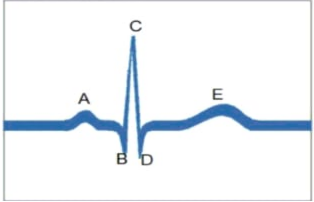
Which letter indicates a P wave?
A
B
C
D
E
The Correct Answer is A
The image shows a single cycle of an electrocardiogram (ECG or EKG), which represents the electrical activity of the heart.
A (P wave): Represents atrial depolarization, which triggers the contraction of the atria.
B, C, D (QRS complex): Represents ventricular depolarization, which triggers the main contraction of the ventricles.
E (T wave): Represents ventricular repolarization, which signifies the electrical recovery and relaxation of the ventricles.
Nursing Test Bank
Naxlex Comprehensive Predictor Exams
Related Questions
Correct Answer is A
Explanation
A. Dalton's:Dalton’s law of partial pressures states that the total pressure of a gas mixture equals the sum of the partial pressures of each individual gas. This principle is essential in understanding gas exchange and calculating oxygen and carbon dioxide pressures in the respiratory system.
B. Charles's:Charles’s law describes the direct relationship between the volume of a gas and its temperature at constant pressure. It does not address the additive nature of gas pressures.
C. Henry's:Henry’s law relates the solubility of a gas in a liquid to its partial pressure above the liquid. It governs how gases dissolve in blood but does not define total atmospheric pressure.
D. Newton's:Newton’s laws of motion describe the relationship between force, mass, and acceleration, which are unrelated to gas pressures in the atmosphere.
E. Boyle's:Boyle’s law states that gas volume varies inversely with pressure at a constant temperature. It explains behavior of gases under compression but does not address total pressure from multiple gases.
Correct Answer is A
Explanation
A. Nitrogen:Nitrogen makes up approximately 78% of the air we breathe, making it the most abundant gas in the atmosphere. It is largely inert and does not participate directly in human respiration.
B. Water vapor:Water vapor is present in variable amounts depending on humidity but generally constitutes a very small fraction of air, far less than nitrogen. Its concentration is not sufficient to be the highest component.
C. Carbon dioxide:Carbon dioxide is present at only about 0.04% in the atmosphere. Despite its critical role in respiration and pH regulation, it is not the major constituent of inhaled air.
D. Hydrogen:Hydrogen exists in trace amounts in the atmosphere and plays no significant role in the composition of breathable air. Its concentration is negligible compared to nitrogen or oxygen.
E. Oxygen:Oxygen makes up roughly 21% of atmospheric air, making it the second most abundant gas. While essential for cellular respiration, its concentration is much lower than that of nitrogen.
Whether you are a student looking to ace your exams or a practicing nurse seeking to enhance your expertise , our nursing education contents will empower you with the confidence and competence to make a difference in the lives of patients and become a respected leader in the healthcare field.
Visit Naxlex, invest in your future and unlock endless possibilities with our unparalleled nursing education contents today