
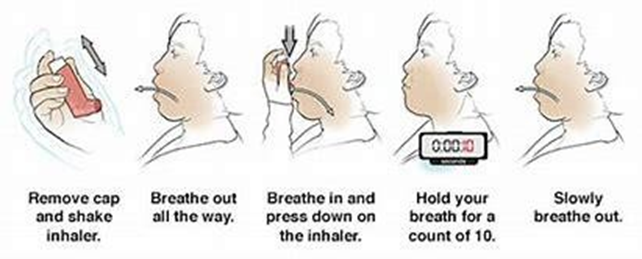
43. A nurse is reinforcing teaching about use of a metered-dose inhaler (MDI) with a client who has a new diagnosis of asthma. Identify the sequence the client should follow. (Move the steps into the box on the right, placing them in the selected order of performance. Use all steps.)
Shake the canister 3 to 5 seconds vigorously.
Place her lips firmly around the mouthpiece.
Inhale slowly over 3 to 5 seconds while pushing down on the canister.
Hold her breath for 10 seconds.
Exhale slowly through pursed lips.
The Correct Answer is A, B, C, D, E
A. Shake the canister 3 to 5 seconds vigorously.
Before each use, it's important to shake the MDI to ensure proper mixing of the medication.
B. Place her lips firmly around the mouthpiece.
Creating a tight seal around the mouthpiece ensures that the medication is delivered directly into the airways.
C. Inhale slowly over 3 to 5 seconds while pushing down on the canister.
While pressing down on the canister, the client should inhale slowly to allow the medication to reach the lungs.
D. Hold her breath for 10 seconds.
After inhaling the medication, holding the breath for 10 seconds allows for better absorption of the medication into the lungs.
E. Exhale slowly through pursed lips.
After holding the breath, exhaling slowly through pursed lips helps to fully exhale and ensures that the medication remains in the airways.
Nursing Test Bank
Naxlex Comprehensive Predictor Exams
Related Questions
Correct Answer is C
Explanation
C. Raisins are a source of carbohydrates, particularly simple sugars like glucose and fructose, which can quickly raise blood sugar levels during an episode of hypoglycemia. However, they do not contain protein, which can help sustain blood sugar levels over time. Raisins may provide a rapid increase in blood sugar but may not be as effective at preventing subsequent episodes of hypoglycemia.
A. Cheese is a source of protein and contains very little carbohydrate. While protein can help stabilize blood sugar levels, it may not provide a rapid increase in blood sugar during an episode of hypoglycemia. Cheese alone may not be the most effective choice for treating low blood sugar promptly.
B. Beef jerky is primarily a source of protein and may not contain enough carbohydrates to quickly raise blood sugar levels during an episode of hypoglycemia. While protein can help stabilize blood sugar over time, it may not provide the rapid increase in blood sugar needed to address acute hypoglycemia.
D. Chocolate, especially dark chocolate with a high cocoa content, contains carbohydrates in the form of sugar and fat. While it can quickly raise blood sugar levels due to its sugar content, it may not provide sustained energy due to its low protein content.
Correct Answer is A
Explanation
A. Holding the breath for at least 10 seconds after inhaling the medication allows the medication to settle in the lungs and increases its effectiveness. This ensures maximum delivery of the drug to the respiratory tract.
B. The recommended time to wait between inhalations is typically around 1 to 2 minutes, not 10 minutes. Waiting too long between puffs may reduce the effectiveness of the medication and is not necessary.
C. There is no specific recommendation that the inhaler must be held with the non-dominant hand. The inhaler should be held in the hand that feels most comfortable and provides the best control, which is usually the dominant hand for most people.
D. The correct technique involves tilting the head slightly back to open the airway, making it easier for the medication to reach the lungs. Tilting the head forward could restrict the airflow and reduce the effectiveness of the inhalation.
Whether you are a student looking to ace your exams or a practicing nurse seeking to enhance your expertise , our nursing education contents will empower you with the confidence and competence to make a difference in the lives of patients and become a respected leader in the healthcare field.
Visit Naxlex, invest in your future and unlock endless possibilities with our unparalleled nursing education contents today