
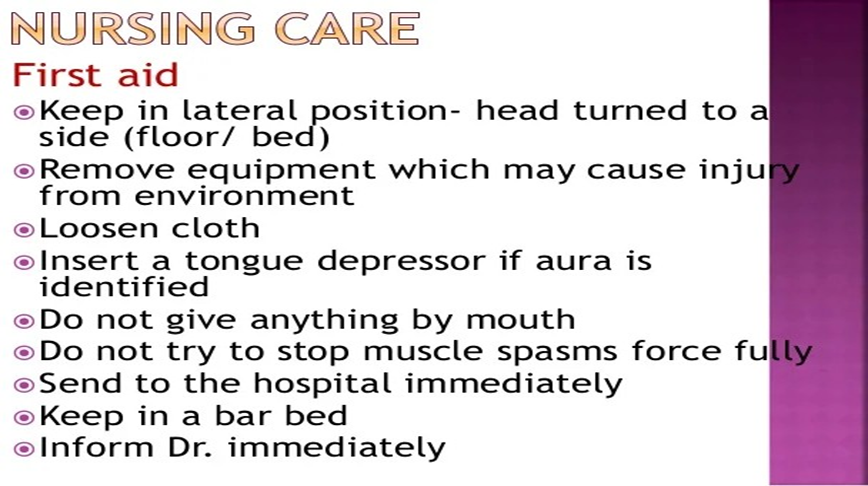
A nurse enters a school age child's room to administer morning medications and finds the client sitting in a chair having a seizure. After lowering the client to the floor, which of the following actions should the nurse take first?
Apply oxygen by nasal cannula.
Administer an anticonvulsant medication.
Turn the client to a lateral position.
Check the client's oxygen saturation.
The Correct Answer is C
C. The priority during a seizure is to protect the patient from harm, particularly from aspiration if they vomit or have excessive saliva production. Turning the client to a lateral position helps maintain an open airway and prevents aspiration. This action should be taken immediately after lowering the client to the floor to ensure their safety.
A. Providing oxygen is important for a patient experiencing a seizure. However, it's not the first action to take. The priority is to ensure the patient's safety and protect them from injury during the seizure.
B. Administering anticonvulsant medication during an active seizure is not appropriate. Anticonvulsants are typically prescribed as maintenance therapy to prevent seizures or to manage seizure disorders in a controlled manner, not during an acute seizure episode.
D. Monitoring oxygen saturation is important but it's not the first action to take during an active seizure. Ensuring the patient's safety and protecting them from injury take precedence. Oxygen saturation can be assessed once the patient is in a safe position.
Nursing Test Bank
Naxlex Comprehensive Predictor Exams
Related Questions
Correct Answer is A
Explanation
A. Wheezing, which is a high-pitched whistling sound heard during expiration, is a common symptom of asthma. It occurs due to narrowed airways and airflow obstruction, often in response to triggers such as allergens, respiratory infections, or exercise.
B. Low-grade fever in the afternoon is not typically associated with asthma. Fever is more commonly seen in response to infections, such as respiratory infections, which can exacerbate asthma symptoms but is not a direct manifestation of asthma itself.
C. Without the complete statement, it is difficult to assess its relevance to asthma symptoms. However, an abrupt onset of symptoms, such as sudden shortness of breath or chest tightness, may occur during an asthma attack or exacerbation.
D. Sharp pleuritic pain is not a typical finding in asthma. Pleuritic pain, which is sharp and worsened by breathing, is more commonly associated with conditions affecting the pleura, such as pneumonia or pleurisy.
Correct Answer is B
Explanation
B Kawasaki disease primarily affects medium-sized arteries, including the coronary arteries. The inflammation associated with Kawasaki disease can weaken the walls of the blood vessels, leading to the formation of aneurysms, particularly in the coronary arteries. Coronary artery aneurysms are a hallmark complication of Kawasaki disease and can increase the risk of myocardial infarction and other cardiovascular problems.
A This option describes a possible consequence of Kawasaki disease. Kawasaki disease can cause inflammation of the blood vessels, including the coronary arteries, which can lead to the formation of coronary artery aneurysms. These aneurysms can disrupt blood flow to the heart muscle, leading to ischemia and potentially heart failure.
C Mitral valve stenosis is not a typical complication of Kawasaki disease. While Kawasaki disease can affect the cardiovascular system and lead to complications such as coronary artery aneurysms, it does not typically cause mitral valve stenosis.
D Atherosclerosis is not a direct consequence of Kawasaki disease. Kawasaki disease primarily involves inflammation of the blood vessels rather than changes in lipid levels, which are more commonly associated with conditions such as hyperlipidemia or familial hypercholesterolemia.
Whether you are a student looking to ace your exams or a practicing nurse seeking to enhance your expertise , our nursing education contents will empower you with the confidence and competence to make a difference in the lives of patients and become a respected leader in the healthcare field.
Visit Naxlex, invest in your future and unlock endless possibilities with our unparalleled nursing education contents today