
A nurse facilitating a group therapy session is listening to clients discuss their coping strategies when feeling stressed. Which of the following statements indicates adaptive coping? (Select all that apply.)
"I sleep in in the mornings."
"I isolate myself in my room for a few hours when things get overwhelming."
"I call a friend who makes me smile and laugh."
"I think about being on my favorite beach vacation."
"I tense and release my muscles, starting with my feet."
Correct Answer : C,E
"I call a friend who makes me smile and laugh," and "I tense and release my muscles, starting with my feet." These are adaptive coping strategies that help to reduce stress and promote relaxation. Calling a friend who makes you smile and laugh, for example, can help to distract from negative thoughts and promote positive emotions. Tense and release exercises can help to reduce muscle tension and promote relaxation.
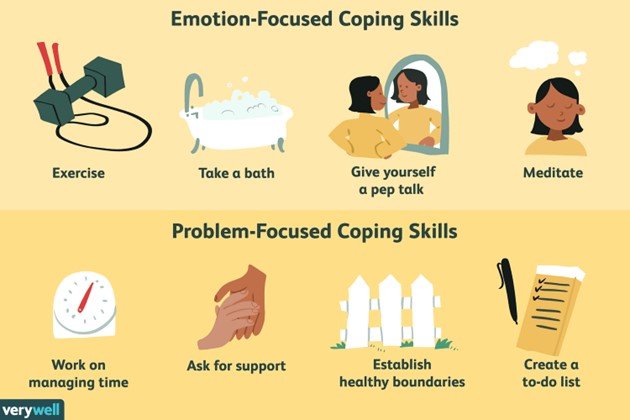
Choice A, "I sleep in in the mornings," is not an adaptive coping strategy because it doesn't address the source of stress and may actually lead to avoidance.
Choice B, "I isolate myself in my room for a few hours when things get overwhelming," is not adaptive because it promotes social withdrawal and avoidance.
Choice D, "I think about being on my favorite beach vacation," is not adaptive because it promotes avoidance and doesn't address the source of stress.
Nursing Test Bank
Naxlex Comprehensive Predictor Exams
Related Questions
Correct Answer is C
Explanation
"The client learns to change negative thoughts into positive statements." This demonstrates the effective use of cognitive reframing, which involves changing negative thoughts into positive self-talk. This strategy can help to reduce stress and improve coping skills.
Choice A, "The client imagines being in a quiet, relaxing environment," is not an example of cognitive reframing, but rather an example of visualization, which can also be useful in reducing stress.
Choice B, "The client trains his mind to relax by using deep inner resources," is not an example of cognitive reframing, but rather an example of relaxation training.
Choice D, "The client learns the source of his stress by writing down daily events," is not an example of cognitive reframing, but rather an example of stress management through self-reflection.
Correct Answer is D
Explanation
Accompany the client when ambulating. The nurse’s priority when caring for a client with alcohol use disorder and who is experiencing withdrawal symptoms is to prevent harm to the client. Physiologic manifestations of alcohol withdrawal syndrome include seizures, delirium tremens (DTs), and hallucinations. Therefore, ensuring the client’s safety is of the utmost importance. Accompanying the client when ambulating is the priority intervention as alcohol withdrawal may lead to ataxia, weakness, and dizziness which may lead to falls.
Choice A, placing the client in a private room, does not address the client’s physical needs.
Choice B, determining the client's level of disorientation, is something necessary to assess but not the priority.
Choice C, padding the side rails of the bed with towels, is not the priority intervention, and contributes little to the prevention of falls.
Whether you are a student looking to ace your exams or a practicing nurse seeking to enhance your expertise , our nursing education contents will empower you with the confidence and competence to make a difference in the lives of patients and become a respected leader in the healthcare field.
Visit Naxlex, invest in your future and unlock endless possibilities with our unparalleled nursing education contents today